P41764
Gene name |
gsdA (g6pD, AN2981) |
Protein name |
Glucose-6-phosphate 1-dehydrogenase |
Names |
G6PD |
Species |
Emericella nidulans (strain FGSC A4 / ATCC 38163 / CBS 112.46 / NRRL 194 / M139) (Aspergillus nidulans) |
KEGG Pathway |
ani:AN2981.2 |
EC number |
1.1.1.49: With NAD(+) or NADP(+) as acceptor |
Protein Class |
|
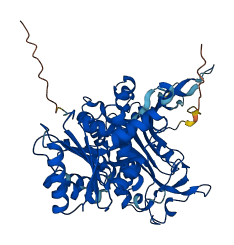
Descriptions
The autoinhibited protein was predicted that may have potential autoinhibitory elements via cis-regPred.
Autoinhibitory domains (AIDs)
Target domain |
|
Relief mechanism |
|
Assay |
cis-regPred |
Accessory elements
No accessory elements
Autoinhibited structure

Activated structure
1 structures for P41764
| Entry ID | Method | Resolution | Chain | Position | Source |
|---|---|---|---|---|---|
| AF-P41764-F1 | Predicted | AlphaFoldDB |
No variants for P41764
| Variant ID(s) | Position | Change | Description | Diseaes Association | Provenance |
|---|---|---|---|---|---|
| No variants for P41764 | |||||
No associated diseases with P41764
Functions
| Description | ||
|---|---|---|
| EC Number | 1.1.1.49 | With NAD(+) or NADP(+) as acceptor |
| Subcellular Localization |
|
|
| PANTHER Family | ||
| PANTHER Subfamily | ||
| PANTHER Protein Class | ||
| PANTHER Pathway Category | No pathway information available | |
1 GO annotations of cellular component
| Name | Definition |
|---|---|
| cytosol | The part of the cytoplasm that does not contain organelles but which does contain other particulate matter, such as protein complexes. |
2 GO annotations of molecular function
| Name | Definition |
|---|---|
| glucose-6-phosphate dehydrogenase activity | Catalysis of the reaction: D-glucose 6-phosphate + NADP+ = D-glucono-1,5-lactone 6-phosphate + NADPH + H+. |
| NADP binding | Binding to nicotinamide-adenine dinucleotide phosphate, a coenzyme involved in many redox and biosynthetic reactions; binding may be to either the oxidized form, NADP+, or the reduced form, NADPH. |
2 GO annotations of biological process
| Name | Definition |
|---|---|
| glucose metabolic process | The chemical reactions and pathways involving glucose, the aldohexose gluco-hexose. D-glucose is dextrorotatory and is sometimes known as dextrose; it is an important source of energy for living organisms and is found free as well as combined in homo- and hetero-oligosaccharides and polysaccharides. |
| pentose-phosphate shunt, oxidative branch | The branch of the pentose-phosphate shunt which involves the oxidation of glucose 6-P and produces ribulose 5-P, reduced NADP+ and carbon dioxide (CO2). |
No homologous proteins in AiPD
| UniProt AC | Gene Name | Protein Name | Species | Evidence Code |
|---|---|---|---|---|
| No homologous proteins | ||||
| 10 | 20 | 30 | 40 | 50 | 60 |
| MSATIARAEE | QQNGSTVELK | DDTVIVVLGA | SGDLAKKKTF | PALFGLFRNK | FLPKGIKIVG |
| 70 | 80 | 90 | 100 | 110 | 120 |
| YARTQMDHNE | YLKRVRSYIK | TPTKEIEEQL | NSFCELCTYI | SGQYDQDDSF | KNLAKHLEEI |
| 130 | 140 | 150 | 160 | 170 | 180 |
| EKNQKEQNRV | FYMALPPSVF | ITVSEQLKRN | CYPKNGVARI | IVEKPFGKDL | QSSRDLQKAL |
| 190 | 200 | 210 | 220 | 230 | 240 |
| EPNWKEEEIF | RIDHYLGKEM | VKNILIMRFG | NEFFNATWNR | HHIDNVQITF | KEPFGTEGRG |
| 250 | 260 | 270 | 280 | 290 | 300 |
| GYFDEFGIIR | DVMQNHLLQV | LTLLAMERPI | SFSAEDIRDE | KVRVLRAMDP | IQPKDVIIGQ |
| 310 | 320 | 330 | 340 | 350 | 360 |
| YGRSLDGSKP | AYKEDDTVPQ | DSRCPTFCAL | VAHIKNERWD | GVPFIMKAGK | ALNEQKTEIR |
| 370 | 380 | 390 | 400 | 410 | 420 |
| IQFKDVTSGI | FKDIPRNELV | IRVQPNESVY | IKMNSKLPGL | SMQTVVTELD | LTYRRRFSDL |
| 430 | 440 | 450 | 460 | 470 | 480 |
| KIPEAYESLI | LDALKGDHSN | FVRDDELDAS | WRMFTPLLHY | LDDNKEIIPM | EYPYGSRGPS |
| 490 | 500 | 510 | |||
| VLDDFTASYG | YKFSDAAGYQ | WPLTHTTPNR | L |