P41221
Gene name |
WNT5A |
Protein name |
Protein Wnt-5a |
Names |
|
Species |
Homo sapiens (Human) |
KEGG Pathway |
hsa:7474 |
EC number |
|
Protein Class |
|
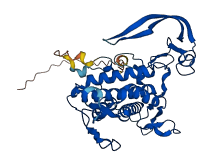
Descriptions
The autoinhibited protein was predicted that may have potential autoinhibitory elements via cis-regPred.
Autoinhibitory domains (AIDs)
Target domain |
|
Relief mechanism |
|
Assay |
cis-regPred |
Accessory elements
No accessory elements
Autoinhibited structure

Activated structure
1 structures for P41221
| Entry ID | Method | Resolution | Chain | Position | Source |
|---|---|---|---|---|---|
| AF-P41221-F1 | Predicted | AlphaFoldDB |
311 variants for P41221
| Variant ID(s) | Position | Change | Description | Diseaes Association | Provenance |
|---|---|---|---|---|---|
|
RCV000363742 RCV000964936 RCV002504007 CA2459138 rs200914260 |
5 | I>T | Autosomal dominant Robinow syndrome 1 [ClinVar] | Yes |
ClinGen ClinVar 1000Genomes ESP ExAC TOPMed dbSNP gnomAD |
|
RCV001254609 rs1369701937 RCV001879915 CA353267839 |
39 | V>L | Autosomal dominant Robinow syndrome 1 [ClinVar] | Yes |
ClinGen ClinVar TOPMed dbSNP gnomAD |
|
CA346840 RCV000169741 rs786204837 |
69 | C>Y | Autosomal dominant Robinow syndrome 1 [ClinVar] | Yes |
ClinGen ClinVar Ensembl dbSNP |
|
rs786200925 RCV000022696 CA342716 VAR_066623 |
83 | C>S | Autosomal dominant Robinow syndrome 1 DRS1; hypomorphic mutation [ClinVar, UniProt] | Yes |
ClinGen ClinVar UniProt Ensembl dbSNP |
|
CA346838 rs786204836 RCV000169740 |
86 | Y>C | Autosomal dominant Robinow syndrome 1 [ClinVar] | Yes |
ClinGen ClinVar Ensembl dbSNP |
|
rs2051315439 RCV001334139 |
154 | C>F | Autosomal dominant Robinow syndrome 1 [ClinVar] | Yes |
ClinVar dbSNP |
|
VAR_083248 rs1553677971 RCV000577882 CA353275502 |
160 | S>C | Autosomal dominant Robinow syndrome 1 DRS1; unknown pathological significance [ClinVar, UniProt] | Yes |
ClinGen ClinVar Ensembl dbSNP UniProt |
|
RCV001597177 rs1553677967 RCV000577908 |
163 | G>missing | Autosomal dominant Robinow syndrome 1 [ClinVar] | Yes |
ClinVar dbSNP |
|
RCV000147988 rs587784562 CA272818 RCV001850013 |
163 | G>R | Autosomal dominant Robinow syndrome 1 [ClinVar] | Yes |
ClinGen ClinVar Ensembl dbSNP |
| VAR_083249 | 164 | C>CGC | DRS1 [UniProt] | Yes | UniProt |
|
CA2459044 rs572796263 RCV002502972 RCV000956107 |
168 | A>T | Autosomal dominant Robinow syndrome 1 [ClinVar] | Yes |
ClinGen ClinVar 1000Genomes ExAC TOPMed dbSNP gnomAD |
|
RCV000022695 VAR_066629 rs387906663 CA259668 |
182 | C>R | Autosomal dominant Robinow syndrome 1 DRS1; hypomorphic mutation [ClinVar, UniProt] | Yes |
ClinGen ClinVar UniProt Ensembl dbSNP |
|
RCV000192022 CA347069 rs869312850 |
182 | C>S | Autosomal dominant Robinow syndrome 1 [ClinVar] | Yes |
ClinGen ClinVar Ensembl dbSNP |
|
RCV001270765 CA353275044 rs1393089710 |
183 | G>S | Autosomal dominant Robinow syndrome 1 [ClinVar] | Yes |
ClinGen ClinVar TOPMed dbSNP gnomAD |
|
RCV002476613 rs766388444 CA2459014 RCV001350914 |
212 | E>K | Autosomal dominant Robinow syndrome 1 [ClinVar] | Yes |
ClinGen ClinVar ExAC TOPMed dbSNP gnomAD |
|
CA10616477 RCV001597513 rs886058744 RCV002501965 |
229 | T>A | Autosomal dominant Robinow syndrome 1 [ClinVar] | Yes |
ClinGen ClinVar dbSNP gnomAD |
|
rs763566950 RCV003135973 CA2458907 RCV001323469 |
375 | D>N | Autosomal dominant Robinow syndrome 1 [ClinVar] | Yes |
ClinGen ClinVar ExAC TOPMed dbSNP gnomAD |
|
rs1053272920 CA74909567 |
2 | K>E | No |
ClinGen Ensembl |
|
|
CA353268192 rs370383438 |
5 | I>F | No |
ClinGen ESP ExAC TOPMed gnomAD |
|
|
CA353268191 rs200914260 |
5 | I>S | No |
ClinGen 1000Genomes ESP ExAC TOPMed gnomAD |
|
|
CA2459139 rs370383438 |
5 | I>V | No |
ClinGen ESP ExAC TOPMed gnomAD |
|
|
CA2459137 rs776543464 |
6 | G>E | Variant assessed as Somatic; 0.0 impact. [NCI-TCGA] | No |
ClinGen ExAC NCI-TCGA gnomAD |
|
CA353268188 rs1292414238 |
6 | G>R | No |
ClinGen TOPMed |
|
|
CA2459135 rs183555808 |
7 | I>L | No |
ClinGen 1000Genomes ESP ExAC TOPMed gnomAD |
|
|
CA2459134 rs554762368 |
7 | I>T | No |
ClinGen 1000Genomes ExAC TOPMed gnomAD |
|
|
rs1319138082 CA353268157 |
11 | G>R | No |
ClinGen gnomAD |
|
|
CA353268147 rs1414051938 |
12 | V>A | No |
ClinGen gnomAD |
|
|
CA353268144 rs1400348463 |
13 | A>P | No |
ClinGen gnomAD |
|
|
CA10619237 rs886058746 |
14 | L>S | No |
ClinGen Ensembl |
|
|
CA2459131 rs778287090 |
15 | G>E | No |
ClinGen ExAC TOPMed gnomAD |
|
|
rs867828828 CA74907011 |
15 | G>W | No |
ClinGen TOPMed gnomAD |
|
|
rs1389369896 CA353268110 |
18 | G>A | No |
ClinGen TOPMed gnomAD |
|
|
CA353268100 rs1476385299 |
20 | A>T | No |
ClinGen TOPMed gnomAD |
|
|
rs1242190462 CA353268086 |
21 | M>L | No |
ClinGen TOPMed gnomAD |
|
|
rs748871825 CA2459129 |
21 | M>T | No |
ClinGen ExAC TOPMed gnomAD |
|
|
rs1242190462 CA353268088 |
21 | M>V | No |
ClinGen TOPMed gnomAD |
|
|
rs1399954454 CA353268051 |
24 | K>Q | No |
ClinGen TOPMed |
|
|
CA74907002 rs908288616 |
26 | F>S | No |
ClinGen TOPMed |
|
|
rs781650629 CA2459128 |
27 | L>I | No |
ClinGen ExAC |
|
|
rs149311661 CA74906997 |
27 | L>P | No |
ClinGen 1000Genomes gnomAD |
|
|
CA74906994 rs781668590 |
28 | V>A | No |
ClinGen Ensembl |
|
|
CA353267952 rs1340579712 |
30 | L>S | No |
ClinGen TOPMed |
|
|
CA2459127 rs371157119 |
31 | A>V | No |
ClinGen ESP ExAC TOPMed gnomAD |
|
|
rs1213316012 CA353267921 |
32 | I>M | No |
ClinGen gnomAD |
|
|
rs752083941 CA2459126 |
32 | I>V | No |
ClinGen ExAC TOPMed gnomAD |
|
|
CA353267875 RCV000595735 rs1553679404 |
35 | S>F | No |
ClinGen ClinVar Ensembl dbSNP |
|
|
CA353267872 rs1270786128 |
36 | F>I | No |
ClinGen gnomAD |
|
|
rs374082538 CA353267862 |
36 | F>L | No |
ClinGen ESP ExAC TOPMed gnomAD |
|
|
CA2459123 rs190451046 RCV000900737 |
37 | A>G | No |
ClinGen ClinVar 1000Genomes ESP ExAC TOPMed dbSNP gnomAD |
|
|
CA353267847 rs1435625630 |
38 | Q>H | No |
ClinGen gnomAD |
|
|
rs1369701937 CA353267842 |
39 | V>I | No |
ClinGen TOPMed gnomAD |
|
|
CA353267817 rs1411528153 |
41 | I>M | No |
ClinGen gnomAD |
|
|
CA2459122 rs765217843 |
41 | I>T | No |
ClinGen ExAC TOPMed gnomAD |
|
|
CA74906949 rs1025253935 |
44 | N>I | No |
ClinGen TOPMed gnomAD |
|
|
rs186124369 CA2459121 CA353267797 |
44 | N>K | No |
ClinGen 1000Genomes ExAC TOPMed gnomAD |
|
|
rs1025253935 CA353267798 |
44 | N>S | No |
ClinGen TOPMed gnomAD |
|
|
rs1439009595 CA353267784 |
46 | W>* | No |
ClinGen TOPMed |
|
|
CA2459100 rs369165725 |
48 | S>L | Variant assessed as Somatic; 0.0 impact. [NCI-TCGA] | No |
ClinGen ESP ExAC NCI-TCGA TOPMed gnomAD |
|
CA353267610 rs1289051164 |
51 | M>V | No |
ClinGen gnomAD |
|
|
rs767356554 CA2459099 |
53 | N>K | No |
ClinGen ExAC gnomAD |
|
|
rs761851847 CA2459098 |
55 | V>G | No |
ClinGen ExAC TOPMed |
|
|
rs759185001 CA2459097 |
57 | M>T | No |
ClinGen ExAC gnomAD |
|
|
CA2459096 rs763684509 |
60 | V>A | No |
ClinGen ExAC gnomAD |
|
|
CA74906484 rs1033182214 |
60 | V>I | No |
ClinGen TOPMed gnomAD |
|
|
CA353267522 rs1409168290 |
63 | I>M | No |
ClinGen gnomAD |
|
|
CA2459093 rs769500757 |
63 | I>V | No |
ClinGen ExAC gnomAD |
|
|
rs745505762 CA2459092 |
65 | A>S | No |
ClinGen ExAC gnomAD |
|
|
rs902221321 CA74906469 |
66 | Q>* | No |
ClinGen Ensembl |
|
|
rs1575402691 CA353267502 |
67 | P>T | No |
ClinGen Ensembl |
|
|
rs748715879 CA2459089 |
72 | L>V | No |
ClinGen ExAC gnomAD |
|
|
CA353267457 rs1218199102 |
74 | G>R | No |
ClinGen gnomAD |
|
|
rs1317822537 CA353267425 |
79 | Q>E | No |
ClinGen gnomAD |
|
|
rs373494821 CA2459087 |
80 | K>N | No |
ClinGen ESP ExAC gnomAD |
|
| TCGA novel | 82 | L>M | Variant assessed as Somatic; impact. [NCI-TCGA] | No | NCI-TCGA |
| TCGA novel | 83 | C>V | Variant assessed as Somatic; impact. [NCI-TCGA] | No | NCI-TCGA |
|
rs749398374 CA2459086 |
84 | H>L | No |
ClinGen ExAC TOPMed gnomAD |
|
|
rs1304024029 CA353267357 |
85 | L>F | No |
ClinGen gnomAD |
|
|
rs780270891 CA74906452 |
87 | Q>* | No |
ClinGen ExAC TOPMed gnomAD |
|
|
rs780270891 CA2459085 |
87 | Q>E | No |
ClinGen ExAC TOPMed gnomAD |
|
|
CA353267278 rs1214041901 |
90 | M>V | No |
ClinGen TOPMed |
|
|
rs750646727 CA2459083 |
93 | I>V | Variant assessed as Somatic; 0.0 impact. [NCI-TCGA] | No |
ClinGen ExAC NCI-TCGA TOPMed gnomAD |
|
rs1358232825 CA353267150 |
96 | G>V | No |
ClinGen gnomAD |
|
|
CA2459079 rs763870268 |
97 | A>T | No |
ClinGen ExAC gnomAD |
|
|
CA353267118 rs1194784391 |
98 | K>N | No |
ClinGen gnomAD |
|
|
CA2459077 rs538890462 |
99 | T>I | No |
ClinGen ExAC gnomAD |
|
|
CA2459076 rs527941562 |
100 | G>D | No |
ClinGen 1000Genomes ExAC gnomAD |
|
|
CA2459075 rs375233428 |
102 | K>R | No |
ClinGen 1000Genomes ESP ExAC TOPMed gnomAD |
|
|
rs751543743 CA2459073 |
105 | Q>L | No |
ClinGen ExAC gnomAD |
|
|
rs751543743 CA2459074 |
105 | Q>R | No |
ClinGen ExAC gnomAD |
|
| TCGA novel | 109 | R>* | Variant assessed as Somatic; impact. [NCI-TCGA] | No | NCI-TCGA |
|
CA2459072 rs371892633 |
109 | R>Q | No |
ClinGen ESP ExAC TOPMed gnomAD |
|
|
CA353267023 rs1280851148 |
110 | H>L | No |
ClinGen gnomAD |
|
|
rs1349752707 CA353267026 |
110 | H>Y | No |
ClinGen gnomAD |
|
| TCGA novel | 111 | R>* | Variant assessed as Somatic; impact. [NCI-TCGA] | No | NCI-TCGA |
|
rs1157131307 CA353266989 |
115 | C>G | No |
ClinGen TOPMed |
|
|
rs774776699 CA2459071 |
119 | D>N | No |
ClinGen ExAC TOPMed gnomAD |
|
|
rs769103194 CA353266950 |
120 | N>K | No |
ClinGen ExAC TOPMed gnomAD |
|
|
CA74906407 rs984257997 |
120 | N>S | No |
ClinGen Ensembl |
|
|
CA74906402 rs1026265548 |
121 | T>I | No |
ClinGen TOPMed |
|
|
CA2459069 rs749783441 |
122 | S>P | No |
ClinGen ExAC gnomAD |
|
|
CA2459068 rs780324252 |
123 | V>I | No |
ClinGen ExAC gnomAD |
|
|
CA353266903 rs1377642864 |
128 | M>T | No |
ClinGen gnomAD |
|
|
CA353266893 rs1399911942 |
129 | Q>H | No |
ClinGen TOPMed |
|
|
CA2459067 rs769955372 |
129 | Q>L | No |
ClinGen ExAC |
|
|
rs1300391603 CA353275859 |
133 | R>H | No |
ClinGen TOPMed gnomAD |
|
|
rs1300391603 CA353275857 |
133 | R>L | No |
ClinGen TOPMed gnomAD |
|
|
rs550768554 CA353275836 |
135 | T>K | No |
ClinGen 1000Genomes gnomAD |
|
|
CA74922350 rs550768554 |
135 | T>M | No |
ClinGen 1000Genomes gnomAD |
|
|
CA2459053 rs774630162 |
135 | T>S | No |
ClinGen ExAC TOPMed |
|
|
CA353275801 rs1162882250 |
138 | T>I | No |
ClinGen gnomAD |
|
|
rs1435836716 CA353275781 |
140 | A>E | No |
ClinGen gnomAD |
|
|
rs1180776171 CA353275785 |
140 | A>T | No |
ClinGen gnomAD |
|
|
rs1439785154 CA353275776 |
141 | V>L | No |
ClinGen TOPMed |
|
|
CA353275762 rs998033323 |
143 | A>S | No |
ClinGen TOPMed gnomAD |
|
|
rs998033323 CA74922339 RCV000729122 |
143 | A>T | No |
ClinGen ClinVar TOPMed dbSNP gnomAD |
|
|
rs1326363656 CA353275746 |
145 | G>V | No |
ClinGen gnomAD |
|
|
rs1335027961 CA353275704 |
149 | A>S | No |
ClinGen gnomAD |
|
|
rs1335027961 CA353275706 |
149 | A>T | No |
ClinGen gnomAD |
|
|
CA353275687 rs1168292086 |
150 | M>I | No |
ClinGen TOPMed |
|
|
CA353275699 rs750679240 |
150 | M>L | No |
ClinGen ExAC TOPMed gnomAD |
|
|
CA2459050 rs750679240 |
150 | M>V | No |
ClinGen ExAC TOPMed gnomAD |
|
|
CA353275667 rs1236488118 |
152 | R>W | No |
ClinGen gnomAD |
|
|
rs1309688159 CA353275647 |
153 | A>V | No |
ClinGen gnomAD |
|
|
rs2051314733 RCV001323406 |
155 | R>missing | No |
ClinVar dbSNP |
|
|
CA353275622 rs1052997621 |
155 | R>C | No |
ClinGen TOPMed gnomAD |
|
|
rs1052997621 CA74922276 |
155 | R>G | No |
ClinGen TOPMed gnomAD |
|
|
CA74922267 rs934590152 |
155 | R>H | No |
ClinGen gnomAD |
|
|
rs1403387925 CA353275605 |
156 | E>Q | No |
ClinGen TOPMed |
|
|
rs1395367007 CA353275544 |
158 | E>D | No |
ClinGen gnomAD |
|
|
rs776770401 CA2459048 |
161 | T>N | No |
ClinGen ExAC TOPMed gnomAD |
|
|
CA353275379 rs1559553986 RCV000733923 |
166 | R>C | No |
ClinGen ClinVar Ensembl dbSNP |
|
|
CA2459046 rs747232175 |
166 | R>H | No |
ClinGen ExAC gnomAD |
|
|
rs1182266890 CA353275372 |
167 | A>T | No |
ClinGen gnomAD |
|
|
rs778761167 CA2459043 |
168 | A>G | No |
ClinGen ExAC TOPMed gnomAD |
|
|
CA74922220 rs572796263 |
168 | A>S | No |
ClinGen 1000Genomes ExAC TOPMed gnomAD |
|
|
RCV001316247 CA2459042 rs778761167 |
168 | A>V | No |
ClinGen ClinVar ExAC TOPMed dbSNP gnomAD |
|
|
rs754486525 CA2459041 |
169 | R>C | No |
ClinGen ExAC gnomAD |
|
|
rs1575398481 CA353275325 |
169 | R>L | No |
ClinGen Ensembl |
|
|
CA353275298 rs1352397840 |
171 | K>E | No |
ClinGen gnomAD |
|
|
rs1352397840 CA353275302 |
171 | K>Q | No |
ClinGen gnomAD |
|
| TCGA novel | 174 | P>L | Variant assessed as Somatic; impact. [NCI-TCGA] | No | NCI-TCGA |
|
rs753406752 CA2459040 |
174 | P>Q | No |
ClinGen ExAC TOPMed gnomAD |
|
|
CA353275244 rs1241355638 |
174 | P>S | No |
ClinGen gnomAD |
|
|
rs755766054 CA2459038 |
175 | R>L | No |
ClinGen ExAC gnomAD |
|
|
CA353275180 rs1231823028 |
177 | W>S | No |
ClinGen TOPMed |
|
|
rs1272834770 CA353275148 |
178 | L>P | No |
ClinGen TOPMed |
|
|
rs765913129 CA2459033 |
181 | G>S | No |
ClinGen ExAC gnomAD |
|
|
rs771010789 CA2459030 |
185 | N>S | No |
ClinGen ExAC TOPMed gnomAD |
|
|
CA353274988 rs1575398385 |
186 | I>V | No |
ClinGen Ensembl |
|
|
CA2459029 rs747226594 |
187 | D>G | No |
ClinGen ExAC gnomAD |
|
|
rs1454706587 CA353274954 |
187 | D>N | Variant assessed as Somatic; 0.0 impact. [NCI-TCGA] | No |
ClinGen NCI-TCGA TOPMed gnomAD |
|
CA353274945 rs1454706587 |
187 | D>Y | No |
ClinGen TOPMed gnomAD |
|
| TCGA novel | 188 | Y>H | Variant assessed as Somatic; impact. [NCI-TCGA] | No | NCI-TCGA |
|
CA2459028 rs200263219 |
190 | Y>* | No |
ClinGen ExAC gnomAD |
|
|
CA353274855 rs1448321572 |
191 | R>C | No |
ClinGen TOPMed gnomAD |
|
|
rs771864079 CA74922092 |
191 | R>H | No |
ClinGen ExAC TOPMed gnomAD |
|
|
CA2459027 rs771864079 |
191 | R>P | No |
ClinGen ExAC TOPMed gnomAD |
|
|
CA2459026 rs747867665 |
193 | A>T | No |
ClinGen ExAC gnomAD |
|
|
CA353274813 rs1347583578 |
193 | A>V | No |
ClinGen gnomAD |
|
|
CA2459025 rs754960119 |
194 | K>E | No |
ClinGen ExAC gnomAD |
|
|
CA2459024 rs754960119 |
194 | K>Q | No |
ClinGen ExAC gnomAD |
|
|
rs181787192 CA353274741 |
199 | A>P | No |
ClinGen 1000Genomes TOPMed gnomAD |
|
|
rs181787192 CA74922029 |
199 | A>T | Variant assessed as Somatic; 0.0 impact. [NCI-TCGA] | No |
ClinGen 1000Genomes NCI-TCGA TOPMed gnomAD |
|
CA74922026 rs988058834 |
200 | R>G | No |
ClinGen TOPMed |
|
|
CA2459021 rs750057475 |
200 | R>H | No |
ClinGen ExAC gnomAD |
|
|
rs750057475 CA353274726 |
200 | R>L | No |
ClinGen ExAC gnomAD |
|
|
rs1414414180 CA353274705 |
203 | E>Q | No |
ClinGen gnomAD |
|
|
rs866738848 CA74922000 |
204 | R>H | Variant assessed as Somatic; 0.0 impact. [NCI-TCGA] | No |
ClinGen NCI-TCGA gnomAD |
|
CA2459018 rs753171819 |
205 | I>T | No |
ClinGen ExAC TOPMed gnomAD |
|
|
rs757182809 CA74921966 |
206 | H>Q | No |
ClinGen Ensembl |
|
| TCGA novel | 206 | H>Y | Variant assessed as Somatic; impact. [NCI-TCGA] | No | NCI-TCGA |
|
rs760160092 CA2459016 |
207 | A>S | No |
ClinGen ExAC TOPMed gnomAD |
|
|
rs777155530 CA2459015 |
208 | K>E | No |
ClinGen ExAC TOPMed gnomAD |
|
|
rs760747132 CA2459013 |
212 | E>D | No |
ClinGen ExAC TOPMed gnomAD |
|
|
rs1484487400 CA353274645 |
212 | E>G | No |
ClinGen gnomAD |
|
|
CA2459012 RCV001309038 rs773308486 |
214 | A>G | No |
ClinGen ClinVar ExAC dbSNP gnomAD |
|
|
rs1293009430 CA353274632 |
214 | A>T | No |
ClinGen TOPMed |
|
|
rs1272969340 CA353274625 |
215 | R>H | No |
ClinGen gnomAD |
|
|
rs1213352508 CA353274608 |
216 | I>M | No |
ClinGen gnomAD |
|
|
CA353274604 rs1341494143 |
217 | L>F | No |
ClinGen gnomAD |
|
|
CA74921861 rs963662325 |
218 | M>I | No |
ClinGen TOPMed |
|
|
CA353274595 rs1232898551 |
218 | M>V | No |
ClinGen gnomAD |
|
|
CA353274534 rs1448534007 |
222 | N>S | No |
ClinGen gnomAD |
|
|
CA2459010 rs762002827 |
223 | N>K | No |
ClinGen ExAC TOPMed gnomAD |
|
|
CA2458984 rs769829279 |
229 | T>M | No |
ClinGen ExAC TOPMed gnomAD |
|
|
CA2458980 rs376640377 |
231 | Y>C | No |
ClinGen ESP ExAC TOPMed gnomAD |
|
|
rs770524527 CA2458981 |
231 | Y>H | No |
ClinGen ExAC gnomAD |
|
|
CA2458979 rs777506252 |
232 | N>S | No |
ClinGen ExAC TOPMed gnomAD |
|
|
rs755298105 CA2458978 |
234 | A>G | No |
ClinGen ExAC gnomAD |
|
| TCGA novel | 235 | D>C | Variant assessed as Somatic; impact. [NCI-TCGA] | No | NCI-TCGA |
| TCGA novel | 235 | D>N | Variant assessed as Somatic; impact. [NCI-TCGA] | No | NCI-TCGA |
|
rs1302532308 CA353272979 |
239 | K>R | No |
ClinGen gnomAD |
|
| TCGA novel | 240 | C>* | Variant assessed as Somatic; impact. [NCI-TCGA] | No | NCI-TCGA |
|
CA74918116 rs181181287 |
241 | H>R | No |
ClinGen 1000Genomes |
|
| TCGA novel | 243 | V>M | Variant assessed as Somatic; impact. [NCI-TCGA] | No | NCI-TCGA |
|
CA2458976 rs780265576 |
248 | S>G | No |
ClinGen ExAC gnomAD |
|
|
CA2458972 rs761827056 |
255 | Q>E | No |
ClinGen ExAC gnomAD |
|
|
rs1269552696 CA353272772 |
259 | F>L | No |
ClinGen gnomAD |
|
|
rs201567461 CA2458970 |
260 | R>C | No |
ClinGen ExAC gnomAD |
|
|
rs1485651707 RCV000733943 CA353272755 |
260 | R>L | No |
ClinGen ClinVar dbSNP gnomAD |
|
|
rs1575394586 CA353272727 |
262 | V>G | No |
ClinGen Ensembl |
|
|
CA353272684 rs1354084512 |
265 | A>T | No |
ClinGen gnomAD |
|
|
rs373379669 CA2458967 |
265 | A>V | No |
ClinGen ESP ExAC TOPMed gnomAD |
|
|
rs1350037873 CA353272635 |
268 | E>Q | No |
ClinGen gnomAD |
|
|
CA2458964 rs770577961 |
271 | D>G | No |
ClinGen ExAC gnomAD |
|
|
rs1359294973 CA353272574 |
271 | D>N | No |
ClinGen gnomAD |
|
|
rs377043203 CA2458963 |
272 | S>R | No |
ClinGen ESP ExAC TOPMed gnomAD |
|
|
CA2458961 rs771812000 |
273 | A>V | No |
ClinGen ExAC gnomAD |
|
|
CA353272502 rs746392030 |
275 | A>G | No |
ClinGen ExAC gnomAD |
|
|
CA2458958 rs546706293 |
275 | A>T | No |
ClinGen 1000Genomes ExAC gnomAD |
|
|
CA2458957 rs746392030 |
275 | A>V | No |
ClinGen ExAC gnomAD |
|
|
CA353272493 rs1182422577 |
276 | M>L | No |
ClinGen gnomAD |
|
|
rs369954366 CA74917898 |
277 | R>Q | Variant assessed as Somatic; impact. [NCI-TCGA] | No |
ClinGen ESP NCI-TCGA TOPMed |
|
rs866667950 CA74917906 |
277 | R>W | No |
ClinGen gnomAD |
|
|
rs1488780337 CA353272437 |
279 | N>S | No |
ClinGen gnomAD |
|
|
rs886042717 RCV000381699 CA10604601 |
280 | S>N | No |
ClinGen ClinVar Ensembl dbSNP |
|
|
CA2458954 rs751696945 |
281 | R>Q | Variant assessed as Somatic; 0.0 impact. [NCI-TCGA] | No |
ClinGen ExAC NCI-TCGA gnomAD |
|
CA2458955 rs533153165 |
281 | R>W | Variant assessed as Somatic; 0.0 impact. [NCI-TCGA] | No |
ClinGen 1000Genomes ExAC NCI-TCGA TOPMed gnomAD |
|
CA353272388 rs1484178482 |
282 | G>V | No |
ClinGen TOPMed gnomAD |
|
|
rs1256476123 CA353272375 |
283 | K>R | Variant assessed as Somatic; 0.0 impact. [NCI-TCGA] | No |
ClinGen NCI-TCGA gnomAD |
|
rs375403509 CA353272360 |
284 | L>V | No |
ClinGen 1000Genomes ESP ExAC TOPMed gnomAD |
|
|
rs1305199053 CA353272342 |
285 | V>I | No |
ClinGen gnomAD |
|
|
rs758690185 CA2458952 |
286 | Q>R | No |
ClinGen ExAC |
|
|
rs1297105774 CA353272307 |
287 | V>L | No |
ClinGen gnomAD |
|
|
rs1559551727 CA353272285 |
288 | N>S | No |
ClinGen Ensembl |
|
|
CA353272286 rs1559551727 |
288 | N>T | No |
ClinGen Ensembl |
|
|
CA353272266 rs1354491206 |
289 | S>N | No |
ClinGen gnomAD |
|
| TCGA novel | 290 | R>C | Variant assessed as Somatic; impact. [NCI-TCGA] | No | NCI-TCGA |
|
CA2458950 rs765101926 |
290 | R>H | No |
ClinGen ExAC gnomAD |
|
|
CA353272254 rs765101926 |
290 | R>L | No |
ClinGen ExAC gnomAD |
|
|
CA353272244 rs1413364471 |
292 | N>H | No |
ClinGen gnomAD |
|
|
CA353272239 rs1404834929 |
292 | N>S | No |
ClinGen gnomAD |
|
|
CA2458949 rs759194223 |
293 | S>L | No |
ClinGen ExAC TOPMed gnomAD |
|
|
CA353272220 rs1277424205 |
295 | T>I | No |
ClinGen TOPMed |
|
|
CA74917844 rs900039147 |
296 | T>A | No |
ClinGen Ensembl |
|
|
rs760675240 CA2458946 |
296 | T>I | No |
ClinGen ExAC gnomAD |
|
|
rs772896188 CA353272215 |
297 | Q>* | No |
ClinGen ExAC gnomAD |
|
|
rs772896188 CA2458945 |
297 | Q>E | No |
ClinGen ExAC gnomAD |
|
|
rs771445451 CA2458944 |
298 | D>N | No |
ClinGen ExAC TOPMed gnomAD |
|
|
rs747860258 CA2458943 |
300 | V>F | No |
ClinGen ExAC |
|
|
CA2458942 rs773819361 |
301 | Y>F | No |
ClinGen ExAC gnomAD |
|
|
rs770199302 CA2458941 |
302 | I>V | No |
ClinGen ExAC gnomAD |
|
|
CA353272171 rs1575394294 |
303 | D>A | No |
ClinGen Ensembl |
|
|
rs781527130 CA74917736 |
303 | D>H | No |
ClinGen ExAC TOPMed gnomAD |
|
|
CA2458939 rs781527130 |
303 | D>N | No |
ClinGen ExAC TOPMed gnomAD |
|
|
CA2458938 rs757813200 |
304 | P>H | No |
ClinGen ExAC gnomAD |
|
|
CA353272153 rs757813200 |
304 | P>L | No |
ClinGen ExAC gnomAD |
|
| TCGA novel | 305 | S>I | Variant assessed as Somatic; impact. [NCI-TCGA] | No | NCI-TCGA |
|
rs747485846 CA353272096 |
309 | C>G | No |
ClinGen ExAC TOPMed gnomAD |
|
|
rs747485846 CA2458937 |
309 | C>R | No |
ClinGen ExAC TOPMed gnomAD |
|
|
CA2458935 rs758357805 |
310 | V>A | No |
ClinGen ExAC TOPMed gnomAD |
|
|
CA353272076 rs758357805 |
310 | V>G | No |
ClinGen ExAC TOPMed gnomAD |
|
|
CA2458936 rs777938109 |
310 | V>L | No |
ClinGen ExAC gnomAD |
|
|
rs1189964563 CA353272070 |
311 | R>C | No |
ClinGen TOPMed |
|
|
rs752974227 CA2458934 |
311 | R>L | No |
ClinGen ExAC TOPMed gnomAD |
|
|
rs752974227 CA353272067 |
311 | R>P | No |
ClinGen ExAC TOPMed gnomAD |
|
|
rs1248491152 CA353272053 |
312 | N>K | No |
ClinGen TOPMed gnomAD |
|
|
CA353272058 rs1469870275 |
312 | N>S | No |
ClinGen TOPMed |
|
|
rs369701725 CA2458933 |
313 | E>K | No |
ClinGen ESP ExAC TOPMed gnomAD |
|
|
CA74917621 rs931674113 |
315 | T>N | No |
ClinGen TOPMed |
|
|
rs1575394230 CA353272021 |
315 | T>P | No |
ClinGen Ensembl |
|
|
rs755247138 CA2458932 |
317 | S>L | Variant assessed as Somatic; 0.0 impact. [NCI-TCGA] | No |
ClinGen ExAC NCI-TCGA gnomAD |
|
CA353271979 rs1575394201 |
318 | L>R | No |
ClinGen Ensembl |
|
|
CA74917600 rs922958622 |
320 | T>M | Variant assessed as Somatic; impact. [NCI-TCGA] | No |
ClinGen NCI-TCGA TOPMed |
| TCGA novel | 321 | Q>H | Variant assessed as Somatic; impact. [NCI-TCGA] | No | NCI-TCGA |
|
CA74917594 rs946840827 |
321 | Q>R | No |
ClinGen TOPMed gnomAD |
|
|
CA2458929 rs373282952 |
326 | N>D | No |
ClinGen ESP ExAC gnomAD |
|
|
CA353271880 rs1368827765 |
326 | N>S | Variant assessed as Somatic; 0.0 impact. [NCI-TCGA] | No |
ClinGen NCI-TCGA TOPMed gnomAD |
|
CA2458928 rs750281702 |
327 | K>R | No |
ClinGen ExAC gnomAD |
|
|
CA2458927 rs767068436 |
328 | T>A | No |
ClinGen ExAC gnomAD |
|
|
CA2458926 rs201975128 |
328 | T>M | Variant assessed as Somatic; 0.0 impact. [NCI-TCGA] | No |
ClinGen 1000Genomes ExAC NCI-TCGA TOPMed gnomAD |
|
CA2458925 rs375700896 |
329 | S>L | No |
ClinGen ESP ExAC gnomAD |
|
|
CA353271839 rs1263066189 |
329 | S>T | No |
ClinGen TOPMed |
|
|
rs2051221341 RCV001325372 |
331 | G>C | No |
ClinVar dbSNP |
|
|
rs768254997 CA353271791 |
332 | M>L | No |
ClinGen ExAC gnomAD |
|
|
rs768254997 CA2458924 |
332 | M>V | No |
ClinGen ExAC gnomAD |
|
|
rs1356686397 CA353271689 |
334 | G>C | No |
ClinGen gnomAD |
|
|
CA353271668 rs1575394098 |
335 | C>G | No |
ClinGen Ensembl |
|
|
rs771248572 CA2458921 |
336 | E>G | No |
ClinGen ExAC gnomAD |
|
|
CA2458922 rs542775163 |
336 | E>K | Variant assessed as Somatic; 0.0 impact. [NCI-TCGA] | No |
ClinGen 1000Genomes ExAC NCI-TCGA gnomAD |
|
rs1370251695 CA353271505 |
341 | G>S | Variant assessed as Somatic; 0.0 impact. [NCI-TCGA] | No |
ClinGen NCI-TCGA gnomAD |
|
rs747534689 CA2458920 |
342 | R>G | No |
ClinGen ExAC gnomAD |
|
| TCGA novel | 343 | G>D | Variant assessed as Somatic; impact. [NCI-TCGA] | No | NCI-TCGA |
|
CA353271379 rs1575394050 |
345 | D>A | No |
ClinGen Ensembl |
|
|
CA353271381 rs1407280678 |
345 | D>H | No |
ClinGen TOPMed gnomAD |
|
|
rs1407280678 CA353271382 |
345 | D>N | Variant assessed as Somatic; 0.0 impact. [NCI-TCGA] | No |
ClinGen NCI-TCGA TOPMed gnomAD |
|
rs573691468 CA2458919 |
346 | Q>K | No |
ClinGen 1000Genomes ExAC gnomAD |
|
|
rs1182836998 CA353271335 |
347 | F>L | No |
ClinGen TOPMed |
|
|
CA353271285 rs1575394028 |
349 | T>P | No |
ClinGen Ensembl |
|
|
CA2458916 rs779036055 |
350 | V>M | Variant assessed as Somatic; 0.0 impact. [NCI-TCGA] | No |
ClinGen ExAC NCI-TCGA TOPMed gnomAD |
|
rs1057524412 RCV000434129 CA16604505 |
351 | Q>L | No |
ClinGen ClinVar dbSNP gnomAD |
|
|
rs1057524412 CA353271209 |
351 | Q>R | No |
ClinGen gnomAD |
|
|
rs755298573 CA2458915 |
352 | T>M | Variant assessed as Somatic; 0.0 impact. [NCI-TCGA] | No |
ClinGen ExAC NCI-TCGA TOPMed gnomAD |
|
rs1575393995 CA353271149 |
354 | R>P | No |
ClinGen Ensembl |
|
|
CA353271129 rs1467578208 |
356 | H>Y | No |
ClinGen TOPMed |
|
|
rs780019128 CA353271095 |
358 | K>M | No |
ClinGen ExAC TOPMed gnomAD |
|
|
CA2458913 rs780019128 |
358 | K>R | No |
ClinGen ExAC TOPMed gnomAD |
|
| TCGA novel | 362 | C>F | Variant assessed as Somatic; impact. [NCI-TCGA] | No | NCI-TCGA |
|
CA353271002 rs1260562227 |
364 | Y>C | No |
ClinGen gnomAD |
|
|
rs1410287718 CA353270991 |
365 | V>I | No |
ClinGen TOPMed |
|
|
CA2458911 rs553825428 |
366 | K>Q | No |
ClinGen 1000Genomes ExAC gnomAD |
|
|
rs767422181 CA2458910 |
370 | C>R | No |
ClinGen ExAC gnomAD |
|
|
CA2458909 rs761800959 |
371 | T>A | No |
ClinGen ExAC TOPMed gnomAD |
|
|
CA74917450 rs984934479 |
371 | T>M | No |
ClinGen TOPMed gnomAD |
|
|
rs762481849 CA353270883 |
372 | E>D | No |
ClinGen gnomAD |
|
|
rs1346821075 CA353270862 |
374 | V>M | No |
ClinGen TOPMed |
|
| TCGA novel | 375 | D>G | Variant assessed as Somatic; impact. [NCI-TCGA] | No | NCI-TCGA |
|
rs775072555 CA2458906 |
376 | Q>H | No |
ClinGen ExAC TOPMed gnomAD |
|
|
rs1344347590 CA353270822 |
376 | Q>R | No |
ClinGen gnomAD |
|
|
rs771295790 CA2458904 |
377 | F>L | No |
ClinGen ExAC gnomAD |
|
|
rs1362145507 CA353270754 |
380 | K>R | No |
ClinGen gnomAD |
1 associated diseases with P41221
[MIM: 180700]: Robinow syndrome, autosomal dominant 1 (DRS1)
A disease characterized by short-limb dwarfism, costovertebral segmentation defects and abnormalities of the head, face and external genitalia. The clinical signs are generally milder in dominant cases. {ECO:0000269|PubMed:19918918, ECO:0000269|PubMed:29276006}. Note=The disease is caused by variants affecting the gene represented in this entry.
Without disease ID
- A disease characterized by short-limb dwarfism, costovertebral segmentation defects and abnormalities of the head, face and external genitalia. The clinical signs are generally milder in dominant cases. {ECO:0000269|PubMed:19918918, ECO:0000269|PubMed:29276006}. Note=The disease is caused by variants affecting the gene represented in this entry.
1 regional properties for P41221
| Type | Name | Position | InterPro Accession |
|---|---|---|---|
| conserved_site | Wnt protein, conserved site | 238 - 247 | IPR018161 |
12 GO annotations of cellular component
| Name | Definition |
|---|---|
| cell surface | The external part of the cell wall and/or plasma membrane. |
| clathrin-coated endocytic vesicle membrane | The lipid bilayer surrounding a clathrin-coated endocytic vesicle. |
| endocytic vesicle membrane | The lipid bilayer surrounding an endocytic vesicle. |
| endoplasmic reticulum lumen | The volume enclosed by the membranes of the endoplasmic reticulum. |
| extracellular exosome | A vesicle that is released into the extracellular region by fusion of the limiting endosomal membrane of a multivesicular body with the plasma membrane. Extracellular exosomes, also simply called exosomes, have a diameter of about 40-100 nm. |
| extracellular matrix | A structure lying external to one or more cells, which provides structural support, biochemical or biomechanical cues for cells or tissues. |
| extracellular region | The space external to the outermost structure of a cell. For cells without external protective or external encapsulating structures this refers to space outside of the plasma membrane. This term covers the host cell environment outside an intracellular parasite. |
| extracellular space | That part of a multicellular organism outside the cells proper, usually taken to be outside the plasma membranes, and occupied by fluid. |
| glutamatergic synapse | A synapse that uses glutamate as a neurotransmitter. |
| Golgi lumen | The volume enclosed by the membranes of any cisterna or subcompartment of the Golgi apparatus, including the cis- and trans-Golgi networks. |
| plasma membrane | The membrane surrounding a cell that separates the cell from its external environment. It consists of a phospholipid bilayer and associated proteins. |
| postsynapse | The part of a synapse that is part of the post-synaptic cell. |
7 GO annotations of molecular function
| Name | Definition |
|---|---|
| chemoattractant activity involved in axon guidance | Any chemoattractant activity that is involved in axon guidance. |
| cytokine activity | The activity of a soluble extracellular gene product that interacts with a receptor to effect a change in the activity of the receptor to control the survival, growth, differentiation and effector function of tissues and cells. |
| frizzled binding | Binding to a frizzled (fz) receptor. |
| phospholipid binding | Binding to a phospholipid, a class of lipids containing phosphoric acid as a mono- or diester. |
| protein domain specific binding | Binding to a specific domain of a protein. |
| receptor ligand activity | The activity of a gene product that interacts with a receptor to effect a change in the activity of the receptor. Ligands may be produced by the same, or different, cell that expresses the receptor. Ligands may diffuse extracellularly from their point of origin to the receiving cell, or remain attached to an adjacent cell surface (e.g. Notch ligands). |
| receptor tyrosine kinase-like orphan receptor binding | Binding to a receptor tyrosine kinase-like orphan receptor (Ror). |
152 GO annotations of biological process
| Name | Definition |
|---|---|
| activation of GTPase activity | Any process that initiates the activity of an inactive GTPase through the replacement of GDP by GTP. |
| activation of protein kinase B activity | Any process that initiates the activity of the inactive enzyme protein kinase B. |
| anterior/posterior axis specification, embryo | The specification of the anterior/posterior axis of the embryo by the products of genes expressed maternally and genes expressed in the zygote. |
| atrial septum development | The progression of the atrial septum over time, from its initial formation to the mature structure. |
| axon extension involved in axon guidance | The long distance growth of a single cell process, that is involved in the migration of an axon growth cone, where the migration is directed to a specific target site by a combination of attractive and repulsive cues. |
| axon guidance | The chemotaxis process that directs the migration of an axon growth cone to a specific target site in response to a combination of attractive and repulsive cues. |
| BMP signaling pathway | The series of molecular signals initiated by the binding of a member of the BMP (bone morphogenetic protein) family to a receptor on the surface of a target cell, and ending with the regulation of a downstream cellular process, e.g. transcription. |
| canonical Wnt signaling pathway | The series of molecular signals initiated by binding of a Wnt protein to a frizzled family receptor on the surface of the target cell, followed by propagation of the signal via beta-catenin, and ending with a change in transcription of target genes. In this pathway, the activated receptor signals via downstream effectors that result in the inhibition of beta-catenin phosphorylation, thereby preventing degradation of beta-catenin. Stabilized beta-catenin can then accumulate and travel to the nucleus to trigger changes in transcription of target genes. |
| cartilage development | The process whose specific outcome is the progression of a cartilage element over time, from its formation to the mature structure. Cartilage elements are skeletal elements that consist of connective tissue dominated by extracellular matrix containing collagen type II and large amounts of proteoglycan, particularly chondroitin sulfate. |
| cell fate commitment | The commitment of cells to specific cell fates and their capacity to differentiate into particular kinds of cells. Positional information is established through protein signals that emanate from a localized source within a cell (the initial one-cell zygote) or within a developmental field. |
| cellular response to calcium ion | Any process that results in a change in state or activity of a cell (in terms of movement, secretion, enzyme production, gene expression, etc.) as a result of a calcium ion stimulus. |
| cellular response to interferon-gamma | Any process that results in a change in state or activity of a cell (in terms of movement, secretion, enzyme production, gene expression, etc.) as a result of an interferon-gamma stimulus. Interferon gamma is the only member of the type II interferon found so far. |
| cellular response to lipopolysaccharide | Any process that results in a change in state or activity of a cell (in terms of movement, secretion, enzyme production, gene expression, etc.) as a result of a lipopolysaccharide stimulus; lipopolysaccharide is a major component of the cell wall of gram-negative bacteria. |
| cellular response to retinoic acid | Any process that results in a change in state or activity of a cell (in terms of movement, secretion, enzyme production, gene expression, etc.) as a result of a retinoic acid stimulus. |
| cellular response to transforming growth factor beta stimulus | Any process that results in a change in state or activity of a cell (in terms of movement, secretion, enzyme production, gene expression, etc.) as a result of a transforming growth factor beta stimulus. |
| cervix development | The reproductive developmental process whose specific outcome is the progression of the cervix over time, from its formation to the mature structure. |
| chemoattraction of serotonergic neuron axon | The process in which a serotonergic neuron growth cone is directed to a specific target site in response to an attractive chemical signal. |
| chemorepulsion of dopaminergic neuron axon | The process in which a dopaminergic neuron growth cone is directed to a specific target site in response to a repulsive chemical cue. |
| cochlea morphogenesis | The process in which the cochlea is generated and organized. |
| convergent extension involved in axis elongation | The morphogenetic process in which an epithelium narrows along one axis and lengthens in a perpendicular axis contributing to the lengthening of the axis of an organism. |
| convergent extension involved in organogenesis | The morphogenetic process in which an epithelium narrows along one axis and lengthens in a perpendicular axis contribution to the shaping of an organ. |
| embryonic digit morphogenesis | The process, occurring in the embryo, by which the anatomical structures of the digit are generated and organized. A digit is one of the terminal divisions of an appendage, such as a finger or toe. |
| embryonic skeletal system development | The process, occurring during the embryonic phase, whose specific outcome is the progression of the skeleton over time, from its formation to the mature structure. |
| epithelial cell migration | The orderly movement of an epithelial cell from one site to another, often during the development of a multicellular organism. |
| epithelial cell proliferation involved in mammary gland duct elongation | The multiplication or reproduction of mammary gland branch epithelial cells, resulting in the elongation of the branch. The mammary gland branch differs from the bud in that it is not the initial curved portion of the outgrowth. |
| epithelial to mesenchymal transition | A transition where an epithelial cell loses apical/basolateral polarity, severs intercellular adhesive junctions, degrades basement membrane components and becomes a migratory mesenchymal cell. |
| establishment of epithelial cell apical/basal polarity | The specification and formation of the apicobasal polarity of an epithelial cell. |
| establishment of planar polarity | Coordinated organization of groups of cells in the plane of an epithelium, such that they all orient to similar coordinates. |
| excitatory synapse assembly | The aggregation, arrangement and bonding together of a set of components to form an excitatory synapse. |
| face development | The biological process whose specific outcome is the progression of a face from an initial condition to its mature state. The face is the ventral division of the head. |
| fibroblast growth factor receptor signaling pathway | The series of molecular signals generated as a consequence of a fibroblast growth factor receptor binding to one of its physiological ligands. |
| genitalia development | The process whose specific outcome is the progression of the genitalia over time, from its formation to the mature structure. |
| heart looping | The tube morphogenesis process in which the primitive heart tube loops asymmetrically. This looping brings the primitive heart chambers into alignment preceding their future integration. Heart looping begins with dextral-looping and ends when the main regional divisions of the mature heart and primordium of the great arterial trunks become established preceeding septation. |
| hematopoietic stem cell proliferation | The expansion of a hematopoietic stem cell population by cell division. A hematopoietic stem cell is a stem cell from which all cells of the lymphoid and myeloid lineages develop. |
| hindgut morphogenesis | The process in which the anatomical structures of the hindgut are generated and organized. |
| hypophysis morphogenesis | The process in which the anatomical structures of the hypophysis are generated and organized. The pituitary gland is an endocrine gland that secretes hormones that regulate many other glands. |
| inhibitory synapse assembly | The aggregation, arrangement and bonding together of a set of components to form an inhibitory synapse. |
| JNK cascade | An intracellular protein kinase cascade containing at least a JNK (a MAPK), a JNKK (a MAPKK) and a JUN3K (a MAP3K). The cascade can also contain an additional tier: the upstream MAP4K. The kinases in each tier phosphorylate and activate the kinases in the downstream tier to transmit a signal within a cell. |
| keratinocyte differentiation | The process in which a relatively unspecialized cell acquires specialized features of a keratinocyte. |
| kidney development | The process whose specific outcome is the progression of the kidney over time, from its formation to the mature structure. The kidney is an organ that filters the blood and/or excretes the end products of body metabolism in the form of urine. |
| lateral sprouting involved in mammary gland duct morphogenesis | The process in which a branch forms along the side of a mammary duct. |
| lens development in camera-type eye | The process whose specific outcome is the progression of the lens over time, from its formation to the mature structure. The lens is a transparent structure in the eye through which light is focused onto the retina. An example of this process is found in Mus musculus. |
| lung development | The process whose specific outcome is the progression of the lung over time, from its formation to the mature structure. In all air-breathing vertebrates the lungs are developed from the ventral wall of the oesophagus as a pouch which divides into two sacs. In amphibians and many reptiles the lungs retain very nearly this primitive sac-like character, but in the higher forms the connection with the esophagus becomes elongated into the windpipe and the inner walls of the sacs become more and more divided, until, in the mammals, the air spaces become minutely divided into tubes ending in small air cells, in the walls of which the blood circulates in a fine network of capillaries. In mammals the lungs are more or less divided into lobes, and each lung occupies a separate cavity in the thorax. |
| male gonad development | The process whose specific outcome is the progression of the male gonad over time, from its formation to the mature structure. |
| mammary gland branching involved in thelarche | The process in which the branching structure of the mammary gland duct is generated and organized during the period of sexual maturity in mammals. The mammary gland is a large compound sebaceous gland that in female mammals is modified to secrete milk. |
| meiotic nuclear division | One of the two nuclear divisions that occur as part of the meiotic cell cycle. |
| melanocyte proliferation | The multiplication or reproduction of melanocytes, resulting in the expansion of a cell population. A melanocyte is a pigment cell derived from the neural crest. It contains melanin-filled pigment granules, which give a brown to black appearance. |
| mesenchymal cell proliferation | The multiplication or reproduction of cells, resulting in the expansion of a mesenchymal cell population. A mesenchymal cell is a cell that normally gives rise to other cells that are organized as three-dimensional masses, rather than sheets. |
| mesenchymal-epithelial cell signaling | Any process that mediates the transfer of information from a mesenchymal cell to an epithelial cell where it is received and interpreted. |
| mesodermal to mesenchymal transition involved in gastrulation | The epithelial to mesenchymal transition process in which a mesodermal cell loses apical/basolateral polarity, severs intercellular adhesive junctions, degrades basement membrane components and becomes a migratory mesenchymal cell as part of the process of gastrulation. |
| midgut development | The process whose specific outcome is the progression of the midgut over time, from its formation to the mature structure. The midgut is the middle part of the alimentary canal from the stomach, or entrance of the bile duct, to, or including, the large intestine. |
| negative regulation of apoptotic process | Any process that stops, prevents, or reduces the frequency, rate or extent of cell death by apoptotic process. |
| negative regulation of axon extension involved in axon guidance | Any process that stops, prevents, or reduces the frequency, rate or extent of axon extension involved in axon guidance. |
| negative regulation of BMP signaling pathway | Any process that stops, prevents, or reduces the frequency, rate or extent of the BMP signaling pathway. |
| negative regulation of canonical Wnt signaling pathway | Any process that decreases the rate, frequency, or extent of the Wnt signaling pathway through beta-catenin, the series of molecular signals initiated by binding of a Wnt protein to a frizzled family receptor on the surface of the target cell, followed by propagation of the signal via beta-catenin, and ending with a change in transcription of target genes. |
| negative regulation of cell proliferation in midbrain | Any process that stops, prevents or reduces the frequency, rate or extent of cell proliferation in midbrain. |
| negative regulation of DNA-templated transcription | Any process that stops, prevents, or reduces the frequency, rate or extent of cellular DNA-templated transcription. |
| negative regulation of epithelial cell proliferation | Any process that stops, prevents or reduces the rate or extent of epithelial cell proliferation. |
| negative regulation of fat cell differentiation | Any process that stops, prevents, or reduces the frequency, rate or extent of adipocyte differentiation. |
| negative regulation of fibroblast growth factor receptor signaling pathway | Any process that stops, prevents, or reduces the frequency, rate or extent of fibroblast growth factor receptor signaling pathway activity. |
| negative regulation of melanin biosynthetic process | Any process that stops, prevents, or reduces the frequency, rate or extent of the chemical reactions and pathways resulting in the formation of melanin. |
| negative regulation of mesenchymal cell proliferation | Any process that decreases the frequency, rate or extent of mesenchymal cell proliferation. A mesenchymal cell is a cell that normally gives rise to other cells that are organized as three-dimensional masses, rather than sheets. |
| negative regulation of prostatic bud formation | Any process that decreases the rate, frequency, or extent of prostatic bud formation, the morphogenetic process in which a region of the fetal urogenital sinus epithelium is specified to become the prostate, resulting in prostate bud outgrowth. |
| negative regulation of synapse assembly | Any process that stops, prevents, or reduces the frequency, rate or extent of synapse assembly, the aggregation, arrangement and bonding together of a set of components to form a synapse. |
| neuron differentiation | The process in which a relatively unspecialized cell acquires specialized features of a neuron. |
| non-canonical Wnt signaling pathway | The series of molecular signals initiated by binding of a Wnt protein to a frizzled family receptor on the surface of the target cell, followed by propagation of the signal via effectors other than beta-catenin. |
| non-canonical Wnt signaling pathway via JNK cascade | The series of molecular signals initiated by binding of a Wnt protein to a frizzled family receptor on the surface of the target cell, where the signal is passed on via the JNK cascade. |
| notochord morphogenesis | The process in which the anatomical structures of the notochord are generated and organized. The notochord is a mesoderm-derived structure located ventral of the developing nerve cord. In vertebrates, the notochord serves as a core around which other mesodermal cells form the vertebrae. In the most primitive chordates, which lack vertebrae, the notochord persists as a substitute for a vertebral column. |
| olfactory bulb interneuron development | The process whose specific outcome is the progression of an interneuron residing in the olfactory bulb, from its initial commitment, to the fully functional differentiated cell. |
| optic cup formation involved in camera-type eye development | The developmental process pertaining to the initial formation of the optic cup, a two-walled vesicle formed from the optic vesicle. |
| paraxial mesoderm formation | The process that gives rise to the paraxial mesoderm. This process pertains to the initial formation of the structure from unspecified parts. |
| planar cell polarity pathway involved in axis elongation | The series of molecular signals initiated by binding of a Wnt protein to a receptor on the surface of the target cell where activated receptors signal to modulate cytoskeletal elements and control cell polarity that contributes to axis elongation. |
| planar cell polarity pathway involved in axon guidance | Any Wnt signaling pathway, planar cell polarity pathway that is involved in axon guidance. |
| planar cell polarity pathway involved in cardiac muscle tissue morphogenesis | The series of molecular signals initiated by binding of a Wnt protein to a receptor on the surface of the target cell where activated receptors signal via downstream effectors including C-Jun N-terminal kinase (JNK) to modulate cytoskeletal elements and control cell polarity that contributes to the shaping of the cardiac muscle tissue. |
| planar cell polarity pathway involved in cardiac right atrium morphogenesis | The series of molecular signals initiated by binding of a Wnt protein to a receptor on the surface of the target cell where activated receptors signal via downstream effectors including C-Jun N-terminal kinase (JNK) to modulate cytoskeletal elements and control cell polarity that contributes to the shaping of the cardiac right atrium. |
| planar cell polarity pathway involved in gastrula mediolateral intercalation | The series of molecular signals initiated by binding of a Wnt protein to a receptor on the surface of the target cell where activated receptors signal via downstream effectors including C-Jun N-terminal kinase (JNK) contributing to the interdigitation of cells along the mediolateral axis during gastrulation. |
| planar cell polarity pathway involved in midbrain dopaminergic neuron differentiation | Any Wnt signaling pathway, planar cell polarity pathway that is involved in midbrain dopaminergic neuron differentiation. |
| planar cell polarity pathway involved in neural tube closure | The series of molecular signals initiated by binding of a Wnt protein to a receptor on the surface of the target cell where activated receptors signal via downstream effectors that modulates the establishment of planar polarity contributing to neural tube closure. |
| planar cell polarity pathway involved in outflow tract morphogenesis | The series of molecular signals initiated by binding of a Wnt protein to a receptor on the surface of the target cell where activated receptors signal via downstream effectors including C-Jun N-terminal kinase (JNK) to modulate cytoskeletal elements and control cell polarity that contributes to the shaping of the outflow tract. |
| planar cell polarity pathway involved in pericardium morphogenesis | The series of molecular signals initiated by binding of a Wnt protein to a receptor on the surface of the target cell where activated receptors signal via downstream effectors including C-Jun N-terminal kinase (JNK) to modulate cytoskeletal elements and control cell polarity that contributes to the shaping of the pericardium. |
| planar cell polarity pathway involved in ventricular septum morphogenesis | The series of molecular signals initiated by binding of a Wnt protein to a receptor on the surface of the target cell where activated receptors signal via downstream effectors including C-Jun N-terminal kinase (JNK) to modulate cytoskeletal elements and control cell polarity that contributes to the shaping of the ventricular septum. |
| positive regulation of angiogenesis | Any process that activates or increases angiogenesis. |
| positive regulation of cartilage development | Any process that increases the rate, frequency, or extent of cartilage development, the process whose specific outcome is the progression of the cartilage over time, from its formation to the mature structure. Cartilage is a connective tissue dominated by extracellular matrix containing collagen type II and large amounts of proteoglycan, particularly chondroitin sulfate. |
| positive regulation of cell-cell adhesion mediated by cadherin | Any process that activates or increases the frequency, rate or extent of cell-cell adhesion mediated by cadherin. |
| positive regulation of chemokine production | Any process that activates or increases the frequency, rate, or extent of chemokine production. |
| positive regulation of cytokine production involved in immune response | Any process that activates or increases the frequency, rate, or extent of cytokine production that contributes to an immune response. |
| positive regulation of DNA-templated transcription | Any process that activates or increases the frequency, rate or extent of cellular DNA-templated transcription. |
| positive regulation of endocytosis | Any process that activates or increases the frequency, rate or extent of endocytosis. |
| positive regulation of endothelial cell migration | Any process that increases the rate, frequency, or extent of the orderly movement of an endothelial cell into the extracellular matrix to form an endothelium. |
| positive regulation of endothelial cell proliferation | Any process that activates or increases the rate or extent of endothelial cell proliferation. |
| positive regulation of fibroblast proliferation | Any process that activates or increases the frequency, rate or extent of multiplication or reproduction of fibroblast cells. |
| positive regulation of gene expression | Any process that increases the frequency, rate or extent of gene expression. Gene expression is the process in which a gene's coding sequence is converted into a mature gene product (protein or RNA). |
| positive regulation of heart induction by negative regulation of canonical Wnt signaling pathway | Any process that decreases the rate, frequency or extent of canonical Wnt signaling pathway that positively regulates heart induction. Canonical Wnt signaling pathway involved in heart induction is the series of molecular signals initiated by binding of a Wnt protein to a frizzled family receptor on the surface of the target cell, followed by propagation of the signal via beta-catenin, and ending with a change in transcription of target genes. |
| positive regulation of hematopoietic stem cell proliferation | Any process that activates or increases the frequency, rate or extent of hematopoietic stem cell proliferation. |
| positive regulation of inflammatory response | Any process that activates or increases the frequency, rate or extent of the inflammatory response. |
| positive regulation of interferon-gamma production | Any process that activates or increases the frequency, rate, or extent of interferon-gamma production. Interferon-gamma is also known as type II interferon. |
| positive regulation of interleukin-1 beta production | Any process that activates or increases the frequency, rate, or extent of interleukin-1 beta production. |
| positive regulation of interleukin-6 production | Any process that activates or increases the frequency, rate, or extent of interleukin-6 production. |
| positive regulation of interleukin-8 production | Any process that activates or increases the frequency, rate, or extent of interleukin-8 production. |
| positive regulation of JNK cascade | Any process that activates or increases the frequency, rate or extent of signal transduction mediated by the JNK cascade. |
| positive regulation of JUN kinase activity | Any process that activates or increases the frequency, rate or extent of JUN kinase activity. |
| positive regulation of macrophage activation | Any process that stimulates, induces or increases the rate of macrophage activation. |
| positive regulation of macrophage cytokine production | Any process that increases the rate, frequency or extent of macrophage cytokine production. Macrophage cytokine production is the appearance of a chemokine due to biosynthesis or secretion following a cellular stimulus, resulting in an increase in its intracellular or extracellular levels. |
| positive regulation of meiotic nuclear division | Any process that activates or increases the frequency, rate or extent of meiosis. |
| positive regulation of mesenchymal cell proliferation | The process of activating or increasing the rate or extent of mesenchymal cell proliferation. Mesenchymal cells are loosely organized embryonic cells. |
| positive regulation of neuron death | Any process that activates or increases the frequency, rate or extent of neuron death. |
| positive regulation of neuron projection arborization | Any process that activates or increases the frequency, rate or extent of the process in which the anatomical structures of a neuron projection are generated and organized into branches. |
| positive regulation of neuron projection development | Any process that increases the rate, frequency or extent of neuron projection development. Neuron projection development is the process whose specific outcome is the progression of a neuron projection over time, from its formation to the mature structure. A neuron projection is any process extending from a neural cell, such as axons or dendrites (collectively called neurites). |
| positive regulation of NF-kappaB transcription factor activity | Any process that activates or increases the frequency, rate or extent of activity of the transcription factor NF-kappaB. |
| positive regulation of non-canonical Wnt signaling pathway | Any process that activates or increases the frequency, rate or extent of non-canonical Wnt-activated signaling pathway. |
| positive regulation of ossification | Any process that activates or increases the frequency, rate or extent of ossification, the formation of bone or of a bony substance or the conversion of fibrous tissue or of cartilage into bone or a bony substance. |
| positive regulation of peptidyl-serine phosphorylation | Any process that activates or increases the frequency, rate or extent of the phosphorylation of peptidyl-serine. |
| positive regulation of peptidyl-threonine phosphorylation | Any process that increases the frequency, rate or extent of peptidyl-threonine phosphorylation. Peptidyl-threonine phosphorylation is the phosphorylation of peptidyl-threonine to form peptidyl-O-phospho-L-threonine. |
| positive regulation of protein binding | Any process that activates or increases the frequency, rate or extent of protein binding. |
| positive regulation of protein catabolic process | Any process that activates or increases the frequency, rate or extent of the chemical reactions and pathways resulting in the breakdown of a protein by the destruction of the native, active configuration, with or without the hydrolysis of peptide bonds. |
| positive regulation of protein kinase C activity | Any process that activates or increases the frequency, rate or extent of protein kinase C activity. |
| positive regulation of protein kinase C signaling | Any process that increases the frequency, rate, or extent of a series of reactions, mediated by the intracellular serine/threonine kinase protein kinase C, which occurs as a result of a single trigger reaction or compound. |
| positive regulation of protein localization to synapse | Any process that activates or increases the frequency, rate or extent of protein localization to synapse. |
| positive regulation of response to cytokine stimulus | Any process that increases the rate, frequency, or extent of a response to cytokine stimulus. |
| positive regulation of T cell chemotaxis | Any process that increases the rate, frequency or extent of T cell chemotaxis. T cell chemotaxis is the directed movement of a T cell in response to an external stimulus. |
| positive regulation of thymocyte apoptotic process | Any process that activates or increases the frequency, rate or extent of thymocyte death by apoptotic process. |
| positive regulation of timing of anagen | Any process that activates or increases the frequency, rate or extent of timing of anagen, the growth phase of the hair cycle. |
| positive regulation of transcription by RNA polymerase II | Any process that activates or increases the frequency, rate or extent of transcription from an RNA polymerase II promoter. |
| positive regulation of tumor necrosis factor production | Any process that activates or increases the frequency, rate or extent of tumor necrosis factor production. |
| positive regulation of type I interferon-mediated signaling pathway | Any process that increases the rate, frequency or extent of a type I interferon-mediated signaling pathway. |
| post-anal tail morphogenesis | The process in which a post-anal tail is generated and organized. A post-anal tail is a muscular region of the body that extends posterior to the anus. The post-anal tail may aid locomotion and balance. |
| postsynapse assembly | The aggregation, arrangement and bonding together of a set of components to form a postsynapse. |
| presynapse assembly | The aggregation, arrangement and bonding together of a set of components to form a presynapse. |
| primary heart field specification | The process that results in the delineation of a specific region of the lateral mesoderm into the area which will form the primary beating heart tube. In mammals the primary heart field gives rise to the left ventricle. |
| primitive streak formation | The developmental process pertaining to the initial formation of the primitive streak from unspecified parts. The primitive streak is a ridge of cells running along the midline of the embryo where the mesoderm ingresses. It defines the anterior-posterior axis. |
| protein localization | Any process in which a protein is transported to, or maintained in, a specific location. |
| protein phosphorylation | The process of introducing a phosphate group on to a protein. |
| regulation of branching involved in mammary gland duct morphogenesis | Any process that modulates the rate, frequency, or extent of branching involved in mammary gland duct morphogenesis. |
| regulation of I-kappaB kinase/NF-kappaB signaling | Any process that modulates I-kappaB kinase/NF-kappaB signaling. |
| regulation of inflammatory response | Any process that modulates the frequency, rate or extent of the inflammatory response, the immediate defensive reaction (by vertebrate tissue) to infection or injury caused by chemical or physical agents. |
| regulation of postsynapse organization | Any process that modulates the physical form of a postsynapse. |
| regulation of postsynaptic cytosolic calcium ion concentration | Any process that regulates the concentration of calcium in the postsynaptic cytosol. |
| regulation of synapse organization | Any process that modulates the physical form of a synapse, the junction between a neuron and a target (neuron, muscle, or secretory cell). |
| response to organic substance | Any process that results in a change in state or activity of a cell or an organism (in terms of movement, secretion, enzyme production, gene expression, etc.) as a result of an organic substance stimulus. |
| secondary heart field specification | The process that results in the delineation of a specific region of the lateral mesoderm into the area which will form the majority of the mesodermal component of the right ventricle, arterial pole (outflow tract) and venous pole (inflow tract). |
| secondary palate development | The biological process whose specific outcome is the progression of the secondary palate from an initial condition to its mature state. This process begins with the formation of the structure and ends with the mature structure. The secondary palate is the part of the palate formed from the fusion of the two palatine shelves, extensions of the maxillary prominences. |
| somitogenesis | The formation of mesodermal clusters that are arranged segmentally along the anterior posterior axis of an embryo. |
| thymocyte apoptotic process | Any apoptotic process in a thymocyte, an immature T cell located in the thymus. |
| type B pancreatic cell development | The process whose specific outcome is the progression of a type B pancreatic cell over time, from its formation to the mature structure. A type B pancreatic cell is a cell located towards center of the islets of Langerhans that secretes insulin. |
| urinary bladder development | The process whose specific outcome is the progression of the urinary bladder over time, from its formation to the mature structure. The urinary bladder is an elastic, muscular sac situated in the anterior part of the pelvic cavity in which urine collects before excretion. |
| uterus development | The reproductive developmental process whose specific outcome is the progression of the uterus over time, from its formation to the mature structure. |
| vagina development | The reproductive developmental process whose specific outcome is the progression of the vagina over time, from its formation to the mature structure. |
| Wnt signaling pathway | The series of molecular signals initiated by binding of a Wnt protein to a frizzled family receptor on the surface of the target cell and ending with a change in cell state. |
| Wnt signaling pathway involved in midbrain dopaminergic neuron differentiation | Any Wnt signaling pathway that is involved in midbrain dopaminergic neuron differentiation. |
| Wnt signaling pathway, calcium modulating pathway | The series of molecular signals initiated by binding of a Wnt protein to a receptor on the surface of the target cell where activated receptors leads to an increase in intracellular calcium and activation of protein kinase C (PKC). |
| Wnt signaling pathway, planar cell polarity pathway | The series of molecular signals initiated by binding of a Wnt protein to a receptor on the surface of the target cell where activated receptors signal via downstream effectors including C-Jun N-terminal kinase (JNK) to modulate cytoskeletal elements and control cell polarity. |
| wound healing | The series of events that restore integrity to a damaged tissue, following an injury. |
| 10 | 20 | 30 | 40 | 50 | 60 |
| MKKSIGILSP | GVALGMAGSA | MSSKFFLVAL | AIFFSFAQVV | IEANSWWSLG | MNNPVQMSEV |
| 70 | 80 | 90 | 100 | 110 | 120 |
| YIIGAQPLCS | QLAGLSQGQK | KLCHLYQDHM | QYIGEGAKTG | IKECQYQFRH | RRWNCSTVDN |
| 130 | 140 | 150 | 160 | 170 | 180 |
| TSVFGRVMQI | GSRETAFTYA | VSAAGVVNAM | SRACREGELS | TCGCSRAARP | KDLPRDWLWG |
| 190 | 200 | 210 | 220 | 230 | 240 |
| GCGDNIDYGY | RFAKEFVDAR | ERERIHAKGS | YESARILMNL | HNNEAGRRTV | YNLADVACKC |
| 250 | 260 | 270 | 280 | 290 | 300 |
| HGVSGSCSLK | TCWLQLADFR | KVGDALKEKY | DSAAAMRLNS | RGKLVQVNSR | FNSPTTQDLV |
| 310 | 320 | 330 | 340 | 350 | 360 |
| YIDPSPDYCV | RNESTGSLGT | QGRLCNKTSE | GMDGCELMCC | GRGYDQFKTV | QTERCHCKFH |
| 370 | |||||
| WCCYVKCKKC | TEIVDQFVCK |