P41035
Gene name |
EIF2S2 (EIF2B) |
Protein name |
Eukaryotic translation initiation factor 2 subunit 2 |
Names |
Eukaryotic translation initiation factor 2 subunit beta, eIF-2-beta |
Species |
Oryctolagus cuniculus (Rabbit) |
KEGG Pathway |
ocu:100009285 |
EC number |
|
Protein Class |
|
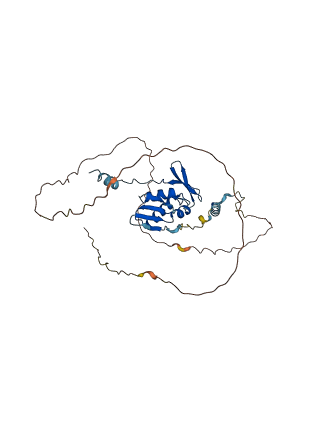
Descriptions
The autoinhibited protein was predicted that may have potential autoinhibitory elements via cis-regPred.
Autoinhibitory domains (AIDs)
Target domain |
|
Relief mechanism |
|
Assay |
cis-regPred |
Accessory elements
No accessory elements
Autoinhibited structure

Activated structure
1 structures for P41035
| Entry ID | Method | Resolution | Chain | Position | Source |
|---|---|---|---|---|---|
| AF-P41035-F1 | Predicted | AlphaFoldDB |
No variants for P41035
| Variant ID(s) | Position | Change | Description | Diseaes Association | Provenance |
|---|---|---|---|---|---|
| No variants for P41035 | |||||
No associated diseases with P41035
1 regional properties for P41035
| Type | Name | Position | InterPro Accession |
|---|---|---|---|
| domain | Translation initiation factor IF2/IF5 domain | 197 - 308 | IPR002735 |
1 GO annotations of cellular component
| Name | Definition |
|---|---|
| eukaryotic translation initiation factor 2 complex | Complex of three heterogeneous polypeptide chains, that form a ternary complex with initiator methionyl-tRNA and GTP. This ternary complex binds to free 40S subunit, which subsequently binds the 5' end of mRNA. |
2 GO annotations of molecular function
| Name | Definition |
|---|---|
| metal ion binding | Binding to a metal ion. |
| translation initiation factor activity | Functions in the initiation of ribosome-mediated translation of mRNA into a polypeptide. |
3 GO annotations of biological process
| Name | Definition |
|---|---|
| in utero embryonic development | The process whose specific outcome is the progression of the embryo in the uterus over time, from formation of the zygote in the oviduct, to birth. An example of this process is found in Mus musculus. |
| male germ cell proliferation | The multiplication or reproduction of male germ cells, resulting in the expansion of a cell population. |
| male gonad development | The process whose specific outcome is the progression of the male gonad over time, from its formation to the mature structure. |
No homologous proteins in AiPD
| UniProt AC | Gene Name | Protein Name | Species | Evidence Code |
|---|---|---|---|---|
| No homologous proteins | ||||
| 10 | 20 | 30 | 40 | 50 | 60 |
| MSGDEMIFDP | TMSKKKKKKK | KPFMLDEEGD | AQTEETQPLE | TKEVEPEPTE | DKDVEADEED |
| 70 | 80 | 90 | 100 | 110 | 120 |
| SRKKDASDDL | DDLNFFNQKK | KKKKTKKIFD | IDEAEEGVKD | LKIENDVQEP | AEPEDDLDIM |
| 130 | 140 | 150 | 160 | 170 | 180 |
| LGNKKKKKKN | VKFPDEDEIL | EKDEALEDED | SKKDDGISFS | NQTGPAWAGS | ERDYTYEELL |
| 190 | 200 | 210 | 220 | 230 | 240 |
| NRVFNIMREK | NPDMVAGEKR | KFVMKPPQVV | RVGTKKTSFV | NFTDICKLLH | RQPKHLLAFL |
| 250 | 260 | 270 | 280 | 290 | 300 |
| LAELGTSGSI | DGNNQLVIKG | RFQQKQIENV | LRRYIKEYVT | CHTCRSPDTI | LQKDTRLYFL |
| 310 | 320 | 330 | |||
| QCETCHSRCS | VASIKTGFQA | VTGKRAQLRA | KAN |