P40986
Gene name |
CDC1 (DSR1, ESP2, YDR182W, YD9395.16) |
Protein name |
Cell division control protein 1 |
Names |
|
Species |
Saccharomyces cerevisiae (strain ATCC 204508 / S288c) (Baker's yeast) |
KEGG Pathway |
sce:YDR182W |
EC number |
|
Protein Class |
|
Descriptions
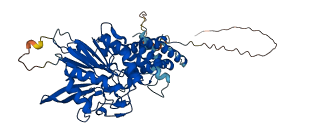
The autoinhibited protein was predicted that may have potential autoinhibitory elements via cis-regPred.
Autoinhibitory domains (AIDs)
Target domain |
|
Relief mechanism |
|
Assay |
cis-regPred |
Accessory elements
No accessory elements
Autoinhibited structure

Activated structure
1 structures for P40986
| Entry ID | Method | Resolution | Chain | Position | Source |
|---|---|---|---|---|---|
| AF-P40986-F1 | Predicted | AlphaFoldDB |
11 variants for P40986
| Variant ID(s) | Position | Change | Description | Diseaes Association | Provenance |
|---|---|---|---|---|---|
| s04-827766 | 63 | S>L | No | SGRP | |
| s04-827904 | 109 | Q>R | No | SGRP | |
| s04-828042 | 155 | K>T | No | SGRP | |
| s04-828273 | 232 | P>L | No | SGRP | |
| s04-828287 | 237 | V>I | No | SGRP | |
| s04-828413 | 279 | E>K | No | SGRP | |
| s04-828492 | 305 | I>T | No | SGRP | |
| s04-828554 | 326 | P>S | No | SGRP | |
| s04-828627 | 350 | R>K | No | SGRP | |
| s04-828702 | 375 | S>L | No | SGRP | |
| s04-828855 | 426 | R>K | No | SGRP |
No associated diseases with P40986
2 GO annotations of cellular component
| Name | Definition |
|---|---|
| endoplasmic reticulum | The irregular network of unit membranes, visible only by electron microscopy, that occurs in the cytoplasm of many eukaryotic cells. The membranes form a complex meshwork of tubular channels, which are often expanded into slitlike cavities called cisternae. The ER takes two forms, rough (or granular), with ribosomes adhering to the outer surface, and smooth (with no ribosomes attached). |
| integral component of membrane | The component of a membrane consisting of the gene products and protein complexes having at least some part of their peptide sequence embedded in the hydrophobic region of the membrane. |
2 GO annotations of molecular function
| Name | Definition |
|---|---|
| hydrolase activity | Catalysis of the hydrolysis of various bonds, e.g. C-O, C-N, C-C, phosphoric anhydride bonds, etc. |
| metal ion binding | Binding to a metal ion. |
4 GO annotations of biological process
| Name | Definition |
|---|---|
| cell cycle | The progression of biochemical and morphological phases and events that occur in a cell during successive cell replication or nuclear replication events. Canonically, the cell cycle comprises the replication and segregation of genetic material followed by the division of the cell, but in endocycles or syncytial cells nuclear replication or nuclear division may not be followed by cell division. |
| cell division | The process resulting in division and partitioning of components of a cell to form more cells; may or may not be accompanied by the physical separation of a cell into distinct, individually membrane-bounded daughter cells. |
| DNA repair | The process of restoring DNA after damage. Genomes are subject to damage by chemical and physical agents in the environment (e.g. UV and ionizing radiations, chemical mutagens, fungal and bacterial toxins, etc.) and by free radicals or alkylating agents endogenously generated in metabolism. DNA is also damaged because of errors during its replication. A variety of different DNA repair pathways have been reported that include direct reversal, base excision repair, nucleotide excision repair, photoreactivation, bypass, double-strand break repair pathway, and mismatch repair pathway. |
| GPI anchor biosynthetic process | The chemical reactions and pathways resulting in the formation of a glycosylphosphatidylinositol (GPI) anchor that attaches some membrane proteins to the lipid bilayer of the cell membrane. The phosphatidylinositol group is linked via the C-6 hydroxyl residue of inositol to a carbohydrate chain which is itself linked to the protein via an ethanolamine phosphate group, its amino group forming an amide linkage with the C-terminal carboxyl of the protein. Some GPI anchors have variants on this canonical linkage. |
No homologous proteins in AiPD
| UniProt AC | Gene Name | Protein Name | Species | Evidence Code |
|---|---|---|---|---|
| No homologous proteins | ||||
| 10 | 20 | 30 | 40 | 50 | 60 |
| MVYRNRSKSV | LSTHSKKSDD | KAHYKSRSKK | KSKSRSKKRL | RIYWRYISIV | WILWLGLISY |
| 70 | 80 | 90 | 100 | 110 | 120 |
| YESVVVKRAM | KKCQWSTWED | WPEGAESHRV | GLFADPQIMD | EYSYPGRPQI | VNYFTRVIVD |
| 130 | 140 | 150 | 160 | 170 | 180 |
| HYHRRNWKYV | QYYLDPDSNF | FLGDLFDGGR | NWDDKQWIKE | YTRFNQIFPK | KPLRRTVMSL |
| 190 | 200 | 210 | 220 | 230 | 240 |
| PGNHDIGFGD | TVVESSLQRF | SSYFGETSSS | LDAGNHTFVL | LDTISLSDKT | NPNVSRVPRQ |
| 250 | 260 | 270 | 280 | 290 | 300 |
| FLDNFAMGSH | PLPRILLTHV | PLWRDPEQQT | CGQLRESKEP | FPIQKGHQYQ | TVIENDISQE |
| 310 | 320 | 330 | 340 | 350 | 360 |
| ILTKIQPEIL | FSGDDHDHCQ | ISHSYPFQGK | TKNAQEITVK | SCAMNMGISR | PAIQLLSLYN |
| 370 | 380 | 390 | 400 | 410 | 420 |
| PSDLTMVNAG | GEYASKTYQT | ELCYMPDPYK | AIRMYLWGLL | FSAAFIAYMH | FFPKSFNNRV |
| 430 | 440 | 450 | 460 | 470 | 480 |
| ATIMNRVFTR | PDGNTSDLPL | PTSISKSKSK | KSLTHSKYAV | NDTRSIKQFL | VNAIVLFVSV |
| 490 | |||||
| MPIFIYFYTV | V |