P40739
Gene name |
bglP (BSU39270, N17C) |
Protein name |
PTS system beta-glucoside-specific EIIBCA component |
Names |
EIIBCA-Bgl, EII-Bgl |
Species |
Bacillus subtilis (strain 168) |
KEGG Pathway |
bsu:BSU39270 |
EC number |
|
Protein Class |
|
Descriptions
The autoinhibited protein was predicted that may have potential autoinhibitory elements via cis-regPred.
Autoinhibitory domains (AIDs)
Target domain |
|
Relief mechanism |
|
Assay |
cis-regPred |
Accessory elements
No accessory elements
Autoinhibited structure

Activated structure
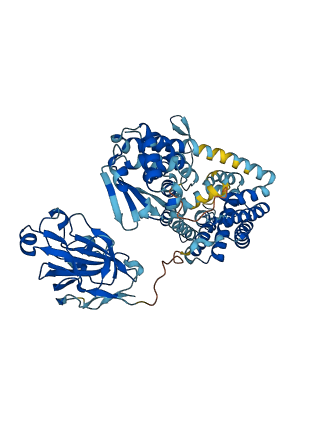
1 structures for P40739
| Entry ID | Method | Resolution | Chain | Position | Source |
|---|---|---|---|---|---|
| AF-P40739-F1 | Predicted | AlphaFoldDB |
No variants for P40739
| Variant ID(s) | Position | Change | Description | Diseaes Association | Provenance |
|---|---|---|---|---|---|
| No variants for P40739 | |||||
No associated diseases with P40739
5 regional properties for P40739
| Type | Name | Position | InterPro Accession |
|---|---|---|---|
| domain | Phosphotransferase system, sugar-specific permease EIIA type 1 | 463 - 588 | IPR001127 |
| domain | Phosphotransferase system, IIB component, type 1 | 4 - 86 | IPR001996 |
| domain | Phosphotransferase system, EIIC | 107 - 386 | IPR003352 |
| domain | Phosphotransferase system, EIIC component, type 1 | 103 - 459 | IPR013013 |
| conserved_site | Phosphotransferase system EIIB, cysteine phosphorylation site | 4 - 80 | IPR018113 |
2 GO annotations of cellular component
| Name | Definition |
|---|---|
| integral component of membrane | The component of a membrane consisting of the gene products and protein complexes having at least some part of their peptide sequence embedded in the hydrophobic region of the membrane. |
| plasma membrane | The membrane surrounding a cell that separates the cell from its external environment. It consists of a phospholipid bilayer and associated proteins. |
4 GO annotations of molecular function
| Name | Definition |
|---|---|
| kinase activity | Catalysis of the transfer of a phosphate group, usually from ATP, to a substrate molecule. |
| protein-N(PI)-phosphohistidine-sugar phosphotransferase activity | Catalysis of the PEP-dependent, phosphoryl transfer-driven transport of substances across a membrane. The transport happens by catalysis of the reaction: protein N-phosphohistidine + sugar(out) = protein histidine + sugar phosphate(in). This differs from primary and secondary active transport in that the solute is modified during transport. |
| protein-phosphocysteine-sugar phosphotransferase activity | Catalysis of the PEP-dependent, phosphoryl transfer-driven transport of substances across a membrane. The transport happens by catalysis of the reaction: protein S-phosphocysteine + sugar(out) = protein cysteine + sugar phosphate(in). This differs from primary and secondary active transport in that the solute is modified during transport. |
| protein-phosphocysteine-trehalose phosphotransferase system transporter activity | Catalysis of the PEP-dependent, phosphoryl transfer-driven transport of substances across a membrane. The transport happens by catalysis of the reaction: protein S-phosphocysteine + trehalose (out) = protein cysteine + trehalose-6-phosphate (in). |
3 GO annotations of biological process
| Name | Definition |
|---|---|
| phosphoenolpyruvate-dependent sugar phosphotransferase system | The uptake and phosphorylation of specific carbohydrates from the extracellular environment; uptake and phosphorylation are coupled, making the PTS a link between the uptake and metabolism of sugars; phosphoenolpyruvate is the original phosphate donor; phosphoenolpyruvate passes the phosphate via a signal transduction pathway, to enzyme 1 (E1), which in turn passes it on to the histidine protein, HPr; the next step in the system involves sugar-specific membrane-bound complex, enzyme 2 (EII), which transports the sugar into the cell; it includes the sugar permease, which catalyzes the transport reactions; EII is usually divided into three different domains, EIIA, EIIB, and EIIC. |
| phosphorylation | The process of introducing a phosphate group into a molecule, usually with the formation of a phosphoric ester, a phosphoric anhydride or a phosphoric amide. |
| trehalose transport | The directed movement of trehalose into, out of or within a cell, or between cells, by means of some agent such as a transporter or pore. Trehalose is a disaccharide isomeric with sucrose and obtained from certain lichens and fungi. |
No homologous proteins in AiPD
| UniProt AC | Gene Name | Protein Name | Species | Evidence Code |
|---|---|---|---|---|
| No homologous proteins | ||||
| 10 | 20 | 30 | 40 | 50 | 60 |
| MDYDKLSKDI | LQLVGGEENV | QRVIHCMTRL | RFNLHDNAKA | DRSQLEQLPG | VMGTNISGEQ |
| 70 | 80 | 90 | 100 | 110 | 120 |
| FQIIIGNDVP | KVYQAIVRHS | NLSDEKSAGS | SSQKKNVLSA | VFDVISGVFT | PILPAIAGAG |
| 130 | 140 | 150 | 160 | 170 | 180 |
| MIKGLVALAV | TFGWMAEKSQ | VHVILTAVGD | GAFYFLPLLL | AMSAARKFGS | NPYVAAAIAA |
| 190 | 200 | 210 | 220 | 230 | 240 |
| AILHPDLTAL | LGAGKPISFI | GLPVTAATYS | STVIPILLSI | WIASYVEKWI | DRFTHASLKL |
| 250 | 260 | 270 | 280 | 290 | 300 |
| IVVPTFTLLI | VVPLTLITVG | PLGAILGEYL | SSGVNYLFDH | AGLVAMILLA | GTFSLIIMTG |
| 310 | 320 | 330 | 340 | 350 | 360 |
| MHYAFVPIMI | NNIAQNGHDY | LLPAMFLANM | GQAGASFAVF | LRSRNKKFKS | LALTTSITAL |
| 370 | 380 | 390 | 400 | 410 | 420 |
| MGITEPAMYG | VNMRLKKPFA | AALIGGAAGG | AFYGMTGVAS | YIVGGNAGLP | SIPVFIGPTF |
| 430 | 440 | 450 | 460 | 470 | 480 |
| IYAMIGLVIA | FAAGTAAAYL | LGFEDVPSDG | SQQPAVHEGS | REIIHSPIKG | EVKALSEVKD |
| 490 | 500 | 510 | 520 | 530 | 540 |
| GVFSAGVMGK | GFAIEPEEGE | VVSPVRGSVT | TIFKTKHAIG | ITSDQGAEIL | IHIGLDTVKL |
| 550 | 560 | 570 | 580 | 590 | 600 |
| EGQWFTAHIK | EGDKVAPGDP | LVSFDLEQIK | AAGYDVITPV | IVTNTDQYSF | SPVKEIGKVQ |
| PKEALLALS |