P40418
Gene name |
SWI6 (KLLA0C01826g) |
Protein name |
Regulatory protein SWI6 |
Names |
Cell-cycle box factor subunit SWI6, MBF subunit P90, Trans-acting activator of HO endonuclease gene |
Species |
Kluyveromyces lactis (strain ATCC 8585 / CBS 2359 / DSM 70799 / NBRC 1267 / NRRL Y-1140 / WM37) (Yeast) (Candida sphaerica) |
KEGG Pathway |
kla:KLLA0_C01826g |
EC number |
|
Protein Class |
|
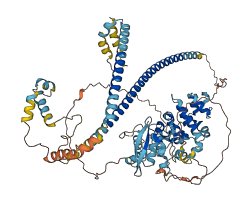
Descriptions
The autoinhibited protein was predicted that may have potential autoinhibitory elements via cis-regPred.
Autoinhibitory domains (AIDs)
Target domain |
|
Relief mechanism |
|
Assay |
cis-regPred |
Accessory elements
No accessory elements
Autoinhibited structure

Activated structure
1 structures for P40418
| Entry ID | Method | Resolution | Chain | Position | Source |
|---|---|---|---|---|---|
| AF-P40418-F1 | Predicted | AlphaFoldDB |
No variants for P40418
| Variant ID(s) | Position | Change | Description | Diseaes Association | Provenance |
|---|---|---|---|---|---|
| No variants for P40418 | |||||
No associated diseases with P40418
3 regional properties for P40418
| Type | Name | Position | InterPro Accession |
|---|---|---|---|
| repeat | Ankyrin repeat | 286 - 318 | IPR002110-1 |
| repeat | Ankyrin repeat | 416 - 461 | IPR002110-2 |
| domain | Swi6, N-terminal | 13 - 90 | IPR040822 |
3 GO annotations of cellular component
| Name | Definition |
|---|---|
| cytoplasm | The contents of a cell excluding the plasma membrane and nucleus, but including other subcellular structures. |
| MBF transcription complex | A protein complex that binds to the Mlu1 cell cycle box (MCB) promoter element, consensus sequence ACGCGN, and is involved in regulation of transcription during the G1/S transition of the cell cycle. In Saccharomyces, the complex contains a heterodimer of the DNA binding protein Mbp1p and the activator Swi6p, and is associated with additional proteins known as Nrm1p, Msa1p, and Msa2p; in Schizosaccharomyces the complex contains Res1p, Res2p, and Cdc10p. |
| SBF transcription complex | A protein complex that binds to the Swi4/6 cell cycle box (SCB) promoter element, consensus sequence CRCGAAA, and activates transcription during the G1/S transition of the cell cycle. In Saccharomyces, the complex contains a heterodimer of the DNA binding protein Swi4p and the activator Swi6p, and is associated with additional proteins known as Whi5p and Msa1p. |
2 GO annotations of molecular function
| Name | Definition |
|---|---|
| DNA binding | Any molecular function by which a gene product interacts selectively and non-covalently with DNA (deoxyribonucleic acid). |
| transcription coactivator activity | A transcription coregulator activity that activates or increases the transcription of specific gene sets via binding to a DNA-bound DNA-binding transcription factor, either on its own or as part of a complex. Coactivators often act by altering chromatin structure and modifications. For example, one class of transcription coactivators modifies chromatin structure through covalent modification of histones. A second class remodels the conformation of chromatin in an ATP-dependent fashion. A third class modulates interactions of DNA-bound DNA-binding transcription factors with other transcription coregulators. A fourth class of coactivator activity is the bridging of a DNA-binding transcription factor to the general (basal) transcription machinery. The Mediator complex, which bridges sequence-specific DNA binding transcription factors and RNA polymerase, is also a transcription coactivator. |
3 GO annotations of biological process
| Name | Definition |
|---|---|
| positive regulation of reciprocal meiotic recombination | Any process that increases the frequency, rate or extent of recombination during meiosis. Reciprocal meiotic recombination is the cell cycle process in which double strand breaks are formed and repaired through a double Holliday junction intermediate. |
| positive regulation of transcription from RNA polymerase II promoter in response to heat stress | Any process that increases the frequency, rate or extent of transcription from an RNA polymerase II promoter as a result of a heat stimulus, a temperature stimulus above the optimal temperature for that organism. |
| positive regulation of transcription involved in G1/S transition of mitotic cell cycle | Any process that activates or increases transcription as part of the G1/S transition of the mitotic cell cycle. |
No homologous proteins in AiPD
| UniProt AC | Gene Name | Protein Name | Species | Evidence Code |
|---|---|---|---|---|
| No homologous proteins | ||||
| 10 | 20 | 30 | 40 | 50 | 60 |
| MSRPIFKVHK | GDRITFQQRL | QDGYVCLDQF | IPLLTNLSSF | NFHRDDPLVE | NLDDMVTSQF |
| 70 | 80 | 90 | 100 | 110 | 120 |
| NILIDTDRSG | TRWITLQKAH | ELWDLLQIKD | DSGSENLTDH | DDDNEANHNG | VEDDGQKTPE |
| 130 | 140 | 150 | 160 | 170 | 180 |
| NNGRKTDNHT | MENGGTENTN | NGNNSSNKND | GNVTAEGSNF | RPATITNGTT | SRISGGEPDT |
| 190 | 200 | 210 | 220 | 230 | 240 |
| VKHELLDLPD | SPTKRHQTKS | VSKIPVFQHD | LPTVSTLQKT | LPPVSNYSND | ERAKLETLLQ |
| 250 | 260 | 270 | 280 | 290 | 300 |
| RILFPETTNL | NVAEGYPSVS | LTQQVQELDT | QFPNVPLNFN | IPIDEHGNTS | LHWLCSIANL |
| 310 | 320 | 330 | 340 | 350 | 360 |
| DLLKQLIVFG | SDRRIGDKSG | ESVLVKSVKS | VNNYDSGTFE | ILLDYLYPCI | VMVDDMDRTV |
| 370 | 380 | 390 | 400 | 410 | 420 |
| LHHIVITSGM | PGCNAAAKYY | LDILMGWIVK | KQSRTKESHC | VLLEDIDLQW | VITHLLNARD |
| 430 | 440 | 450 | 460 | 470 | 480 |
| SNGDTCLNIA | ARLGNVAIVE | ALLDYGADPN | IANNSGLCPV | DFGAGTQPRF | QSNTKNLMAT |
| 490 | 500 | 510 | 520 | 530 | 540 |
| PTKTHETSLD | PMAESTSLIT | NIKSLLSKIS | NDYGDEIKQH | NGKMKELLDT | LNIKREALAN |
| 550 | 560 | 570 | 580 | 590 | 600 |
| ARDRLAKAKQ | IQDEYNLLSD | RLNNVENTIA | EEDQNFQLAS | RELGLSLDDV | QEEGLNSADI |
| 610 | 620 | 630 | 640 | 650 | 660 |
| AFDADEPFRI | SYVYTKFEEK | IKDEYNNDFE | LFLKHCNLSQ | LVHEIYDNFP | SRAEIPHPKI |
| 670 | 680 | 690 | 700 | 710 | 720 |
| LKARIKAYNR | NELHLDSTLQ | TIIPHPKILK | ARIKAYNRNE | LHLDSTLQTI | KDKQKNLESK |
| 730 | 740 | 750 | 760 | ||
| FRKVLSLCLK | IDEEKVDSML | DGLLQAISNE | DPEDIDTDEV | NNFLESAAE |