P40376
Gene name |
pka1 (tpk, SPBC106.10) |
Protein name |
cAMP-dependent protein kinase catalytic subunit |
Names |
|
Species |
Schizosaccharomyces pombe (strain 972 / ATCC 24843) (Fission yeast) |
KEGG Pathway |
spo:SPBC106.10 |
EC number |
2.7.11.11: Protein-serine/threonine kinases |
Protein Class |
|
Descriptions
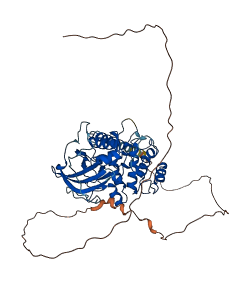
The autoinhibited protein was predicted that may have potential autoinhibitory elements via cis-regPred.
Autoinhibitory domains (AIDs)
Target domain |
|
Relief mechanism |
|
Assay |
cis-regPred |
Accessory elements
341-362 (Activation loop from InterPro)
Target domain |
201-456 (Protein kinase domain) |
Relief mechanism |
|
Assay |
|
Autoinhibited structure

Activated structure
1 structures for P40376
| Entry ID | Method | Resolution | Chain | Position | Source |
|---|---|---|---|---|---|
| AF-P40376-F1 | Predicted | AlphaFoldDB |
No variants for P40376
| Variant ID(s) | Position | Change | Description | Diseaes Association | Provenance |
|---|---|---|---|---|---|
| No variants for P40376 | |||||
No associated diseases with P40376
4 regional properties for P40376
| Type | Name | Position | InterPro Accession |
|---|---|---|---|
| domain | Cryptochrome/DNA photolyase, FAD-binding domain | 241 - 395 | IPR005101 |
| domain | DNA photolyase, N-terminal | 2 - 153 | IPR006050 |
| conserved_site | Cryptochrome/DNA photolyase class 1, conserved site, C-terminal | 290 - 302 | IPR018394-1 |
| conserved_site | Cryptochrome/DNA photolyase class 1, conserved site, C-terminal | 310 - 329 | IPR018394-2 |
Functions
| Description | ||
|---|---|---|
| EC Number | 2.7.11.11 | Protein-serine/threonine kinases |
| Subcellular Localization |
|
|
| PANTHER Family | ||
| PANTHER Subfamily | ||
| PANTHER Protein Class | ||
| PANTHER Pathway Category | No pathway information available | |
5 GO annotations of cellular component
| Name | Definition |
|---|---|
| cAMP-dependent protein kinase complex | An enzyme complex, composed of regulatory and catalytic subunits, that catalyzes protein phosphorylation. Inactive forms of the enzyme have two regulatory chains and two catalytic chains; activation by cAMP produces two active catalytic monomers and a regulatory dimer. |
| cytoplasm | The contents of a cell excluding the plasma membrane and nucleus, but including other subcellular structures. |
| cytosol | The part of the cytoplasm that does not contain organelles but which does contain other particulate matter, such as protein complexes. |
| fungal-type vacuole | A vacuole that has both lytic and storage functions. The fungal vacuole is a large, membrane-bounded organelle that functions as a reservoir for the storage of small molecules (including polyphosphate, amino acids, several divalent cations (e.g. calcium), other ions, and other small molecules) as well as being the primary compartment for degradation. It is an acidic compartment, containing an ensemble of acid hydrolases. At least in S. cerevisiae, there are indications that the morphology of the vacuole is variable and correlated with the cell cycle, with logarithmically growing cells having a multilobed, reticulated vacuole, while stationary phase cells contain a single large structure. |
| nucleus | A membrane-bounded organelle of eukaryotic cells in which chromosomes are housed and replicated. In most cells, the nucleus contains all of the cell's chromosomes except the organellar chromosomes, and is the site of RNA synthesis and processing. In some species, or in specialized cell types, RNA metabolism or DNA replication may be absent. |
5 GO annotations of molecular function
| Name | Definition |
|---|---|
| AMP-activated protein kinase activity | Catalysis of the reaction: ATP + a protein = ADP + a phosphoprotein. This reaction requires the presence of AMP. |
| ATP binding | Binding to ATP, adenosine 5'-triphosphate, a universally important coenzyme and enzyme regulator. |
| cAMP-dependent protein kinase activity | cAMP-dependent catalysis of the reaction: ATP + a protein = ADP + a phosphoprotein. |
| protein serine kinase activity | Catalysis of the reactions: ATP + protein serine = ADP + protein serine phosphate. |
| protein serine/threonine kinase activity | Catalysis of the reactions: ATP + protein serine = ADP + protein serine phosphate, and ATP + protein threonine = ADP + protein threonine phosphate. |
10 GO annotations of biological process
| Name | Definition |
|---|---|
| adenylate cyclase-activating G protein-coupled receptor signaling pathway | A G protein-coupled receptor signaling pathway in which the signal is transmitted via the activation of adenylyl cyclase activity and a subsequent increase in the intracellular concentration of cyclic AMP (cAMP). |
| adenylate cyclase-activating glucose-activated G protein-coupled receptor signaling pathway | An adenylate cyclase-activating G protein-coupled receptor signaling pathway initiated by glucose binding to its receptor on the surface of the target cell, and ending with the regulation of a downstream cellular process. |
| negative regulation of cytoplasmic translation | Any process that stops, prevents or reduces the frequency, rate or extent of cytoplasmic translation. |
| negative regulation of gluconeogenesis | Any process that stops, prevents, or reduces the frequency, rate or extent of gluconeogenesis. |
| negative regulation of induction of conjugation with cellular fusion | Any process that stops, prevents, or reduces the frequency or rate of initiation of conjugation with cellular fusion. |
| negative regulation of transcription from RNA polymerase II promoter by glucose | Any process involving glucose that decreases the frequency, rate or extent or transcription from an RNA polymerase II promoter. |
| positive regulation of microtubule depolymerization | Any process that activates or increases the frequency, rate or extent of microtubule depolymerization. |
| positive regulation of protein export from nucleus | Any process that activates or increases the frequency, rate or extent of directed movement of proteins from the nucleus into the cytoplasm. |
| protein kinase A signaling | A series of reactions, mediated by the intracellular serine/threonine kinase protein kinase A, which occurs as a result of a single trigger reaction or compound. |
| protein phosphorylation | The process of introducing a phosphate group on to a protein. |
No homologous proteins in AiPD
| UniProt AC | Gene Name | Protein Name | Species | Evidence Code |
|---|---|---|---|---|
| No homologous proteins | ||||
| 10 | 20 | 30 | 40 | 50 | 60 |
| MDTTAVASKG | STNVGSSTDT | LSTSASLHPS | MNAGSVNEYS | EQQRHGTNSF | NGKPSVHDSV |
| 70 | 80 | 90 | 100 | 110 | 120 |
| GSDASVSNGH | NNHNESSLWT | SGIPKALEEA | TKSKKPDSLV | STSTSGCASA | HSVGYQNIDN |
| 130 | 140 | 150 | 160 | 170 | 180 |
| LIPSPLPESA | SRSSSQSSHQ | RHSRDGRGEL | GSEHGERRSA | MDGLRDRHIR | KVRVSQLLDL |
| 190 | 200 | 210 | 220 | 230 | 240 |
| QRRRIRPADH | TTKDRYGIQD | FNFLQTLGTG | SFGRVHLVQS | NHNRLYYAIK | VLEKKKIVDM |
| 250 | 260 | 270 | 280 | 290 | 300 |
| KQIEHTCDER | YILSRVQHPF | ITILWGTFQD | AKNLFMVMDF | AEGGELFSLL | RKCHRFPEKV |
| 310 | 320 | 330 | 340 | 350 | 360 |
| AKFYAAEVIL | ALDYLHHNQI | VYRDLKPENL | LLDRFGHLKI | VDFGFAKRVS | TSNCCTLCGT |
| 370 | 380 | 390 | 400 | 410 | 420 |
| PDYLAPEIIS | LKPYNKAADW | WSLGILIFEM | LAGYPPFYSE | NPMKLYENIL | EGKVNYPSYF |
| 430 | 440 | 450 | 460 | 470 | 480 |
| SPASIDLLSH | LLQRDITCRY | GNLKDGSMDI | IMHPWFRDIS | WDKILTRKIE | VPYVPPIQAG |
| 490 | 500 | 510 | |||
| MGDSSQFDAY | ADVATDYGTS | EDPEFTSIFK | DF |