P40359
Gene name |
PSF2 (YJL072C, HRF213, J1086) |
Protein name |
DNA replication complex GINS protein PSF2 |
Names |
Partner of Sld five 2 |
Species |
Saccharomyces cerevisiae (strain ATCC 204508 / S288c) (Baker's yeast) |
KEGG Pathway |
sce:YJL072C |
EC number |
|
Protein Class |
|
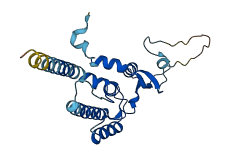
Descriptions
The autoinhibited protein was predicted that may have potential autoinhibitory elements via cis-regPred.
Autoinhibitory domains (AIDs)
Target domain |
|
Relief mechanism |
|
Assay |
cis-regPred |
Accessory elements
No accessory elements
Autoinhibited structure

Activated structure
22 structures for P40359
| Entry ID | Method | Resolution | Chain | Position | Source |
|---|---|---|---|---|---|
| 3JC5 | EM | 470 A | B | 1-213 | PDB |
| 3JC6 | EM | 370 A | B | 1-213 | PDB |
| 3JC7 | EM | 480 A | B | 1-213 | PDB |
| 5U8S | EM | 610 A | B | 1-213 | PDB |
| 5U8T | EM | 490 A | B | 1-213 | PDB |
| 6HV9 | EM | 498 A | D | 1-213 | PDB |
| 6PTJ | EM | 380 A | B | 1-213 | PDB |
| 6PTN | EM | 580 A | B/b | 1-213 | PDB |
| 6PTO | EM | 700 A | B/b/o | 1-213 | PDB |
| 6SKL | EM | 370 A | B | 1-213 | PDB |
| 6U0M | EM | 390 A | B | 3-200 | PDB |
| 7PMK | EM | 320 A | B | 1-213 | PDB |
| 7PMN | EM | 320 A | B | 1-213 | PDB |
| 8B9A | EM | 350 A | D | 1-213 | PDB |
| 8B9B | EM | 350 A | D | 1-213 | PDB |
| 8B9C | EM | 460 A | D | 1-213 | PDB |
| 8KG6 | EM | 307 A | B | 1-213 | PDB |
| 8KG8 | EM | 423 A | B | 1-213 | PDB |
| 8KG9 | EM | 452 A | B | 1-213 | PDB |
| 8W7M | EM | 412 A | B | 1-213 | PDB |
| 8W7S | EM | 739 A | B | 1-213 | PDB |
| AF-P40359-F1 | Predicted | AlphaFoldDB |
1 variants for P40359
| Variant ID(s) | Position | Change | Description | Diseaes Association | Provenance |
|---|---|---|---|---|---|
| s10-305831 | 9 | Q>H | No | SGRP |
No associated diseases with P40359
1 regional properties for P40359
| Type | Name | Position | InterPro Accession |
|---|---|---|---|
| domain | GINS subunit, domain A | 69 - 178 | IPR021151 |
6 GO annotations of cellular component
| Name | Definition |
|---|---|
| CMG complex | A protein complex that contains the GINS complex, Cdc45p, and the heterohexameric MCM complex, and that is involved in unwinding DNA during replication. |
| DNA replication preinitiation complex | A protein-DNA complex assembled at eukaryotic DNA replication origins immediately prior to the initiation of DNA replication. The preinitiation complex is formed by the assembly of additional proteins onto an existing prereplicative complex. In budding yeast, the additional proteins might include Cdc45p, Sld2p, Sld3p, Dpb11p, DNA polymerases, and others; in fission yeast the GINS complex is present. |
| GINS complex | A heterotetrameric protein complex that associates with replication origins, where it is required for the initiation of DNA replication, and with replication forks. |
| nuclear replication fork | The Y-shaped region of a nuclear replicating DNA molecule, resulting from the separation of the DNA strands and in which the synthesis of new strands takes place. Also includes associated protein complexes. |
| nucleus | A membrane-bounded organelle of eukaryotic cells in which chromosomes are housed and replicated. In most cells, the nucleus contains all of the cell's chromosomes except the organellar chromosomes, and is the site of RNA synthesis and processing. In some species, or in specialized cell types, RNA metabolism or DNA replication may be absent. |
| replication fork protection complex | A protein complex conserved in eukaryotes and associated with the replication fork; the complex stabilizes stalled replication forks and is thought to be involved in coordinating leading- and lagging-strand synthesis and in replication checkpoint signaling. |
No GO annotations of molecular function
| Name | Definition |
|---|---|
| No GO annotations for molecular function |
5 GO annotations of biological process
| Name | Definition |
|---|---|
| DNA unwinding involved in DNA replication | The process in which interchain hydrogen bonds between two strands of DNA are broken or 'melted', generating unpaired template strands for DNA replication. |
| DNA-templated DNA replication | A DNA replication process that uses parental DNA as a template for the DNA-dependent DNA polymerases that synthesize the new strands. |
| double-strand break repair via break-induced replication | The error-free repair of a double-strand break in DNA in which the centromere-proximal end of a broken chromosome searches for a homologous region in an intact chromosome. DNA synthesis initiates from the 3' end of the invading DNA strand, using the intact chromosome as the template, and progresses to the end of the chromosome. |
| positive regulation of DNA primase activity | Any process that activates or increases the frequency, rate or extent of DNA primase activity. |
| positive regulation of DNA-directed DNA polymerase activity | Any process that activates or increases the frequency, rate or extent of DNA-directed DNA polymerase activity. |
No homologous proteins in AiPD
| UniProt AC | Gene Name | Protein Name | Species | Evidence Code |
|---|---|---|---|---|
| No homologous proteins | ||||
| 10 | 20 | 30 | 40 | 50 | 60 |
| MSLPAHLQQT | FSPEEIQFIV | ENEPIKIFPR | ITTRQKIRGD | DRGTGNHTRW | QLITTDDKAL |
| 70 | 80 | 90 | 100 | 110 | 120 |
| NNMVAMRSTE | VVLWIALLLK | QQSKCSIVAP | QWLTTKELDR | KIQYEKTHPD | RFSELPWNWL |
| 130 | 140 | 150 | 160 | 170 | 180 |
| VLARILFNKA | KDDFHDPIHE | LRGKIQDLRE | IRQIKVLKGL | KYLNESHLQL | DNLSLLEINE |
| 190 | 200 | 210 | |||
| LRPFITEIMD | KLREIHTASL | TAGTENDEEE | FNI |