P39995
Gene name |
EAF5 (YEL018W) |
Protein name |
Chromatin modification-related protein EAF5 |
Names |
ESA1-associated factor 5 |
Species |
Saccharomyces cerevisiae (strain ATCC 204508 / S288c) (Baker's yeast) |
KEGG Pathway |
sce:YEL018W |
EC number |
|
Protein Class |
|
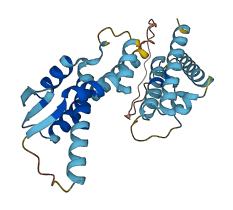
Descriptions
The autoinhibited protein was predicted that may have potential autoinhibitory elements via cis-regPred.
Autoinhibitory domains (AIDs)
Target domain |
|
Relief mechanism |
|
Assay |
cis-regPred |
Accessory elements
No accessory elements
Autoinhibited structure

Activated structure
2 structures for P39995
| Entry ID | Method | Resolution | Chain | Position | Source |
|---|---|---|---|---|---|
| 5Y81 | EM | 470 A | H | 1-279 | PDB |
| AF-P39995-F1 | Predicted | AlphaFoldDB |
2 variants for P39995
| Variant ID(s) | Position | Change | Description | Diseaes Association | Provenance |
|---|---|---|---|---|---|
| s05-121928 | 153 | N>S | No | SGRP | |
| s05-121966 | 166 | I>V | No | SGRP |
No associated diseases with P39995
5 regional properties for P39995
| Type | Name | Position | InterPro Accession |
|---|---|---|---|
| domain | Tyrosine-specific protein phosphatases domain | 344 - 406 | IPR000387 |
| domain | Protein-tyrosine phosphatase, catalytic | 323 - 471 | IPR003595 |
| domain | GRAM domain | 29 - 143 | IPR004182 |
| domain | Myotubularin-like, phosphatase domain | 151 - 538 | IPR010569 |
| active_site | Protein-tyrosine phosphatase, active site | 373 - 383 | IPR016130 |
4 GO annotations of cellular component
| Name | Definition |
|---|---|
| cytosol | The part of the cytoplasm that does not contain organelles but which does contain other particulate matter, such as protein complexes. |
| NuA4 histone acetyltransferase complex | A complex having histone acetylase activity on chromatin, as well as ATPase, DNA helicase and structural DNA binding activities. The complex is thought to be involved in double-strand DNA break repair. Subunits of the human complex include HTATIP/TIP60, TRRAP, RUVBL1, BUVBL2, beta-actin and BAF53/ACTL6A. In yeast, the complex has 13 subunits, including the catalytic subunit Esa1 (homologous to human Tip60). |
| nucleosome disassembly/reassembly complex | A protein complex involved in the disassembly and subsequent reassembly of nucleosomes. It associates with the coding region of transcriptionally active genes where it interacts with the RNA polymerase II and affects its processivity during co-transcriptional RNA processing and maturation. It exists as a functionally independent part of the NuA4 complex. |
| nucleus | A membrane-bounded organelle of eukaryotic cells in which chromosomes are housed and replicated. In most cells, the nucleus contains all of the cell's chromosomes except the organellar chromosomes, and is the site of RNA synthesis and processing. In some species, or in specialized cell types, RNA metabolism or DNA replication may be absent. |
No GO annotations of molecular function
| Name | Definition |
|---|---|
| No GO annotations for molecular function |
6 GO annotations of biological process
| Name | Definition |
|---|---|
| DNA repair | The process of restoring DNA after damage. Genomes are subject to damage by chemical and physical agents in the environment (e.g. UV and ionizing radiations, chemical mutagens, fungal and bacterial toxins, etc.) and by free radicals or alkylating agents endogenously generated in metabolism. DNA is also damaged because of errors during its replication. A variety of different DNA repair pathways have been reported that include direct reversal, base excision repair, nucleotide excision repair, photoreactivation, bypass, double-strand break repair pathway, and mismatch repair pathway. |
| DNA replication-dependent chromatin assembly | The formation of nucleosomes on newly synthesized DNA, coupled to strand elongation. |
| DNA-templated transcription | The synthesis of an RNA transcript from a DNA template. |
| histone acetylation | The modification of a histone by the addition of an acetyl group. |
| nucleosome disassembly | The controlled breakdown of nucleosomes, the beadlike structural units of eukaryotic chromatin composed of histones and DNA. |
| positive regulation of transcription elongation by RNA polymerase II | Any process that activates or increases the frequency, rate or extent of transcription elongation, the extension of an RNA molecule after transcription initiation and promoter clearance by the addition of ribonucleotides, catalyzed by RNA polymerase II. |
No homologous proteins in AiPD
| UniProt AC | Gene Name | Protein Name | Species | Evidence Code |
|---|---|---|---|---|
| No homologous proteins | ||||
| 10 | 20 | 30 | 40 | 50 | 60 |
| MDKEVSELVV | LQLIHTLISN | KNEELVRNGG | GINMIGNNLR | ISLVKLTNEI | QNNLLINELT |
| 70 | 80 | 90 | 100 | 110 | 120 |
| NLRRQSNVAN | GNRKLGINDI | LTIVKNLFPE | YRTTLNDGQL | SLHGLEMHDI | EKLLDEKYDR |
| 130 | 140 | 150 | 160 | 170 | 180 |
| FKKTQVEQIR | MMEDEILKNG | IKTGASQLQP | HANAGKSGSA | GTSATITTTT | PHMAHSMDPK |
| 190 | 200 | 210 | 220 | 230 | 240 |
| REKLLKLYRD | TVLNKLESKT | GNFQKLFKSP | DGSIIKNEIN | YEDIKNETPG | SVHELQLILQ |
| 250 | 260 | 270 | |||
| KSITDGVMRK | VIGTDDWKLA | RQVQFELDDT | VQFMRRALE |