P39750
Gene name |
rad2 |
Protein name |
Flap endonuclease 1 |
Names |
FEN-1, DNA repair protein rad2, Flap structure-specific endonuclease 1 |
Species |
Schizosaccharomyces pombe (strain 972 / ATCC 24843) (Fission yeast) |
KEGG Pathway |
spo:SPAC3G6.06c |
EC number |
|
Protein Class |
|
Descriptions
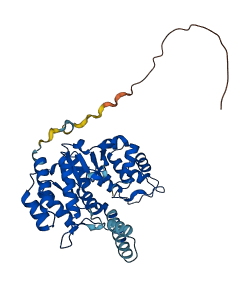
The autoinhibited protein was predicted that may have potential autoinhibitory elements via cis-regPred.
Autoinhibitory domains (AIDs)
Target domain |
|
Relief mechanism |
|
Assay |
cis-regPred |
Accessory elements
No accessory elements
Autoinhibited structure

Activated structure
1 structures for P39750
| Entry ID | Method | Resolution | Chain | Position | Source |
|---|---|---|---|---|---|
| AF-P39750-F1 | Predicted | AlphaFoldDB |
3 variants for P39750
| Variant ID(s) | Position | Change | Description | Diseaes Association | Provenance |
|---|---|---|---|---|---|
| I_5390469_T_C | 115 | T>A | No | Jeffares_SNPs | |
| I_5390160_C_T | 218 | D>N | No | Jeffares_SNPs | |
| I_5389937_C_A | 292 | G>V | No | Jeffares_SNPs |
No associated diseases with P39750
5 regional properties for P39750
| Type | Name | Position | InterPro Accession |
|---|---|---|---|
| domain | XPG, N-terminal | 1 - 108 | IPR006085 |
| domain | XPG-I domain | 147 - 234 | IPR006086 |
| conserved_site | Helix-hairpin-helix motif, class 2 | 221 - 254 | IPR008918 |
| conserved_site | XPG conserved site | 80 - 94 | IPR019974-1 |
| conserved_site | XPG conserved site | 150 - 164 | IPR019974-2 |
Functions
6 GO annotations of cellular component
| Name | Definition |
|---|---|
| cytoplasm | The contents of a cell excluding the plasma membrane and nucleus, but including other subcellular structures. |
| mitochondrion | A semiautonomous, self replicating organelle that occurs in varying numbers, shapes, and sizes in the cytoplasm of virtually all eukaryotic cells. It is notably the site of tissue respiration. |
| nucleolus | A small, dense body one or more of which are present in the nucleus of eukaryotic cells. It is rich in RNA and protein, is not bounded by a limiting membrane, and is not seen during mitosis. Its prime function is the transcription of the nucleolar DNA into 45S ribosomal-precursor RNA, the processing of this RNA into 5.8S, 18S, and 28S components of ribosomal RNA, and the association of these components with 5S RNA and proteins synthesized outside the nucleolus. This association results in the formation of ribonucleoprotein precursors; these pass into the cytoplasm and mature into the 40S and 60S subunits of the ribosome. |
| nucleoplasm | That part of the nuclear content other than the chromosomes or the nucleolus. |
| nucleus | A membrane-bounded organelle of eukaryotic cells in which chromosomes are housed and replicated. In most cells, the nucleus contains all of the cell's chromosomes except the organellar chromosomes, and is the site of RNA synthesis and processing. In some species, or in specialized cell types, RNA metabolism or DNA replication may be absent. |
| site of double-strand break | A region of a chromosome at which a DNA double-strand break has occurred. DNA damage signaling and repair proteins accumulate at the lesion to respond to the damage and repair the DNA to form a continuous DNA helix. |
7 GO annotations of molecular function
| Name | Definition |
|---|---|
| 5'-3' exodeoxyribonuclease activity | Catalysis of the sequential cleavage of mononucleotides from a free 5' terminus of a DNA molecule. |
| 5'-3' exonuclease activity | Catalysis of the hydrolysis of ester linkages within nucleic acids by removing nucleotide residues from the 5' end. |
| 5'-flap endonuclease activity | Catalysis of the cleavage of a 5' flap structure in DNA, but not other DNA structures; processes the 5' ends of Okazaki fragments in lagging strand DNA synthesis. |
| DNA binding | Any molecular function by which a gene product interacts selectively and non-covalently with DNA (deoxyribonucleic acid). |
| double-stranded DNA 5'-3' exodeoxyribonuclease activity | Catalysis of the sequential cleavage of mononucleotides from a free 5' terminus of a double-stranded DNA molecule. |
| magnesium ion binding | Binding to a magnesium (Mg) ion. |
| single-stranded DNA 5'-3' exodeoxyribonuclease activity | Catalysis of the sequential cleavage of nucleotides (such as mononucleotides or dinucleotides) from a free 5' terminus of a single-stranded DNA molecule. |
3 GO annotations of biological process
| Name | Definition |
|---|---|
| base-excision repair | In base excision repair, an altered base is removed by a DNA glycosylase enzyme, followed by excision of the resulting sugar phosphate. The small gap left in the DNA helix is filled in by the sequential action of DNA polymerase and DNA ligase. |
| DNA replication, removal of RNA primer | Removal of the Okazaki RNA primer from the lagging strand of replicating DNA, by a combination of the actions of DNA polymerase, DNA helicase and an endonuclease. |
| UV-damage excision repair | A DNA repair process that is initiated by an endonuclease that introduces a single-strand incision immediately 5' of a UV-induced damage site. UV-damage excision repair acts on both cyclobutane pyrimidine dimers (CPDs) and pyrimidine-pyrimidone 6-4 photoproducts (6-4PPs). |
No homologous proteins in AiPD
| UniProt AC | Gene Name | Protein Name | Species | Evidence Code |
|---|---|---|---|---|
| No homologous proteins | ||||
| 10 | 20 | 30 | 40 | 50 | 60 |
| MGIKGLAQVL | SEHAPASVKH | NDIKNYFGRK | VAIDASMSLY | QFLIQVRSQD | GQQLMNEQGE |
| 70 | 80 | 90 | 100 | 110 | 120 |
| TTSHLMGMFY | RTLRIVDNGI | KPCFVFDGKP | PTLKSGELAK | RVARHQKARE | DQEETKEVGT |
| 130 | 140 | 150 | 160 | 170 | 180 |
| AEMVDRFAKR | TVKVTRQHND | EAKRLLELMG | IPFVNAPCEA | EAQCAALARS | GKVYAAASED |
| 190 | 200 | 210 | 220 | 230 | 240 |
| MDTLCFQAPV | LLRHLTFSEQ | RKEPISEYNI | EKALNGLDMS | VEQFVDLCIL | LGCDYCEPIR |
| 250 | 260 | 270 | 280 | 290 | 300 |
| GVGPARAVEL | IRQYGTLDRF | VKEADRSKYP | IPEDWPYEDA | RRLFLDAEVL | PGEEIELKWK |
| 310 | 320 | 330 | 340 | 350 | 360 |
| SPDADGIIQF | LVKEKGFNED | RVKLGINRLE | KASKTIPQGR | LDSFFKPVPS | SPKKPVDTKS |
| 370 | |||||
| KGSAKRKRDS | NKGGESKKKR |