P39707
Gene name |
SEN34 (YAR008W, FUN4) |
Protein name |
tRNA-splicing endonuclease subunit SEN34 |
Names |
Splicing endonuclease of 34 kDa, tRNA-intron endonuclease SEN34 |
Species |
Saccharomyces cerevisiae (strain ATCC 204508 / S288c) (Baker's yeast) |
KEGG Pathway |
sce:YAR008W |
EC number |
4.6.1.16: Phosphorus-oxygen lyases |
Protein Class |
|
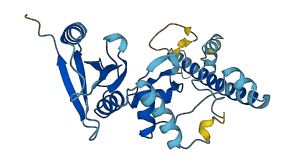
Descriptions
The autoinhibited protein was predicted that may have potential autoinhibitory elements via cis-regPred.
Autoinhibitory domains (AIDs)
Target domain |
|
Relief mechanism |
|
Assay |
cis-regPred |
Accessory elements
No accessory elements
Autoinhibited structure

Activated structure
1 structures for P39707
| Entry ID | Method | Resolution | Chain | Position | Source |
|---|---|---|---|---|---|
| AF-P39707-F1 | Predicted | AlphaFoldDB |
7 variants for P39707
| Variant ID(s) | Position | Change | Description | Diseaes Association | Provenance |
|---|---|---|---|---|---|
| s01-159101 | 45 | L>F | No | SGRP | |
| s01-159165 | 67 | D>H | No | SGRP | |
| s01-159226 | 87 | D>A | No | SGRP | |
| s01-159350 | 128 | K>N | No | SGRP | |
| s01-159370 | 135 | L>P | No | SGRP | |
| s01-159468 | 168 | D>N | No | SGRP | |
| s01-159528 | 188 | A>P | No | SGRP |
No associated diseases with P39707
1 regional properties for P39707
| Type | Name | Position | InterPro Accession |
|---|---|---|---|
| domain | tRNA intron endonuclease, catalytic domain-like | 183 - 271 | IPR006677 |
Functions
| Description | ||
|---|---|---|
| EC Number | 4.6.1.16 | Phosphorus-oxygen lyases |
| Subcellular Localization |
|
|
| PANTHER Family | ||
| PANTHER Subfamily | ||
| PANTHER Protein Class | ||
| PANTHER Pathway Category | No pathway information available | |
4 GO annotations of cellular component
| Name | Definition |
|---|---|
| endomembrane system | A collection of membranous structures involved in transport within the cell. The main components of the endomembrane system are endoplasmic reticulum, Golgi bodies, vesicles, cell membrane and nuclear envelope. Members of the endomembrane system pass materials through each other or though the use of vesicles. |
| mitochondrial outer membrane | The outer, i.e. cytoplasm-facing, lipid bilayer of the mitochondrial envelope. |
| mitochondrion | A semiautonomous, self replicating organelle that occurs in varying numbers, shapes, and sizes in the cytoplasm of virtually all eukaryotic cells. It is notably the site of tissue respiration. |
| tRNA-intron endonuclease complex | A protein complex that catalyzes the endonucleolytic cleavage of pre-tRNA, producing 5'-hydroxyl and 2',3'-cyclic phosphate termini, and specifically removing the intron. |
3 GO annotations of molecular function
| Name | Definition |
|---|---|
| lyase activity | Catalysis of the cleavage of C-C, C-O, C-N and other bonds by other means than by hydrolysis or oxidation, or conversely adding a group to a double bond. They differ from other enzymes in that two substrates are involved in one reaction direction, but only one in the other direction. When acting on the single substrate, a molecule is eliminated and this generates either a new double bond or a new ring. |
| nucleic acid binding | Binding to a nucleic acid. |
| tRNA-intron endonuclease activity | Catalysis of the endonucleolytic cleavage of pre-tRNA, producing 5'-hydroxyl and 2',3'-cyclic phosphate termini, and specifically removing the intron. |
1 GO annotations of biological process
| Name | Definition |
|---|---|
| tRNA-type intron splice site recognition and cleavage | RNA processing that begins when the tertiary structure of a tRNA type intron is recognized, and ends when the endonucleolytic cleavage of the RNA at both the 5' and 3' splice sites occurs. |
No homologous proteins in AiPD
| UniProt AC | Gene Name | Protein Name | Species | Evidence Code |
|---|---|---|---|---|
| No homologous proteins | ||||
| 10 | 20 | 30 | 40 | 50 | 60 |
| MPPLVFDIDH | IKLLRKWGIC | GVLSGTLPTA | AQQNVFLSVP | LRLMLEDVLW | LHLNNLADVK |
| 70 | 80 | 90 | 100 | 110 | 120 |
| LIRQEGDEIM | EGITLERGAK | LSKIVNDRLN | KSFEYQRKFK | KDEHIAKLKK | IGRINDKTTA |
| 130 | 140 | 150 | 160 | 170 | 180 |
| EELQRLDKSS | NNDQLIESSL | FIDIANTSMI | LRDIRSDSDS | LSRDDISDLL | FKQYRQAGKM |
| 190 | 200 | 210 | 220 | 230 | 240 |
| QTYFLYKALR | DQGYVLSPGG | RFGGKFIAYP | GDPLRFHSHL | TIQDAIDYHN | EPIDLISMIS |
| 250 | 260 | 270 | |||
| GARLGTTVKK | LWVIGGVAEE | TKETHFFSIE | WAGFG |