P39185
Gene name |
napA |
Protein name |
Periplasmic nitrate reductase |
Names |
|
Species |
Cupriavidus necator (strain ATCC 17699 / DSM 428 / KCTC 22496 / NCIMB 10442 / H16 / Stanier 337) (Ralstonia eutropha) |
KEGG Pathway |
reh:PHG211 |
EC number |
1.9.6.1: With a nitrogenous group as acceptor |
Protein Class |
|
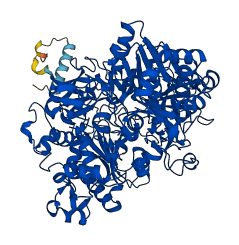
Descriptions
The autoinhibited protein was predicted that may have potential autoinhibitory elements via cis-regPred.
Autoinhibitory domains (AIDs)
Target domain |
|
Relief mechanism |
|
Assay |
cis-regPred |
Accessory elements
No accessory elements
Autoinhibited structure

Activated structure
3 structures for P39185
| Entry ID | Method | Resolution | Chain | Position | Source |
|---|---|---|---|---|---|
| 3ML1 | X-ray | 160 A | A | 30-831 | PDB |
| 3O5A | X-ray | 172 A | A | 30-831 | PDB |
| AF-P39185-F1 | Predicted | AlphaFoldDB |
No variants for P39185
| Variant ID(s) | Position | Change | Description | Diseaes Association | Provenance |
|---|---|---|---|---|---|
| No variants for P39185 | |||||
No associated diseases with P39185
7 regional properties for P39185
| Type | Name | Position | InterPro Accession |
|---|---|---|---|
| conserved_site | Twin-arginine translocation pathway, signal sequence | 1 - 29 | IPR006311 |
| domain | Molybdopterin oxidoreductase | 98 - 571 | IPR006656 |
| domain | Molybdopterin dinucleotide-binding domain | 717 - 825 | IPR006657 |
| domain | Molybdopterin oxidoreductase, 4Fe-4S domain | 41 - 97 | IPR006963 |
| conserved_site | Twin-arginine translocation pathway, signal sequence, bacterial/archaeal | 3 - 26 | IPR019546 |
| binding_site | Molybdopterin oxidoreductase, molybdopterin cofactor binding site | 46 - 64 | IPR027467 |
| domain | Nitrate reductase NapA-like, molybdopterin-binding domain | 714 - 831 | IPR041957 |
Functions
| Description | ||
|---|---|---|
| EC Number | 1.9.6.1 | With a nitrogenous group as acceptor |
| Subcellular Localization |
|
|
| PANTHER Family | ||
| PANTHER Subfamily | ||
| PANTHER Protein Class | ||
| PANTHER Pathway Category | No pathway information available | |
1 GO annotations of cellular component
| Name | Definition |
|---|---|
| periplasmic space | The region between the inner (cytoplasmic) and outer membrane (Gram-negative Bacteria) or cytoplasmic membrane and cell wall (Fungi and Gram-positive Bacteria). |
7 GO annotations of molecular function
| Name | Definition |
|---|---|
| 4 iron, 4 sulfur cluster binding | Binding to a 4 iron, 4 sulfur (4Fe-4S) cluster; this cluster consists of four iron atoms, with the inorganic sulfur atoms found between the irons and acting as bridging ligands. |
| electron transfer activity | Any molecular entity that serves as an electron acceptor and electron donor in an electron transport chain. An electron transport chain is a process in which a series of electron carriers operate together to transfer electrons from donors to any of several different terminal electron acceptors to generate a transmembrane electrochemical gradient. |
| iron ion binding | Binding to an iron (Fe) ion. |
| molybdenum ion binding | Binding to a molybdenum ion (Mo). |
| molybdopterin cofactor binding | Binding to a molybdopterin cofactor (Moco), essential for the catalytic activity of some enzymes, e.g. sulfite oxidase, xanthine dehydrogenase, and aldehyde oxidase. The cofactor consists of a mononuclear molybdenum (Mo-molybdopterin) or tungsten ion (W-molybdopterin) coordinated by one or two molybdopterin ligands. |
| nitrate reductase (cytochrome) activity | Catalysis of the reaction: ferrocytochrome + nitrate = ferricytochrome + nitrite. |
| nitrate reductase activity | Catalysis of the reaction: nitrite + acceptor = nitrate + reduced acceptor. |
2 GO annotations of biological process
| Name | Definition |
|---|---|
| Mo-molybdopterin cofactor biosynthetic process | The chemical reactions and pathways resulting in the formation of the Mo-molybdopterin cofactor, essential for the catalytic activity of some enzymes. The cofactor consists of a mononuclear molybdenum (Mo) ion coordinated by one or two molybdopterin ligands. |
| nitrate assimilation | The nitrogen metabolic process that encompasses the uptake of nitrate from the environment and reduction to ammonia, and results in the incorporation of nitrogen derived from nitrate into cellular substances. |
No homologous proteins in AiPD
| UniProt AC | Gene Name | Protein Name | Species | Evidence Code |
|---|---|---|---|---|
| No homologous proteins | ||||
| 10 | 20 | 30 | 40 | 50 | 60 |
| MKISRRDFIK | QTAITATASV | AGVTLPAGAA | NFVTDSEVTK | LKWSKAPCRF | CGTGCGVTVA |
| 70 | 80 | 90 | 100 | 110 | 120 |
| VKDNKVVATQ | GDPQAEVNKG | LNCVKGYFLS | KIMYGQDRLT | RPLMRMKNGK | YDKNGDFAPV |
| 130 | 140 | 150 | 160 | 170 | 180 |
| TWDQAFDEME | RQFKRVLKEK | GPTAVGMFGS | GQWTVWEGYA | AAKLYKAGFR | SNNIDPNARH |
| 190 | 200 | 210 | 220 | 230 | 240 |
| CMASAAAGFM | RTFGMDEPMG | CYDDFEAADA | FVLWGSNMAE | MHPILWTRVT | DRRLSHPKTR |
| 250 | 260 | 270 | 280 | 290 | 300 |
| VVVLSTFTHR | CFDLADIGII | FKPQTDLAML | NYIANYIIRN | NKVNKDFVNK | HTVFKEGVTD |
| 310 | 320 | 330 | 340 | 350 | 360 |
| IGYGLRPDHP | LQKAAKNASD | PGAAKVITFD | EFAKFVSKYD | ADYVSKLSAV | PKAKLDQLAE |
| 370 | 380 | 390 | 400 | 410 | 420 |
| LYADPNIKVM | SLWTMGFNQH | TRGTWANNMV | YNLHLLTGKI | ATPGNSPFSL | TGQPSACGTA |
| 430 | 440 | 450 | 460 | 470 | 480 |
| REVGTFSHRL | PADMVVTNPK | HREEAERIWK | LPPGTIPDKP | GYDAVLQNRM | LKDGKLNAYW |
| 490 | 500 | 510 | 520 | 530 | 540 |
| VQVNNNMQAA | ANLMEEGLPG | YRNPANFIVV | SDAYPTVTAL | AADLVLPSAM | WVEKEGAYGN |
| 550 | 560 | 570 | 580 | 590 | 600 |
| AERRTQFWHQ | LVDAPGEARS | DLWQLVEFAK | RFKVEEVWPP | ELIAKKPEYK | GKTLYDVLYR |
| 610 | 620 | 630 | 640 | 650 | 660 |
| NGQVDKFPLK | DVNAEYHNAE | AKAFGFYLQK | GLFEEYATFG | RGHGHDLAPF | DAYHEARGLR |
| 670 | 680 | 690 | 700 | 710 | 720 |
| WPVVNGKETR | WRYREGSDPY | VKAGTGFQFY | GNPDGKAVIF | ALPYEPPAES | PDKEYPYWLV |
| 730 | 740 | 750 | 760 | 770 | 780 |
| TGRVLEHWHS | GSMTRRVPEL | YRSFPNAVVF | MHPEDAKALG | LRRGVEVEVV | SRRGRMRSRI |
| 790 | 800 | 810 | 820 | 830 | |
| ETRGRDAPPR | GLVFVPWFDA | SQLINKVTLD | ATCPISLQTD | FKKCAVKIVK | V |