P39065
Gene name |
acuA (BSU29690) |
Protein name |
Acetoin utilization protein AcuA |
Names |
Protein acetyltransferase AcuA |
Species |
Bacillus subtilis (strain 168) |
KEGG Pathway |
bsu:BSU29690 |
EC number |
|
Protein Class |
|
Descriptions
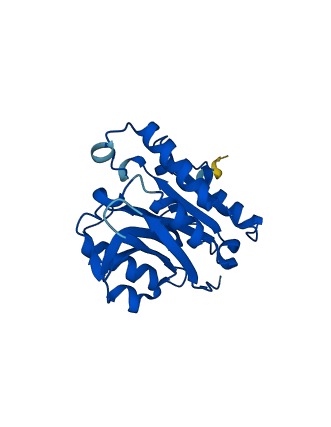
The autoinhibited protein was predicted that may have potential autoinhibitory elements via cis-regPred.
Autoinhibitory domains (AIDs)
Target domain |
|
Relief mechanism |
|
Assay |
cis-regPred |
Accessory elements
No accessory elements
Autoinhibited structure

Activated structure
1 structures for P39065
| Entry ID | Method | Resolution | Chain | Position | Source |
|---|---|---|---|---|---|
| AF-P39065-F1 | Predicted | AlphaFoldDB |
No variants for P39065
| Variant ID(s) | Position | Change | Description | Diseaes Association | Provenance |
|---|---|---|---|---|---|
| No variants for P39065 | |||||
No associated diseases with P39065
1 regional properties for P39065
| Type | Name | Position | InterPro Accession |
|---|---|---|---|
| domain | GNAT domain | 20 - 161 | IPR000182 |
No GO annotations of cellular component
| Name | Definition |
|---|---|
| No GO annotations for cellular component |
2 GO annotations of molecular function
| Name | Definition |
|---|---|
| acetoin dehydrogenase activity | Catalysis of the reaction: acetoin + NAD+ = diacetyl + NADH + H+. |
| acetyl-CoA synthetase acetyltransferase activity | Catalysis of the acetylation of residue Lys609 of the enzyme acetyl-CoA synthetase, using acetyl-CoA as substrate. |
6 GO annotations of biological process
| Name | Definition |
|---|---|
| acetoin catabolic process | The chemical reactions and pathways resulting in the breakdown of acetoin, 3-hydroxy-2-butanone. |
| butanediol catabolic process | The chemical reactions and pathways resulting in the breakdown of butanediol; the biologically relevant isomer is 2,3-butanediol, CH3CH(OH)CH(OH)CH3. |
| carbon catabolite repression of transcription by glucose | A transcription regulation process in which the presence of glucose leads to a decrease in the frequency, rate, or extent of transcription of specific genes involved in the metabolism of other carbon sources. Carbon catabolite repression is a mechanism of genetic regulation which the accumulation of catabolites of one substance in the cell represses the formation of enzymes that contribute to the catabolism of other substances. |
| cellular response to acetate | Any process that results in a change in state or activity of a cell (in terms of movement, secretion, enzyme production, gene expression, etc.) as a result of an acetate stimulus. |
| spore germination | The physiological and developmental changes that occur in a spore following release from dormancy up to the earliest signs of growth (e.g. emergence from a spore wall). |
| sporulation resulting in formation of a cellular spore | The process in which a relatively unspecialized cell acquires the specialized features of a cellular spore, a cell form that can be used for dissemination, for survival of adverse conditions because of its heat and dessication resistance, and/or for reproduction. |
No homologous proteins in AiPD
| UniProt AC | Gene Name | Protein Name | Species | Evidence Code |
|---|---|---|---|---|
| No homologous proteins | ||||
| 10 | 20 | 30 | 40 | 50 | 60 |
| MEHHKTYHSA | NIKTATGSLL | IEGPVSPEDL | AGYEFHKDLT | AFRPPREQHE | ALVDIAGLPE |
| 70 | 80 | 90 | 100 | 110 | 120 |
| GRIIIARDGR | TIVGYVTYLY | PDPLERWSEG | NMEDLIELGA | IEVAPDYRGC | AVGKTLLTVS |
| 130 | 140 | 150 | 160 | 170 | 180 |
| MMDEQMENYI | VMTTEYYWHW | DLKGMKKDVW | EYRKIMEKMM | NAGGLVWFAT | DEPEISSHPA |
| 190 | 200 | ||||
| NCLMARIGKN | VSQESIEQFD | RLRFYHRYMY |