P38482
Gene name |
ATP2 |
Protein name |
ATP synthase subunit beta, mitochondrial |
Names |
|
Species |
Chlamydomonas reinhardtii (Chlamydomonas smithii) |
KEGG Pathway |
cre:CHLRE_17g698000v5 |
EC number |
7.1.2.2: Hydron translocation linked to the hydrolysis of a nucleoside triphosphate |
Protein Class |
|
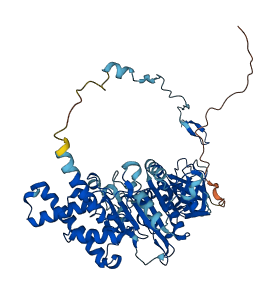
Descriptions
The autoinhibited protein was predicted that may have potential autoinhibitory elements via cis-regPred.
Autoinhibitory domains (AIDs)
Target domain |
|
Relief mechanism |
|
Assay |
cis-regPred |
Accessory elements
No accessory elements
Autoinhibited structure

Activated structure
1 structures for P38482
| Entry ID | Method | Resolution | Chain | Position | Source |
|---|---|---|---|---|---|
| AF-P38482-F1 | Predicted | AlphaFoldDB |
No variants for P38482
| Variant ID(s) | Position | Change | Description | Diseaes Association | Provenance |
|---|---|---|---|---|---|
| No variants for P38482 | |||||
No associated diseases with P38482
4 regional properties for P38482
| Type | Name | Position | InterPro Accession |
|---|---|---|---|
| domain | ATPase, F1/V1/A1 complex, alpha/beta subunit, nucleotide-binding domain | 163 - 384 | IPR000194 |
| domain | AAA+ ATPase domain | 175 - 361 | IPR003593 |
| domain | ATPase, F1/V1/A1 complex, alpha/beta subunit, N-terminal domain | 40 - 106 | IPR004100 |
| active_site | ATPase, alpha/beta subunit, nucleotide-binding domain, active site | 375 - 384 | IPR020003 |
Functions
| Description | ||
|---|---|---|
| EC Number | 7.1.2.2 | Hydron translocation linked to the hydrolysis of a nucleoside triphosphate |
| Subcellular Localization |
|
|
| PANTHER Family | ||
| PANTHER Subfamily | ||
| PANTHER Protein Class | ||
| PANTHER Pathway Category | No pathway information available | |
2 GO annotations of cellular component
| Name | Definition |
|---|---|
| mitochondrial inner membrane | The inner, i.e. lumen-facing, lipid bilayer of the mitochondrial envelope. It is highly folded to form cristae. |
| proton-transporting ATP synthase complex, catalytic core F(1) | The sector of a hydrogen-transporting ATP synthase complex in which the catalytic activity resides; it comprises the catalytic core and central stalk, and is peripherally associated with a membrane, such as the plasma membrane or the mitochondrial inner membrane, when the entire ATP synthase is assembled. |
3 GO annotations of molecular function
| Name | Definition |
|---|---|
| ATP binding | Binding to ATP, adenosine 5'-triphosphate, a universally important coenzyme and enzyme regulator. |
| proton-transporting ATP synthase activity, rotational mechanism | Enables the synthesis of ATP from ADP and phosphate by the transfer of protons from one side of a membrane to the other by a rotational mechanism driven by a gradient according to the reaction: ADP + H2O + phosphate + H+(in) -> ATP + H+(out). |
| proton-transporting ATPase activity, rotational mechanism | Enables the transfer of protons from one side of a membrane to the other according to the reaction: ATP + H2O + H+(in) = ADP + phosphate + H+(out), by a rotational mechanism. |
No GO annotations of biological process
| Name | Definition |
|---|---|
| No GO annotations for biological process |
No homologous proteins in AiPD
| UniProt AC | Gene Name | Protein Name | Species | Evidence Code |
|---|---|---|---|---|
| No homologous proteins | ||||
| 10 | 20 | 30 | 40 | 50 | 60 |
| MLSSVRLAAL | RAGKTNSVFQ | AVRAFAAEPA | AAATTDAGFV | SQVIGPVVDV | RFDGELPSIL |
| 70 | 80 | 90 | 100 | 110 | 120 |
| SALEVQGHNV | RLVLEVAQHM | GDNTVRCVAM | DSTDGLVRGQ | KVVNTGSPIK | VPVGRGTLGR |
| 130 | 140 | 150 | 160 | 170 | 180 |
| IMNVIGEPVD | EQGPIECSEV | WSIHREAPEF | TEQSTEQEIL | VTGIKVVDLL | APYQRGGKIG |
| 190 | 200 | 210 | 220 | 230 | 240 |
| LFGGAGVGKT | VLIMELINNV | AKAHGGFSVF | AGVGERTREG | NDLYREMIES | GVIKLGDKRG |
| 250 | 260 | 270 | 280 | 290 | 300 |
| ESKCTLVYGQ | MNEPPGARAR | VALTGLTVAE | YFRDVEGQDV | LLFVDNIFRF | TQANSEVSAL |
| 310 | 320 | 330 | 340 | 350 | 360 |
| LGRIPSAVGY | QPTLATDLGG | LQERITTTTK | GSITSVQAVY | VPADDLTDPA | PATTFAHLDA |
| 370 | 380 | 390 | 400 | 410 | 420 |
| TTVLSRSIAE | LGIYPAVDPL | DSTSRMLNPN | IIGAEHYNIA | RGVQKVLQDY | KNLQDIIAIL |
| 430 | 440 | 450 | 460 | 470 | 480 |
| GMDELSEEDK | LTVARARKIQ | RFLSQPFQVA | EVFTGTPGKY | VDLKDTISAF | TGILQGKYDD |
| 490 | 500 | 510 | 520 | 530 | 540 |
| LPEMAFYMVG | GIHEVVEKAD | KLAKDVAARK | DESKKAKSSE | ALKDVPSLEK | MAGEIKDEVI |
| 550 | 560 | 570 | |||
| DADDSLEEDF | KAEAISSENM | VLNEKGEKVP | LPKK |