P38402
Gene name |
GNAI2 |
Protein name |
Guanine nucleotide-binding protein G(i) subunit alpha-2 |
Names |
Adenylate cyclase-inhibiting G alpha protein |
Species |
Cavia porcellus (Guinea pig) |
KEGG Pathway |
cpoc:100135529 |
EC number |
|
Protein Class |
|
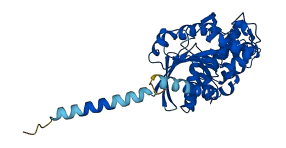
Descriptions
The autoinhibited protein was predicted that may have potential autoinhibitory elements via cis-regPred.
Autoinhibitory domains (AIDs)
Target domain |
|
Relief mechanism |
|
Assay |
cis-regPred |
Accessory elements
No accessory elements
Autoinhibited structure

Activated structure
1 structures for P38402
| Entry ID | Method | Resolution | Chain | Position | Source |
|---|---|---|---|---|---|
| AF-P38402-F1 | Predicted | AlphaFoldDB |
No variants for P38402
| Variant ID(s) | Position | Change | Description | Diseaes Association | Provenance |
|---|---|---|---|---|---|
| No variants for P38402 | |||||
No associated diseases with P38402
No regional properties for P38402
| Type | Name | Position | InterPro Accession |
|---|---|---|---|
| No domain, repeats, and functional sites for P38402 | |||
Functions
9 GO annotations of cellular component
| Name | Definition |
|---|---|
| cell body | The portion of a cell bearing surface projections such as axons, dendrites, cilia, or flagella that includes the nucleus, but excludes all cell projections. |
| centrosome | A structure comprised of a core structure (in most organisms, a pair of centrioles) and peripheral material from which a microtubule-based structure, such as a spindle apparatus, is organized. Centrosomes occur close to the nucleus during interphase in many eukaryotic cells, though in animal cells it changes continually during the cell-division cycle. |
| cytoplasm | The contents of a cell excluding the plasma membrane and nucleus, but including other subcellular structures. |
| cytosol | The part of the cytoplasm that does not contain organelles but which does contain other particulate matter, such as protein complexes. |
| dendrite | A neuron projection that has a short, tapering, morphology. Dendrites receive and integrate signals from other neurons or from sensory stimuli, and conduct nerve impulses towards the axon or the cell body. In most neurons, the impulse is conveyed from dendrites to axon via the cell body, but in some types of unipolar neuron, the impulse does not travel via the cell body. |
| midbody | A thin cytoplasmic bridge formed between daughter cells at the end of cytokinesis. The midbody forms where the contractile ring constricts, and may persist for some time before finally breaking to complete cytokinesis. |
| nucleoplasm | That part of the nuclear content other than the chromosomes or the nucleolus. |
| plasma membrane | The membrane surrounding a cell that separates the cell from its external environment. It consists of a phospholipid bilayer and associated proteins. |
| synapse | The junction between an axon of one neuron and a dendrite of another neuron, a muscle fiber or a glial cell. As the axon approaches the synapse it enlarges into a specialized structure, the presynaptic terminal bouton, which contains mitochondria and synaptic vesicles. At the tip of the terminal bouton is the presynaptic membrane; facing it, and separated from it by a minute cleft (the synaptic cleft) is a specialized area of membrane on the receiving cell, known as the postsynaptic membrane. In response to the arrival of nerve impulses, the presynaptic terminal bouton secretes molecules of neurotransmitters into the synaptic cleft. These diffuse across the cleft and transmit the signal to the postsynaptic membrane. |
4 GO annotations of molecular function
| Name | Definition |
|---|---|
| G-protein beta/gamma-subunit complex binding | Binding to a complex of G-protein beta/gamma subunits. |
| GTP binding | Binding to GTP, guanosine triphosphate. |
| GTPase activity | Catalysis of the reaction: GTP + H2O = GDP + H+ + phosphate. |
| metal ion binding | Binding to a metal ion. |
6 GO annotations of biological process
| Name | Definition |
|---|---|
| adenylate cyclase-inhibiting G protein-coupled receptor signaling pathway | A G protein-coupled receptor signaling pathway in which the signal is transmitted via the inhibition of adenylyl cyclase activity and a subsequent decrease in the intracellular concentration of cyclic AMP (cAMP). |
| cell cycle | The progression of biochemical and morphological phases and events that occur in a cell during successive cell replication or nuclear replication events. Canonically, the cell cycle comprises the replication and segregation of genetic material followed by the division of the cell, but in endocycles or syncytial cells nuclear replication or nuclear division may not be followed by cell division. |
| cell division | The process resulting in division and partitioning of components of a cell to form more cells; may or may not be accompanied by the physical separation of a cell into distinct, individually membrane-bounded daughter cells. |
| cell population proliferation | The multiplication or reproduction of cells, resulting in the expansion of a cell population. |
| G protein-coupled acetylcholine receptor signaling pathway | A G protein-coupled receptor signaling pathway initiated by a ligand binding to an acetylcholine receptor on the surface of a target cell, and ends with regulation of a downstream cellular process, e.g. transcription. |
| positive regulation of cell population proliferation | Any process that activates or increases the rate or extent of cell proliferation. |
No homologous proteins in AiPD
| UniProt AC | Gene Name | Protein Name | Species | Evidence Code |
|---|---|---|---|---|
| No homologous proteins | ||||
| 10 | 20 | 30 | 40 | 50 | 60 |
| MGCTVSAEDK | AAAERSKMID | KNLREDGEKA | AREVKLLLLG | AGESGKSTIV | KQMKIIHEDG |
| 70 | 80 | 90 | 100 | 110 | 120 |
| YSEEECRQYR | AVVYSNTIQS | IMAIVKAMGN | LQIDFADPLR | ADDARQLFAL | SCTAEEQGML |
| 130 | 140 | 150 | 160 | 170 | 180 |
| PEDLSGVIRR | LWADHGVQAC | FSRSREYQLN | DSAAYYLNDL | DRIAQSDYIP | TQQDVLRTRV |
| 190 | 200 | 210 | 220 | 230 | 240 |
| KTTGIVETHF | TFKDLHFKMF | DVGGQRSERK | KWIHCFEGVT | AIIFCVALSA | YDLVLAEDEE |
| 250 | 260 | 270 | 280 | 290 | 300 |
| MNRMHESMKL | FDSICNNKWF | TDTSIILFLN | KKDLFEEKIT | HSPLTICFPE | YTGANKYDEA |
| 310 | 320 | 330 | 340 | 350 | |
| ASYIQSKFED | LNKRKDTKEI | YTHFTCATDT | KNVQFVFDAV | TDVIIKNNLK | DCGLF |