P38316
Gene name |
ATG12 (APG12, YBR217W, YBR1506) |
Protein name |
Ubiquitin-like protein ATG12 |
Names |
Autophagy-related protein 12 |
Species |
Saccharomyces cerevisiae (strain ATCC 204508 / S288c) (Baker's yeast) |
KEGG Pathway |
sce:YBR217W |
EC number |
|
Protein Class |
|
Descriptions
The autoinhibited protein was predicted that may have potential autoinhibitory elements via cis-regPred.
Autoinhibitory domains (AIDs)
Target domain |
|
Relief mechanism |
|
Assay |
cis-regPred |
Accessory elements
No accessory elements
Autoinhibited structure

Activated structure
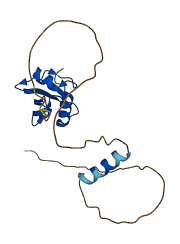
2 structures for P38316
| Entry ID | Method | Resolution | Chain | Position | Source |
|---|---|---|---|---|---|
| 3W1S | X-ray | 260 A | C | 100-186 | PDB |
| AF-P38316-F1 | Predicted | AlphaFoldDB |
7 variants for P38316
| Variant ID(s) | Position | Change | Description | Diseaes Association | Provenance |
|---|---|---|---|---|---|
| s02-658052 | 76 | T>A | No | SGRP | |
| s02-658065 | 80 | E>G | No | SGRP | |
| s02-658074 | 83 | I>T | No | SGRP | |
| s02-658238 | 138 | K>E | No | SGRP | |
| s02-658310 | 162 | I>V | No | SGRP | |
| s02-658346 | 174 | E>K | No | SGRP | |
| s02-658347 | 174 | E>V | No | SGRP |
No associated diseases with P38316
Functions
5 GO annotations of cellular component
| Name | Definition |
|---|---|
| Atg12-Atg5-Atg16 complex | A protein complex required for the expansion of the autophagosomal membrane. In budding yeast, this complex consists of Atg12p, Atg5p and Atg16p. |
| cytosol | The part of the cytoplasm that does not contain organelles but which does contain other particulate matter, such as protein complexes. |
| phagophore assembly site | Punctate structures proximal to the endoplasmic reticulum which are the sites where the Atg machinery assembles upon autophagy induction. |
| phagophore assembly site membrane | A cellular membrane associated with the phagophore assembly site. |
| transferase complex | A protein complex capable of catalyzing the transfer of a group, e.g. a methyl group, glycosyl group, acyl group, phosphorus-containing, or other groups, from one compound (generally regarded as the donor) to another compound (generally regarded as the acceptor). |
2 GO annotations of molecular function
| Name | Definition |
|---|---|
| enzyme activator activity | Binds to and increases the activity of an enzyme. |
| protein tag | A molecular function exhibited by a protein that is covalently attached (AKA tagged or conjugated) to another protein where it acts as a marker, recognized by the cellular apparatus to target the tagged protein for some cellular process such as modification, sequestration, transport or degradation. |
10 GO annotations of biological process
| Name | Definition |
|---|---|
| autophagosome assembly | The formation of a double membrane-bounded structure, the autophagosome, that occurs when a specialized membrane sac, called the isolation membrane, starts to enclose a portion of the cytoplasm. |
| autophagy of mitochondrion | The autophagic process in which mitochondria are delivered to a type of vacuole and degraded in response to changing cellular conditions. |
| autophagy of nucleus | A form of autophagy, by which damaged or non-essential parts of the nucleus, or even an entire nucleus is degraded. |
| C-terminal protein lipidation | The covalent attachment of a lipid group to the carboxy-terminus of a protein. |
| cytoplasm to vacuole transport by the Cvt pathway | A cytoplasm to vacuole targeting pathway that uses machinery common with autophagy. The Cvt vesicle is formed when the receptor protein, Atg19, binds to the complexes of the target protein (aminopeptidase or alpha-mannosidase homododecamers), forming the Cvt complex. Atg11 binds to Atg9 and transports the Cvt complex to the pre-autophagosome (PAS). The phagophore membrane expands around the Cvt complex (excluding bulk cytoplasm) forming the Cvt vesicle. This pathway is mostly observed in yeast. |
| late nucleophagy | A type of nucleophagy, distinct from piecemeal microautophagy of the nucleus (PNM) where the nuclear material is delivered to the vacuole/lysosome for breakdown and recycling later than observed for PNM. |
| macroautophagy | The major inducible pathway for the general turnover of cytoplasmic constituents in eukaryotic cells, it is also responsible for the degradation of active cytoplasmic enzymes and organelles during nutrient starvation. Macroautophagy involves the formation of double-membrane-bounded autophagosomes which enclose the cytoplasmic constituent targeted for degradation in a membrane-bounded structure. Autophagosomes then fuse with a lysosome (or vacuole) releasing single-membrane-bounded autophagic bodies that are then degraded within the lysosome (or vacuole). Some types of macroautophagy, e.g. pexophagy, mitophagy, involve selective targeting of the targets to be degraded. |
| piecemeal microautophagy of the nucleus | Degradation of a cell nucleus by lysosomal microautophagy. |
| protein lipidation | The covalent attachment of lipid groups to an amino acid in a protein. |
| protein lipidation involved in autophagosome assembly | The protein lipidation process by which phosphatidylethanolamine is conjugated to a protein of the ATG8 family, leading to membrane insertion of the protein as a step in autophagosome assembly. |
No homologous proteins in AiPD
| UniProt AC | Gene Name | Protein Name | Species | Evidence Code |
|---|---|---|---|---|
| No homologous proteins | ||||
| 10 | 20 | 30 | 40 | 50 | 60 |
| MSRILESENE | TESDESSIIS | TNNGTAMERS | RNNQELRSSP | HTVQNRLELF | SRRLSQLGLA |
| 70 | 80 | 90 | 100 | 110 | 120 |
| SDISVDQQVE | DSSSGTYEQE | ETIKTNAQTS | KQKSHKDEKN | IQKIQIKFQP | IGSIGQLKPS |
| 130 | 140 | 150 | 160 | 170 | 180 |
| VCKISMSQSF | AMVILFLKRR | LKMDHVYCYI | NNSFAPSPQQ | NIGELWMQFK | TNDELIVSYC |
| ASVAFG |