P38287
Gene name |
CSH1 |
Protein name |
Mannosyl phosphorylinositol ceramide synthase CSH1 |
Names |
CSG1/SUR1 homolog 1 |
Species |
Saccharomyces cerevisiae (strain ATCC 204508 / S288c) (Baker's yeast) |
KEGG Pathway |
sce:YBR161W |
EC number |
2.4.1.370: Hexosyltransferases |
Protein Class |
|
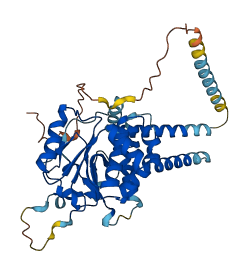
Descriptions
The autoinhibited protein was predicted that may have potential autoinhibitory elements via cis-regPred.
Autoinhibitory domains (AIDs)
Target domain |
|
Relief mechanism |
|
Assay |
cis-regPred |
Accessory elements
No accessory elements
Autoinhibited structure

Activated structure
1 structures for P38287
| Entry ID | Method | Resolution | Chain | Position | Source |
|---|---|---|---|---|---|
| AF-P38287-F1 | Predicted | AlphaFoldDB |
6 variants for P38287
| Variant ID(s) | Position | Change | Description | Diseaes Association | Provenance |
|---|---|---|---|---|---|
| s02-561790 | 54 | F>L | No | SGRP | |
| s02-562291 | 221 | K>N | No | SGRP | |
| s02-562362 | 245 | M>K | No | SGRP | |
| s02-562376 | 250 | F>L | No | SGRP | |
| s02-562506 | 293 | F>Y | No | SGRP | |
| s02-562634 | 336 | R>G | No | SGRP |
1 associated diseases with P38287
[MIM: 609741]: Cataract 22, multiple types (CTRCT22)
An opacification of the crystalline lens of the eye that frequently results in visual impairment or blindness. Opacities vary in morphology, are often confined to a portion of the lens, and may be static or progressive. In general, the more posteriorly located and dense an opacity, the greater the impact on visual function. CTRCT22 includes nuclear cataract among others. Nuclear cataracts affect the central nucleus of the eye, and are often not highly visually significant. The density of the opacities varies greatly from fine dots to a dense, white and chalk-like, central cataract. The condition is usually bilateral. Nuclear cataracts are often combined with opacified cortical fibers encircling the nuclear opacity, which are referred to as cortical riders. {ECO:0000269|PubMed:15914629, ECO:0000269|PubMed:19182255, ECO:0000269|PubMed:23508780}. Note=The disease is caused by variants affecting the gene represented in this entry.
Without disease ID
- An opacification of the crystalline lens of the eye that frequently results in visual impairment or blindness. Opacities vary in morphology, are often confined to a portion of the lens, and may be static or progressive. In general, the more posteriorly located and dense an opacity, the greater the impact on visual function. CTRCT22 includes nuclear cataract among others. Nuclear cataracts affect the central nucleus of the eye, and are often not highly visually significant. The density of the opacities varies greatly from fine dots to a dense, white and chalk-like, central cataract. The condition is usually bilateral. Nuclear cataracts are often combined with opacified cortical fibers encircling the nuclear opacity, which are referred to as cortical riders. {ECO:0000269|PubMed:15914629, ECO:0000269|PubMed:19182255, ECO:0000269|PubMed:23508780}. Note=The disease is caused by variants affecting the gene represented in this entry.
Functions
| Description | ||
|---|---|---|
| EC Number | 2.4.1.370 | Hexosyltransferases |
| Subcellular Localization |
|
|
| PANTHER Family | ||
| PANTHER Subfamily | ||
| PANTHER Protein Class | ||
| PANTHER Pathway Category | No pathway information available | |
5 GO annotations of cellular component
| Name | Definition |
|---|---|
| fungal-type vacuole | A vacuole that has both lytic and storage functions. The fungal vacuole is a large, membrane-bounded organelle that functions as a reservoir for the storage of small molecules (including polyphosphate, amino acids, several divalent cations (e.g. calcium), other ions, and other small molecules) as well as being the primary compartment for degradation. It is an acidic compartment, containing an ensemble of acid hydrolases. At least in S. cerevisiae, there are indications that the morphology of the vacuole is variable and correlated with the cell cycle, with logarithmically growing cells having a multilobed, reticulated vacuole, while stationary phase cells contain a single large structure. |
| Golgi apparatus | A membrane-bound cytoplasmic organelle of the endomembrane system that further processes the core oligosaccharides (e.g. N-glycans) added to proteins in the endoplasmic reticulum and packages them into membrane-bound vesicles. The Golgi apparatus operates at the intersection of the secretory, lysosomal, and endocytic pathways. |
| integral component of membrane | The component of a membrane consisting of the gene products and protein complexes having at least some part of their peptide sequence embedded in the hydrophobic region of the membrane. |
| mannosyltransferase complex | A complex that posseses mannosyltransferase activity. |
| vacuolar membrane | The lipid bilayer surrounding the vacuole and separating its contents from the cytoplasm of the cell. |
2 GO annotations of molecular function
| Name | Definition |
|---|---|
| inositol phosphorylceramide mannosyltransferase activity | Catalysis of the reaction: a 1D-myo-inositol-1-phospho-N-[(R)-2-hydroxy-very-long-chain fatty acyl]-(R)-4-hydroxysphingoid base + GDP-alpha-D-mannose = an alpha-D-mannosyl-(1,6)-1D-myo-inositol-1-phospho-N-[(R)-2-hydroxy-very-long-chain fatty acyl]-(R)-4-hydroxysphingoid base + GDP + H+. |
| mannosyltransferase activity | Catalysis of the transfer of a mannosyl group to an acceptor molecule, typically another carbohydrate or a lipid. |
4 GO annotations of biological process
| Name | Definition |
|---|---|
| glycosphingolipid biosynthetic process | The chemical reactions and pathways resulting in the formation of glycosphingolipid, a compound with residues of sphingoid and at least one monosaccharide. |
| mannosyl diphosphorylinositol ceramide metabolic process | The chemical reactions and pathways involving mannosyl diphosphorylinositol ceramide, any lipid with a phosphodiester bridge between an inositol residue and the ceramide group which contains two phosphoryl (-P(O)=) groups and a mannose derivative. |
| mannosyl-inositol phosphorylceramide biosynthetic process | The chemical reactions and pathways resulting in the formation of mannosyl-inositol phosphorylceramide, any lipid with a phosphodiester bridge between an inositol residue and the ceramide group which contains a phosphoryl (-P(O)=) groups and a mannose derivative. |
| sphingolipid biosynthetic process | The chemical reactions and pathways resulting in the formation of sphingolipids, any of a class of lipids containing the long-chain amine diol sphingosine or a closely related base (a sphingoid). |
No homologous proteins in AiPD
| UniProt AC | Gene Name | Protein Name | Species | Evidence Code |
|---|---|---|---|---|
| No homologous proteins | ||||
| 10 | 20 | 30 | 40 | 50 | 60 |
| MKKELKILII | ANIALLISII | HYTFDLLTLC | IDDTSKDALT | DEQLNPPNGF | NSTFYESPPQ |
| 70 | 80 | 90 | 100 | 110 | 120 |
| LIPKIIHQTY | KTNDIPEQWV | KGRQKCIDLH | PDYTYILWTD | EMSDTFIKQE | YPWFLDTFRS |
| 130 | 140 | 150 | 160 | 170 | 180 |
| YEYPIERADA | IRYFILSHYG | GIYIDLDDGC | ERRLDPLLKV | PAFLRKTSPT | GVSNDVMGSV |
| 190 | 200 | 210 | 220 | 230 | 240 |
| PRHPFFLKVI | KSLKHYKKNW | YIPYMTIMGS | TGPLFISVVW | KQYKRWSNTA | ENGAVRILQP |
| 250 | 260 | 270 | 280 | 290 | 300 |
| ADYKMHNNSF | FSISKGSSWH | TGDANFMKTL | ENHILSCVVT | GFIFGFFILY | GEFTFYTWLC |
| 310 | 320 | 330 | 340 | 350 | 360 |
| SGPFNNKRYY | IQWLSDKFKL | HKWKLTSSYK | NKEKRRNPTR | HEYNSRGKRL | RKDSNIPYDS |
| 370 | |||||
| VFLDIEKNHA | KFTDLT |