P38261
Gene name |
EXO84 (USA3, YBR102C, YBR0831) |
Protein name |
Exocyst complex component EXO84 |
Names |
Exocyst complex protein of 84 kDa, U1 SNP1-associating protein 3 |
Species |
Saccharomyces cerevisiae (strain ATCC 204508 / S288c) (Baker's yeast) |
KEGG Pathway |
sce:YBR102C |
EC number |
|
Protein Class |
|
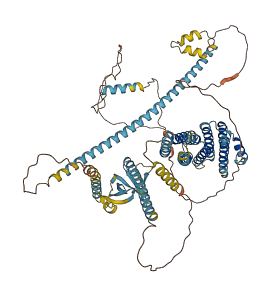
Descriptions
The autoinhibited protein was predicted that may have potential autoinhibitory elements via cis-regPred.
Autoinhibitory domains (AIDs)
Target domain |
|
Relief mechanism |
|
Assay |
cis-regPred |
Accessory elements
No accessory elements
Autoinhibited structure

Activated structure
4 structures for P38261
| Entry ID | Method | Resolution | Chain | Position | Source |
|---|---|---|---|---|---|
| 2D2S | X-ray | 285 A | A | 523-753 | PDB |
| 5YFP | EM | 440 A | H | 1-753 | PDB |
| 6VKL | EM | 440 A | H | 1-753 | PDB |
| AF-P38261-F1 | Predicted | AlphaFoldDB |
5 variants for P38261
| Variant ID(s) | Position | Change | Description | Diseaes Association | Provenance |
|---|---|---|---|---|---|
| s02-447236 | 28 | T>A | No | SGRP | |
| s02-447019 | 100 | I>T | No | SGRP | |
| s02-446465 | 285 | V>I | No | SGRP | |
| s02-446401 | 306 | L>R | No | SGRP | |
| s02-446149 | 390 | F>C | No | SGRP |
No associated diseases with P38261
7 regional properties for P38261
| Type | Name | Position | InterPro Accession |
|---|---|---|---|
| domain | FERM domain | 1 - 279 | IPR000299 |
| domain | Zinc finger, RING-type | 387 - 422 | IPR001841 |
| domain | FERM, N-terminal | 5 - 67 | IPR018979 |
| domain | FERM, C-terminal PH-like domain | 194 - 283 | IPR018980 |
| domain | FERM central domain | 84 - 190 | IPR019748 |
| domain | Band 4.1 domain | 1 - 190 | IPR019749 |
| domain | MYLIP, FERM domain C-lobe | 185 - 295 | IPR041790 |
Functions
7 GO annotations of cellular component
| Name | Definition |
|---|---|
| cellular bud neck | The constriction between the mother cell and daughter cell (bud) in an organism that reproduces by budding. |
| cellular bud tip | The end of a cellular bud distal to the site of attachment to the mother cell. |
| exocyst | A protein complex peripherally associated with the plasma membrane that determines where vesicles dock and fuse. At least eight complex components are conserved between yeast and mammals. |
| incipient cellular bud site | The portion of the budding yeast plasma membrane where a daughter cell will emerge. The yeast marks this spot with bud-site selection proteins before bud emergence occurs. Actin is polarized to this spot just prior to and during bud emergence. |
| mating projection tip | The apex of the mating projection in unicellular fungi exposed to mating pheromone; site of polarized growth. |
| prospore membrane | The prospore membrane is a double-membraned structure that extends from the cytoplasmic face of the spindle pole bodies to encompass the spindle pole bodies and the four nuclear lobes that are formed during meiosis. It helps isolate the meiotic nuclei from the cytoplasm during spore formation and serves as a foundation for the formation of the spore walls. An example of this component is found in Schizosaccharomyces pombe. |
| transport vesicle | Any of the vesicles of the constitutive secretory pathway, which carry cargo from the endoplasmic reticulum to the Golgi, between Golgi cisternae, from the Golgi to the ER (retrograde transport) or to destinations within or outside the cell. |
No GO annotations of molecular function
| Name | Definition |
|---|---|
| No GO annotations for molecular function |
9 GO annotations of biological process
| Name | Definition |
|---|---|
| exocyst assembly | The aggregation, arrangement and bonding together of various polypeptides into the exocyst complex. |
| exocyst localization | Any process in which an exocyst is transported to, or maintained in, a specific location. An exocyst is a protein complex peripherally associated with the plasma membrane that determines where vesicles dock and fuse. |
| exocytosis | A process of secretion by a cell that results in the release of intracellular molecules (e.g. hormones, matrix proteins) contained within a membrane-bounded vesicle. Exocytosis can occur either by full fusion, when the vesicle collapses into the plasma membrane, or by a kiss-and-run mechanism that involves the formation of a transient contact, a pore, between a granule (for exemple of chromaffin cells) and the plasma membrane. The latter process most of the time leads to only partial secretion of the granule content. Exocytosis begins with steps that prepare vesicles for fusion with the membrane (tethering and docking) and ends when molecules are secreted from the cell. |
| Golgi to plasma membrane transport | The directed movement of substances from the Golgi to the plasma membrane in transport vesicles that move from the trans-Golgi network to the plasma membrane, where they fuse and release their contents by exocytosis. |
| protein localization | Any process in which a protein is transported to, or maintained in, a specific location. |
| protein transport | The directed movement of proteins into, out of or within a cell, or between cells, by means of some agent such as a transporter or pore. |
| spliceosomal complex assembly | The aggregation, arrangement and bonding together of a spliceosomal complex, a ribonucleoprotein apparatus that catalyzes nuclear mRNA splicing via transesterification reactions. |
| vesicle docking involved in exocytosis | The initial attachment of a vesicle membrane to a target membrane, mediated by proteins protruding from the membrane of the vesicle and the target membrane, that contributes to exocytosis. |
| vesicle tethering involved in exocytosis | The initial, indirect interaction between a secretory vesicle membrane and a site of exocytosis in the plasma membrane. This interaction is mediated by tethering factors (or complexes), which interact with both membranes. Interaction can occur via direct binding to membrane phospholipids or membrane proteins, or via binding to vesicle coat proteins. This process is distinct from and prior to docking and fusion. |
No homologous proteins in AiPD
| UniProt AC | Gene Name | Protein Name | Species | Evidence Code |
|---|---|---|---|---|
| No homologous proteins | ||||
| 10 | 20 | 30 | 40 | 50 | 60 |
| MVEFSLKKAR | NNWKHVKKSA | SSPAKQKTPP | SPAKPKQKTK | KNPYSDLKDP | ATSYTLPTIN |
| 70 | 80 | 90 | 100 | 110 | 120 |
| ARERSRVATS | MQRRLSIHNT | NYAPPTLDYS | MPLPDMPNMI | VPNDNVDSSH | NNSSFTTENE |
| 130 | 140 | 150 | 160 | 170 | 180 |
| SVSSKGPSNS | LNLSTADLSL | NDSSYNKVPA | RSAMRNTVNP | SGSNDPFNNS | TSLRKMLANP |
| 190 | 200 | 210 | 220 | 230 | 240 |
| HFNAKDFVHD | KLGNASAITI | DKFTSNLTDL | SIQVQEEVKL | NINKSYNEIM | TVNNDLNVAM |
| 250 | 260 | 270 | 280 | 290 | 300 |
| LELKRVRANI | NDLNEVLDQC | TKIAEKRLQL | QDQIDQERQG | NFNNVESHSN | SPALLPPLKA |
| 310 | 320 | 330 | 340 | 350 | 360 |
| GQNGNLMRRD | RSSVLILEKF | WDTELDQLFK | NVEGAQKFIN | STKGRHILMN | SANWMELNTT |
| 370 | 380 | 390 | 400 | 410 | 420 |
| TGKPLQMVQI | FILNDLVLIA | DKSRDKQNDF | IVSQCYPLKD | VTVTQEEFST | KRLLFKFSNS |
| 430 | 440 | 450 | 460 | 470 | 480 |
| NSSLYECRDA | DECSRLLDVI | RKAKDDLCDI | FHVEEENSKR | IRESFRYLQS | TQQTPGRENN |
| 490 | 500 | 510 | 520 | 530 | 540 |
| RSPNKNKRRS | MGGSITPGRN | VTGAMDQYLL | QNLTLSMHSR | PRSRDMSSTA | QRLKFLDEGV |
| 550 | 560 | 570 | 580 | 590 | 600 |
| EEIDIELARL | RFESAVETLL | DIESQLEDLS | ERISDEELML | LNLISLKIEQ | RREAISSKLS |
| 610 | 620 | 630 | 640 | 650 | 660 |
| QSILSSNEIV | HLKSGTENMI | KLGLPEQALD | LFLQNRSNFI | QDLILQIGSV | DNPTNYLTQL |
| 670 | 680 | 690 | 700 | 710 | 720 |
| AVIRFQTIKK | TVEDFQDIFK | ELGAKISSIL | VDWCSDEVDN | HFKLIDKQLL | NDEMLSPGSI |
| 730 | 740 | 750 | |||
| KSSRKQIDGL | KAVGLDFVYK | LDEFIKKNSD | KIR |