P38094
Gene name |
fluG (acoD, AN4819) |
Protein name |
Protein fluG |
Names |
|
Species |
Emericella nidulans (strain FGSC A4 / ATCC 38163 / CBS 112.46 / NRRL 194 / M139) (Aspergillus nidulans) |
KEGG Pathway |
ani:AN4819.2 |
EC number |
|
Protein Class |
|
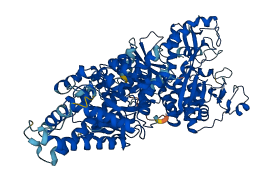
Descriptions
The autoinhibited protein was predicted that may have potential autoinhibitory elements via cis-regPred.
Autoinhibitory domains (AIDs)
Target domain |
|
Relief mechanism |
|
Assay |
cis-regPred |
Accessory elements
No accessory elements
Autoinhibited structure

Activated structure
1 structures for P38094
| Entry ID | Method | Resolution | Chain | Position | Source |
|---|---|---|---|---|---|
| AF-P38094-F1 | Predicted | AlphaFoldDB |
No variants for P38094
| Variant ID(s) | Position | Change | Description | Diseaes Association | Provenance |
|---|---|---|---|---|---|
| No variants for P38094 | |||||
No associated diseases with P38094
1 GO annotations of cellular component
| Name | Definition |
|---|---|
| cytoplasm | The contents of a cell excluding the plasma membrane and nucleus, but including other subcellular structures. |
1 GO annotations of molecular function
| Name | Definition |
|---|---|
| hydrolase activity | Catalysis of the hydrolysis of various bonds, e.g. C-O, C-N, C-C, phosphoric anhydride bonds, etc. |
10 GO annotations of biological process
| Name | Definition |
|---|---|
| autolysis | A programmed cell death process observed in bacteria and filamentous fungi and leading to spontaneous death by lysis. Examples are lysis of the mother cell during sporulation of Bacillus subtilis and self-degradation of fungal cells in Aspergillus nidulans. Autolysis is also involved in bacterial biofilm formation. |
| conidium formation | The process of producing non-motile spores, called conidia, via mitotic asexual reproduction in higher fungi. Conidia are haploid cells genetically identical to their haploid parent. They are produced by conversion of hyphal elements, or are borne on sporogenous cells on or within specialized structures termed conidiophores, and participate in dispersal of the fungus. |
| nitrogen compound metabolic process | The chemical reactions and pathways involving organic or inorganic compounds that contain nitrogen. |
| positive regulation of conidium formation | Any process that activates, maintains or increases the frequency, rate or extent of conidium formation, a process of producing non-motile spores, called conidia, via mitotic asexual reproduction in higher fungi. Conidia are haploid cells genetically identical to their haploid parent. They are produced by conversion of hyphal elements, or are borne on sporogenous cells on or within specialized structures termed conidiophores, and participate in dispersal of the fungus. |
| positive regulation of sterigmatocystin biosynthetic process | Any process that increases the rate, frequency, or extent of sterigmatocystin biosynthesis. Sterigmatocystin biosynthetic processes are the chemical reactions and pathways resulting in the formation of sterigmatocystin, a carcinogenic mycotoxin produced in high yields by strains of the common molds. |
| regulation of secondary metabolite biosynthetic process | Any process that modulates the frequency, rate or extent of secondary metabolite biosynthetic process. |
| regulation of sterigmatocystin biosynthetic process | Any process that modulates the rate, frequency, or extent of sterigmatocystin biosynthesis. Sterigmatocystin biosynthetic processes are the chemical reactions and pathways resulting in the formation of sterigmatocystin, a carcinogenic mycotoxin produced in high yields by strains of the common molds. |
| sporocarp development involved in asexual reproduction | The formation of a spore-bearing structure by fungus where spores will arise from asexual reproduction. |
| sporulation resulting in formation of a cellular spore | The process in which a relatively unspecialized cell acquires the specialized features of a cellular spore, a cell form that can be used for dissemination, for survival of adverse conditions because of its heat and dessication resistance, and/or for reproduction. |
| sterigmatocystin biosynthetic process | The chemical reactions and pathways resulting in the formation of sterigmatocystin, a carcinogenic mycotoxin produced in high yields by strains of the common molds. |
No homologous proteins in AiPD
| UniProt AC | Gene Name | Protein Name | Species | Evidence Code |
|---|---|---|---|---|
| No homologous proteins | ||||
| 10 | 20 | 30 | 40 | 50 | 60 |
| MATLSSLRHL | IQTHPLIDNH | AHNLLSQSAA | CKYAKYPFEQ | IISEAQGVAL | ANAPSTLSFH |
| 70 | 80 | 90 | 100 | 110 | 120 |
| RAASQLATLY | QSSSSDWDSV | RAARDQSVQR | DYEGLIRKCL | EGTQVLLLDD | LLTENDVELF |
| 130 | 140 | 150 | 160 | 170 | 180 |
| DWHDRFTASA | TKRIVRIEAL | AASVLSQIVH | GGPVPQDSSD | LSAFQTLWES | FSRNFSALVS |
| 190 | 200 | 210 | 220 | 230 | 240 |
| DAIADPAVVG | FKSVICYRTG | LDVQPTDDRD | TERLIRSFAR | TISQAAVSTP | RVEDKPLNDW |
| 250 | 260 | 270 | 280 | 290 | 300 |
| LVRQTLNLLK | AAKVTQPNKP | LQLHTGLGDN | DINLLKSNPA | HLQSLIAQYP | EVDFVLLHSS |
| 310 | 320 | 330 | 340 | 350 | 360 |
| YPYTREAGYL | ACVYPNVYLD | LGEVFPMVSR | DAQESILRES | LEIVPSTRLL | WSTDGHFFPE |
| 370 | 380 | 390 | 400 | 410 | 420 |
| TFWLANRQFR | DALEKVFVDY | VQNGDYTIEQ | AMQAAADILF | HNSNRLYELN | EQPPSAALSS |
| 430 | 440 | 450 | 460 | 470 | 480 |
| GHQTVSRISS | TDLLEKFIRS | NPGVKYVWTQ | FIDYTATVRV | RMFPVMEFAK | IVRKQRRLGI |
| 490 | 500 | 510 | 520 | 530 | 540 |
| SMATFWMLQD | DEVVGGSTTG | QFYLIPDLST | LSPNVGIDSK | SATVMTWWKS | EQGESLEECP |
| 550 | 560 | 570 | 580 | 590 | 600 |
| RTNLLNINNK | LKDEFGIQAT | CGFEIEVVFL | KPTTDPSTGE | EDWAPSVTNH | SWSQMTRETR |
| 610 | 620 | 630 | 640 | 650 | 660 |
| RMLPLLEEIA | ETLASIGIHL | QQFHAESAPG | QFEFILPPDN | PVAAVDTLIK | SRQVIANIVE |
| 670 | 680 | 690 | 700 | 710 | 720 |
| KHGLRATLYP | RPYPSAAGTA | SHAHVSISPS | TKEESFLAGV | LQHYPAVLAF | TLSGDASYDR |
| 730 | 740 | 750 | 760 | 770 | 780 |
| VKSGIWAGSE | WVTWGTQNRE | APIRKISPGH | WEIKSLDGLA | NMYLAMAAFL | AAGYTGVKEN |
| 790 | 800 | 810 | 820 | 830 | 840 |
| LPLTIKDCPY | DAASLPESER | AALGITTKLP | NTLAKSLAAL | ESDEILRSLL | GENLVEDYII |
| 850 | 860 | ||||
| VKRAESKKLS | AMDEKARRKW | LVERY |