P37958
Gene name |
mecA (BSU11520) |
Protein name |
Adapter protein MecA 1 |
Names |
|
Species |
Bacillus subtilis (strain 168) |
KEGG Pathway |
bsu:BSU11520 |
EC number |
|
Protein Class |
|
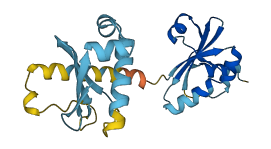
Descriptions
The autoinhibited protein was predicted that may have potential autoinhibitory elements via cis-regPred.
Autoinhibitory domains (AIDs)
Target domain |
|
Relief mechanism |
|
Assay |
cis-regPred |
Accessory elements
No accessory elements
Autoinhibited structure

Activated structure
9 structures for P37958
| Entry ID | Method | Resolution | Chain | Position | Source |
|---|---|---|---|---|---|
| 2Y1R | X-ray | 260 A | I/J/K/L/M/N/O/P | 121-218 | PDB |
| 3J3R | EM | 940 A | 1/2/3/4/5/6 | 1-218 | PDB |
| 3J3S | EM | 1100 A | 1/2/3/4/5/6 | 1-218 | PDB |
| 3J3T | EM | 900 A | 1/2/3/4/5/6 | 1-218 | PDB |
| 3J3U | EM | 1000 A | 1/2/3/4/5/6 | 1-218 | PDB |
| 3JTP | X-ray | 217 A | A/B/C/D | 121-218 | PDB |
| 3PXG | X-ray | 365 A | a/b/c/d/e/f | 121-218 | PDB |
| 3PXI | X-ray | 693 A | a/b/c | 108-218 | PDB |
| AF-P37958-F1 | Predicted | AlphaFoldDB |
No variants for P37958
| Variant ID(s) | Position | Change | Description | Diseaes Association | Provenance |
|---|---|---|---|---|---|
| No variants for P37958 | |||||
No associated diseases with P37958
No regional properties for P37958
| Type | Name | Position | InterPro Accession |
|---|---|---|---|
| No domain, repeats, and functional sites for P37958 | |||
No GO annotations of cellular component
| Name | Definition |
|---|---|
| No GO annotations for cellular component |
1 GO annotations of molecular function
| Name | Definition |
|---|---|
| protein-macromolecule adaptor activity | The binding activity of a protein that brings together two or more macromolecules in contact, permitting those molecules to function in a coordinated way. The adaptor can bring together two proteins, or a protein and another macromolecule such as a lipid or a nucleic acid. |
4 GO annotations of biological process
| Name | Definition |
|---|---|
| establishment of competence for transformation | The process in which a naturally transformable bacterium acquires the ability to take up exogenous DNA. This term should be applied only to naturally transformable bacteria, and should not be used in the context of artificially induced bacterial transformation. |
| negative regulation of establishment of competence for transformation | Any process that stops, prevents, or reduces the frequency, rate or extent of establishment of competence for transformation. |
| negative regulation of sporulation resulting in formation of a cellular spore | Any process that stops, prevents, or reduces the frequency, rate or extent of sporulation. |
| sporulation resulting in formation of a cellular spore | The process in which a relatively unspecialized cell acquires the specialized features of a cellular spore, a cell form that can be used for dissemination, for survival of adverse conditions because of its heat and dessication resistance, and/or for reproduction. |
No homologous proteins in AiPD
| UniProt AC | Gene Name | Protein Name | Species | Evidence Code |
|---|---|---|---|---|
| No homologous proteins | ||||
| 10 | 20 | 30 | 40 | 50 | 60 |
| MEIERINEHT | VKFYMSYGDI | EDRGFDREEI | WYNRERSEEL | FWEVMDEVHE | EEEFAVEGPL |
| 70 | 80 | 90 | 100 | 110 | 120 |
| WIQVQALDKG | LEIIVTKAQL | SKDGQKLELP | IPEDKKQEPA | SEDLDALLDD | FQKEEQAVNQ |
| 130 | 140 | 150 | 160 | 170 | 180 |
| EEKEQKLQFV | LRFGDFEDVI | SLSKLNVNGS | KTTLYSFENR | YYLYVDFCNM | TDEEVENQLS |
| 190 | 200 | 210 | |||
| ILLEYATESS | ISIHRLEEYG | KLIISEHALE | TIKKHFAS |