Descriptions
The autoinhibited protein was predicted that may have potential autoinhibitory elements via cis-regPred.
Autoinhibitory domains (AIDs)
Target domain |
|
Relief mechanism |
|
Assay |
cis-regPred |
Accessory elements
No accessory elements
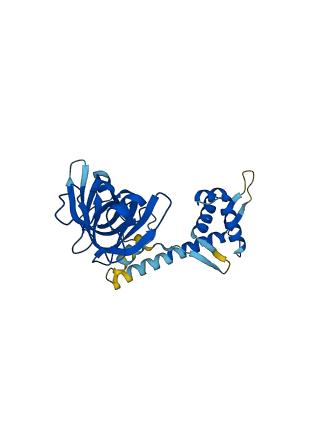
Autoinhibited structure

Activated structure
1 structures for P37733
| Entry ID | Method | Resolution | Chain | Position | Source |
|---|---|---|---|---|---|
| AF-P37733-F1 | Predicted | AlphaFoldDB |
No variants for P37733
| Variant ID(s) | Position | Change | Description | Diseaes Association | Provenance |
|---|---|---|---|---|---|
| No variants for P37733 | |||||
No associated diseases with P37733
6 regional properties for P37733
| Type | Name | Position | InterPro Accession |
|---|---|---|---|
| domain | Transcription regulator HTH, LysR | 24 - 86 | IPR000847 |
| domain | Molybdenum-binding protein ModE, N-terminal | 22 - 110 | IPR003725 |
| domain | Molybdenum-pterin binding domain | 130 - 198 | IPR004606-1 |
| domain | Molybdenum-pterin binding domain | 201 - 268 | IPR004606-2 |
| domain | Transport-associated OB, type 1 | 132 - 195 | IPR005116-1 |
| domain | Transport-associated OB, type 1 | 204 - 266 | IPR005116-2 |
1 GO annotations of cellular component
| Name | Definition |
|---|---|
| protein-containing complex | A stable assembly of two or more macromolecules, i.e. proteins, nucleic acids, carbohydrates or lipids, in which at least one component is a protein and the constituent parts function together. |
2 GO annotations of molecular function
| Name | Definition |
|---|---|
| DNA-binding transcription factor activity | A transcription regulator activity that modulates transcription of gene sets via selective and non-covalent binding to a specific double-stranded genomic DNA sequence (sometimes referred to as a motif) within a cis-regulatory region. Regulatory regions include promoters (proximal and distal) and enhancers. Genes are transcriptional units, and include bacterial operons. |
| molybdenum ion binding | Binding to a molybdenum ion (Mo). |
1 GO annotations of biological process
| Name | Definition |
|---|---|
| molybdate ion transport | The directed movement of molybdate (MoO4 2-) ions into, out of or within a cell, or between cells, by means of some agent such as a transporter or pore. Molybdate is the bivalent anion derived from molybdic acid. |
No homologous proteins in AiPD
| UniProt AC | Gene Name | Protein Name | Species | Evidence Code |
|---|---|---|---|---|
| No homologous proteins | ||||
| 10 | 20 | 30 | 40 | 50 | 60 |
| MTATRFLARM | SLDTDVGTAL | SDTRIRLLEA | IEREGSINRA | AKVVPLSYKA | AWDAIDTMNN |
| 70 | 80 | 90 | 100 | 110 | 120 |
| LAPEPLVVRV | AGGRQGGGTQ | LTDYGRRIVA | MYRALEIEYQ | SALDRLSERL | NEVTGGDIQA |
| 130 | 140 | 150 | 160 | 170 | 180 |
| FQRLMHSMSM | KTSARNQFAG | IVTGLRVGGV | DYEVRIRLDA | ENEIAAVITK | ASAENLELAI |
| 190 | 200 | 210 | 220 | 230 | 240 |
| GKEVFALVKS | SSVMLTTEPS | LKLTARNQLW | GEVIDIHEGP | VNNEVTLALP | SGRSVTCVVT |
| 250 | 260 | ||||
| ADSCKALGLA | PGVAACAFFK | SSSVILAVYG |