P36102
Gene name |
PAN3 |
Protein name |
PAN2-PAN3 deadenylation complex subunit PAN3 |
Names |
PAB1P-dependent poly(A)-specific ribonuclease, Poly(A)-nuclease deadenylation complex subunit 3, PAN deadenylation complex subunit 3 |
Species |
Saccharomyces cerevisiae (strain ATCC 204508 / S288c) (Baker's yeast) |
KEGG Pathway |
sce:YKL025C |
EC number |
|
Protein Class |
|
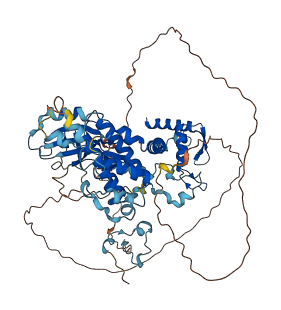
Descriptions
The autoinhibited protein was predicted that may have potential autoinhibitory elements via cis-regPred.
Autoinhibitory domains (AIDs)
Target domain |
|
Relief mechanism |
|
Assay |
cis-regPred |
Accessory elements
No accessory elements
Autoinhibited structure

Activated structure
3 structures for P36102
| Entry ID | Method | Resolution | Chain | Position | Source |
|---|---|---|---|---|---|
| 4CYK | NMR | - | A | 1-41 | PDB |
| 4XR7 | X-ray | 380 A | B/C/E/F/H/I/K/L | 226-679 | PDB |
| AF-P36102-F1 | Predicted | AlphaFoldDB |
14 variants for P36102
| Variant ID(s) | Position | Change | Description | Diseaes Association | Provenance |
|---|---|---|---|---|---|
| s11-391743 | 60 | M>I | No | SGRP | |
| s11-391636 | 96 | N>I | No | SGRP | |
| s11-391614 | 103 | M>I | No | SGRP | |
| s11-391594 | 110 | A>D | No | SGRP | |
| s11-391595 | 110 | A>T | No | SGRP | |
| s11-391592 | 111 | S>A | No | SGRP | |
| s11-391528 | 132 | N>S | No | SGRP | |
| s11-391353 | 190 | D>E | No | SGRP | |
| s11-391355 | 190 | D>N | No | SGRP | |
| s11-390565 | 453 | F>S | No | SGRP | |
| s11-390381 | 514 | D>E | No | SGRP | |
| s11-390322 | 534 | G>V | No | SGRP | |
| s11-390307 | 539 | S>N | No | SGRP | |
| s11-390179 | 582 | V>I | No | SGRP |
No associated diseases with P36102
3 GO annotations of cellular component
| Name | Definition |
|---|---|
| cytoplasm | The contents of a cell excluding the plasma membrane and nucleus, but including other subcellular structures. |
| P-body | A focus in the cytoplasm where mRNAs may become inactivated by decapping or some other mechanism. Protein and RNA localized to these foci are involved in mRNA degradation, nonsense-mediated mRNA decay (NMD), translational repression, and RNA-mediated gene silencing. |
| PAN complex | A complex that possesses poly(A)-specific ribonuclease activity; catalyzes the message-specific shortening of mRNA poly(A) tails. Contains at least two subunits, known as Pan2p and Pan3p in Saccharomyces. |
5 GO annotations of molecular function
| Name | Definition |
|---|---|
| ATP binding | Binding to ATP, adenosine 5'-triphosphate, a universally important coenzyme and enzyme regulator. |
| metal ion binding | Binding to a metal ion. |
| poly(A) binding | Binding to a sequence of adenylyl residues in an RNA molecule, such as the poly(A) tail, a sequence of adenylyl residues at the 3' end of eukaryotic mRNA. |
| protein kinase activity | Catalysis of the phosphorylation of an amino acid residue in a protein, usually according to the reaction: a protein + ATP = a phosphoprotein + ADP. |
| RNA binding | Binding to an RNA molecule or a portion thereof. |
5 GO annotations of biological process
| Name | Definition |
|---|---|
| DNA repair | The process of restoring DNA after damage. Genomes are subject to damage by chemical and physical agents in the environment (e.g. UV and ionizing radiations, chemical mutagens, fungal and bacterial toxins, etc.) and by free radicals or alkylating agents endogenously generated in metabolism. DNA is also damaged because of errors during its replication. A variety of different DNA repair pathways have been reported that include direct reversal, base excision repair, nucleotide excision repair, photoreactivation, bypass, double-strand break repair pathway, and mismatch repair pathway. |
| mRNA processing | Any process involved in the conversion of a primary mRNA transcript into one or more mature mRNA(s) prior to translation into polypeptide. |
| nuclear-transcribed mRNA poly(A) tail shortening | Shortening of the poly(A) tail of a nuclear-transcribed mRNA from full length to an oligo(A) length. |
| postreplication repair | The conversion of DNA-damage induced single-stranded gaps into large molecular weight DNA after replication. Includes pathways that remove replication-blocking lesions in conjunction with DNA replication. |
| protein phosphorylation | The process of introducing a phosphate group on to a protein. |
No homologous proteins in AiPD
| UniProt AC | Gene Name | Protein Name | Species | Evidence Code |
|---|---|---|---|---|
| No homologous proteins | ||||
| 10 | 20 | 30 | 40 | 50 | 60 |
| MDKINPDWAK | DIPCRNITIY | GYCKKEKEGC | PFKHSDNTTA | TTINDVPPPI | DVGEATTPTM |
| 70 | 80 | 90 | 100 | 110 | 120 |
| TSVPKFNAKV | SASFTPMTVG | SDSLTTVTNT | TSAATNATGN | IAMAATSATA | STVNPMINPI |
| 130 | 140 | 150 | 160 | 170 | 180 |
| VNSSLVNNNN | NNSNISISIP | TTASSSNYDP | FNAPIFTPSS | TSSIHTNANA | HSFPFPSIAN |
| 190 | 200 | 210 | 220 | 230 | 240 |
| SGGININATD | DNSNNMSMAN | NVPPPMQPPP | IESSNLKYPR | IYPPPHSLLQ | YHLYAPEQPS |
| 250 | 260 | 270 | 280 | 290 | 300 |
| SLKSLLKPNE | RSADQLFIPN | NIREDLTKKN | LSILQVFPSS | GKVIPSIVQD | YFNLVPLNFN |
| 310 | 320 | 330 | 340 | 350 | 360 |
| NNDFLNKTTL | FKVFSNYDGK | AYVLKRLPNI | DKSMNPNKIS | KIYQIWSKIN | CTNLIKFRDI |
| 370 | 380 | 390 | 400 | 410 | 420 |
| FQTTKFGDLS | ICLVFDYYPN | SLSLYDYHFV | NFPKFPITNN | YLWIYLVQLT | NVINSIHSQN |
| 430 | 440 | 450 | 460 | 470 | 480 |
| LSIGNTLNWR | KVLITGDPGR | IKLSHCNFMD | LLFNDDTDTV | VSSGGSTIEG | QQQLDYKYLG |
| 490 | 500 | 510 | 520 | 530 | 540 |
| ELLFNLSINI | ENSNNNTAPK | EYRLEEITPQ | SIDDMRQIDD | KFKDVLKYLI | SDNGDSKKSI |
| 550 | 560 | 570 | 580 | 590 | 600 |
| HDLTSHFYDK | MFMVLESSQT | YTEYMESVLS | RELENGRLFR | LVNKLNCIFG | RIESRIDINW |
| 610 | 620 | 630 | 640 | 650 | 660 |
| SESGTKFPII | LFYDYVFHQV | DSNGKPIMDL | THVLRCLNKL | DAGIQEKLML | VTPDELNCII |
| 670 | |||||
| ISYKELKDLI | ESTFRSITQ |