P36024
Gene name |
SIS2 (HAL3, YKR072C) |
Protein name |
Phosphopantothenoylcysteine decarboxylase subunit SIS2 |
Names |
Halotolerance protein HAL3, Sit4 suppressor 2 |
Species |
Saccharomyces cerevisiae (strain ATCC 204508 / S288c) (Baker's yeast) |
KEGG Pathway |
sce:YKR072C |
EC number |
|
Protein Class |
|
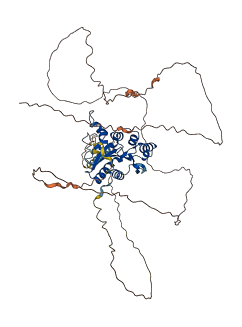
Descriptions
The autoinhibited protein was predicted that may have potential autoinhibitory elements via cis-regPred.
Autoinhibitory domains (AIDs)
Target domain |
|
Relief mechanism |
|
Assay |
cis-regPred |
Accessory elements
No accessory elements
Autoinhibited structure

Activated structure
1 structures for P36024
| Entry ID | Method | Resolution | Chain | Position | Source |
|---|---|---|---|---|---|
| AF-P36024-F1 | Predicted | AlphaFoldDB |
6 variants for P36024
| Variant ID(s) | Position | Change | Description | Diseaes Association | Provenance |
|---|---|---|---|---|---|
| s11-577421 | 115 | D>E | No | SGRP | |
| s11-577411 | 119 | T>A | No | SGRP | |
| s11-577102 | 222 | G>R | No | SGRP | |
| s11-577086 | 227 | R>H | No | SGRP | |
| s11-577068 | 233 | T>M | No | SGRP | |
| s11-576125 | 547 | E>D | No | SGRP |
No associated diseases with P36024
1 regional properties for P36024
| Type | Name | Position | InterPro Accession |
|---|---|---|---|
| domain | Flavoprotein | 265 - 488 | IPR003382 |
5 GO annotations of cellular component
| Name | Definition |
|---|---|
| chromatin | The ordered and organized complex of DNA, protein, and sometimes RNA, that forms the chromosome. |
| CoA-synthesizing protein complex | A multisubunit complex likely involved in the synthesis of coenzyme A (CoA). In S. cerevisiae, the complex consists of at least Cab2, Cab3, Cab4 and Cab5 but may also include Sis2 and Vhs3. The latter subunits are shared by the GO:0071513 phosphopantothenoylcysteine decarboxylase complex that catalyses the third step of the coenzyme A (CoA) biosynthetic pathway. |
| cytoplasm | The contents of a cell excluding the plasma membrane and nucleus, but including other subcellular structures. |
| nucleus | A membrane-bounded organelle of eukaryotic cells in which chromosomes are housed and replicated. In most cells, the nucleus contains all of the cell's chromosomes except the organellar chromosomes, and is the site of RNA synthesis and processing. In some species, or in specialized cell types, RNA metabolism or DNA replication may be absent. |
| phosphopantothenoylcysteine decarboxylase complex | A protein complex that catalyzes decarboxylation of 4'-phosphopantothenoylcysteine to yield 4'-phosphopantetheine; this is the third step in the biosynthesis of Coenzyme A. The complex is homotrimeric in many eukaryotes, but is a heterotrimer in Saccharomyces. |
4 GO annotations of molecular function
| Name | Definition |
|---|---|
| catalytic activity | Catalysis of a biochemical reaction at physiological temperatures. In biologically catalyzed reactions, the reactants are known as substrates, and the catalysts are naturally occurring macromolecular substances known as enzymes. Enzymes possess specific binding sites for substrates, and are usually composed wholly or largely of protein, but RNA that has catalytic activity (ribozyme) is often also regarded as enzymatic. |
| FMN binding | Binding to flavin mono nucleotide. Flavin mono nucleotide (FMN) is the coenzyme or the prosthetic group of various flavoprotein oxidoreductase enzymes. |
| identical protein binding | Binding to an identical protein or proteins. |
| protein serine/threonine phosphatase inhibitor activity | Binds to and stops, prevents or reduces the activity of a serine/threonine protein phosphatase, an enzyme that catalyzes the reaction: protein serine/threonine phosphate + H2O = protein serine/threonine + phosphate. |
4 GO annotations of biological process
| Name | Definition |
|---|---|
| coenzyme A biosynthetic process | The chemical reactions and pathways resulting in the formation of coenzyme A, 3'-phosphoadenosine-(5')diphospho(4')pantatheine, an acyl carrier in many acylation and acyl-transfer reactions in which the intermediate is a thiol ester. |
| negative regulation of phosphoprotein phosphatase activity | Any process that stops or reduces the activity of a phosphoprotein phosphatase. |
| regulation of mitotic cell cycle | Any process that modulates the rate or extent of progress through the mitotic cell cycle. |
| response to salt stress | Any process that results in a change in state or activity of a cell or an organism (in terms of movement, secretion, enzyme production, gene expression, etc.) as a result of a stimulus indicating an increase or decrease in the concentration of salt (particularly but not exclusively sodium and chloride ions) in the environment. |
No homologous proteins in AiPD
| UniProt AC | Gene Name | Protein Name | Species | Evidence Code |
|---|---|---|---|---|
| No homologous proteins | ||||
| 10 | 20 | 30 | 40 | 50 | 60 |
| MTAVASTSGK | QDADHNQSIE | CPRFSRGQKE | ILLDHEDAKG | KDSIINSPVS | GRQSISPTLS |
| 70 | 80 | 90 | 100 | 110 | 120 |
| NATTTTTKSI | MNATGTSGAV | VSNTPEPGLK | RVPAVTFSDL | KQQQKQDSLT | QLKNDSERTK |
| 130 | 140 | 150 | 160 | 170 | 180 |
| SPNSNPAPVS | NSIPGNHAVI | PNHTNTSRTT | QLSGSPLVNE | MKDYDPKKKD | SALKIVDTMK |
| 190 | 200 | 210 | 220 | 230 | 240 |
| PDKIMATSTP | ISRENNKVTA | KAPTSITLRK | EDAQDQANNV | SGQINVRSTP | EETPVKQSVI |
| 250 | 260 | 270 | 280 | 290 | 300 |
| PSIIPKRENS | KNLDPRLPQD | DGKLHVLFGA | TGSLSVFKIK | PMIKKLEEIY | GRDRISIQVI |
| 310 | 320 | 330 | 340 | 350 | 360 |
| LTQSATQFFE | QRYTKKIIKS | SEKLNKMSQY | ESTPATPVTP | TPGQCNMAQV | VELPPHIQLW |
| 370 | 380 | 390 | 400 | 410 | 420 |
| TDQDEWDAWK | QRTDPVLHIE | LRRWADILVV | APLTANTLSK | IALGLCDNLL | TSVIRAWNPS |
| 430 | 440 | 450 | 460 | 470 | 480 |
| YPILLAPSMV | SSTFNSMMTK | KQLQTIKEEM | SWVTVFKPSE | KVMDINGDIG | LGGMMDWNEI |
| 490 | 500 | 510 | 520 | 530 | 540 |
| VNKIVMKLGG | YPKNNEEEDD | DEDEEEDDDE | EEDTEDKNEN | NNDDDDDDDD | DDDDDDDDDD |
| 550 | 560 | ||||
| DDDDDDEDED | EAETPGIIDK | HQ |