P35695
Gene name |
bla (oxa7) |
Protein name |
Beta-lactamase OXA-7 |
Names |
|
Species |
Escherichia coli |
KEGG Pathway |
ag:CAA53242 |
EC number |
3.5.2.6: In cyclic amides |
Protein Class |
|
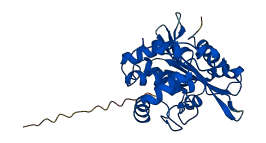
Descriptions
The autoinhibited protein was predicted that may have potential autoinhibitory elements via cis-regPred.
Autoinhibitory domains (AIDs)
Target domain |
|
Relief mechanism |
|
Assay |
cis-regPred |
Accessory elements
No accessory elements
Autoinhibited structure

Activated structure
1 structures for P35695
| Entry ID | Method | Resolution | Chain | Position | Source |
|---|---|---|---|---|---|
| AF-P35695-F1 | Predicted | AlphaFoldDB |
No variants for P35695
| Variant ID(s) | Position | Change | Description | Diseaes Association | Provenance |
|---|---|---|---|---|---|
| No variants for P35695 | |||||
No associated diseases with P35695
Functions
| Description | ||
|---|---|---|
| EC Number | 3.5.2.6 | In cyclic amides |
| Subcellular Localization |
|
|
| PANTHER Family | ||
| PANTHER Subfamily | ||
| PANTHER Protein Class | ||
| PANTHER Pathway Category | No pathway information available | |
No GO annotations of cellular component
| Name | Definition |
|---|---|
| No GO annotations for cellular component |
2 GO annotations of molecular function
| Name | Definition |
|---|---|
| beta-lactamase activity | Catalysis of the reaction: a beta-lactam + H2O = a substituted beta-amino acid. |
| penicillin binding | Binding to penicillin, an antibiotic that contains the condensed beta-lactamthiazolidine ring system. |
2 GO annotations of biological process
| Name | Definition |
|---|---|
| antibiotic catabolic process | The chemical reactions and pathways resulting in the breakdown of antibiotic, a substance produced by or derived from certain fungi, bacteria, and other organisms, that can destroy or inhibit the growth of other microorganisms. |
| response to antibiotic | Any process that results in a change in state or activity of a cell or an organism (in terms of movement, secretion, enzyme production, gene expression, etc.) as a result of an antibiotic stimulus. An antibiotic is a chemical substance produced by a microorganism which has the capacity to inhibit the growth of or to kill other microorganisms. |
No homologous proteins in AiPD
| UniProt AC | Gene Name | Protein Name | Species | Evidence Code |
|---|---|---|---|---|
| No homologous proteins | ||||
| 10 | 20 | 30 | 40 | 50 | 60 |
| MKTFAAYVIT | ACLSSTALAS | SITENTFWNK | EFSAEAVNGV | FVLCKSSSKL | ACATNNLARA |
| 70 | 80 | 90 | 100 | 110 | 120 |
| SKEYLPASTF | KIPNAIIGLE | TGVIKNEHQI | FKWDGKPRAM | KQWERDLSLR | GAIQVSAVPV |
| 130 | 140 | 150 | 160 | 170 | 180 |
| FQQIAREVGE | VRMQKYLKKF | SYGNQNISGG | IDKFWLEGQL | RISAVNQVEF | LESLFLNKLS |
| 190 | 200 | 210 | 220 | 230 | 240 |
| ASKENQLIVK | EALVTEAPEY | LVHSKTGFSG | VGTESNPGVA | WWVGWVEKGA | EVYFFAFNMD |
| 250 | 260 | ||||
| IDNENKLPLR | KSIPTKIMAS | EGIIGG |