P35193
Gene name |
ATG19 (CVT19, YOL082W, O0980, YOL01) |
Protein name |
Autophagy-related protein 19 |
Names |
Cytoplasm-to-vacuole targeting protein 19 |
Species |
Saccharomyces cerevisiae (strain ATCC 204508 / S288c) (Baker's yeast) |
KEGG Pathway |
sce:YOL082W |
EC number |
|
Protein Class |
|
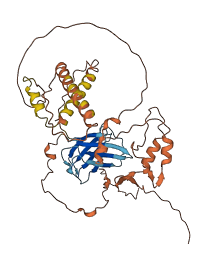
Descriptions
The autoinhibited protein was predicted that may have potential autoinhibitory elements via cis-regPred.
Autoinhibitory domains (AIDs)
Target domain |
|
Relief mechanism |
|
Assay |
cis-regPred |
Accessory elements
No accessory elements
Autoinhibited structure

Activated structure
4 structures for P35193
| Entry ID | Method | Resolution | Chain | Position | Source |
|---|---|---|---|---|---|
| 2KZB | NMR | - | A | 254-367 | PDB |
| 2ZPN | X-ray | 270 A | E/F/G/H | 412-415 | PDB |
| 5JGE | X-ray | 191 A | A/B/D/E | 160-187 | PDB |
| AF-P35193-F1 | Predicted | AlphaFoldDB |
11 variants for P35193
| Variant ID(s) | Position | Change | Description | Diseaes Association | Provenance |
|---|---|---|---|---|---|
| s15-168734 | 3 | N>I | No | SGRP | |
| s15-169150 | 142 | E>K | No | SGRP | |
| s15-169250 | 175 | N>S | No | SGRP | |
| s15-169289 | 188 | P>R | No | SGRP | |
| s15-169309 | 195 | T>A | No | SGRP | |
| s15-169333 | 203 | S>P | No | SGRP | |
| s15-169355 | 210 | T>R | No | SGRP | |
| s15-169414 | 230 | R>G | No | SGRP | |
| s15-169525 | 267 | N>D | No | SGRP | |
| s15-169718 | 331 | A>G | No | SGRP | |
| s15-169772 | 349 | K>R | No | SGRP |
No associated diseases with P35193
1 regional properties for P35193
| Type | Name | Position | InterPro Accession |
|---|---|---|---|
| domain | Signal transduction response regulator, receiver domain | 91 - 209 | IPR001789 |
6 GO annotations of cellular component
| Name | Definition |
|---|---|
| Cvt complex | A protein complex that is involved in the Cvt pathway. In budding yeast, the Cvt complex consists of multimers of preApe1p. |
| cytoplasm | The contents of a cell excluding the plasma membrane and nucleus, but including other subcellular structures. |
| cytosol | The part of the cytoplasm that does not contain organelles but which does contain other particulate matter, such as protein complexes. |
| extrinsic component of membrane | The component of a membrane consisting of gene products and protein complexes that are loosely bound to one of its surfaces, but not integrated into the hydrophobic region. |
| phagophore assembly site | Punctate structures proximal to the endoplasmic reticulum which are the sites where the Atg machinery assembles upon autophagy induction. |
| phagophore assembly site membrane | A cellular membrane associated with the phagophore assembly site. |
1 GO annotations of molecular function
| Name | Definition |
|---|---|
| protein-macromolecule adaptor activity | The binding activity of a protein that brings together two or more macromolecules in contact, permitting those molecules to function in a coordinated way. The adaptor can bring together two proteins, or a protein and another macromolecule such as a lipid or a nucleic acid. |
5 GO annotations of biological process
| Name | Definition |
|---|---|
| protein transport | The directed movement of proteins into, out of or within a cell, or between cells, by means of some agent such as a transporter or pore. |
| protein-containing complex localization | A localization process that acts on a protein complex; the complex is transported to, or maintained in, a specific location. |
| selective autophagy | The macroautophagy process in which specific structures are targeted by the autophagy process. |
| ubiquitin-dependent ERAD pathway | The series of steps necessary to target endoplasmic reticulum (ER)-resident proteins for degradation by the cytoplasmic proteasome. Begins with recognition of the ER-resident protein, includes retrotranslocation (dislocation) of the protein from the ER to the cytosol, protein ubiquitination necessary for correct substrate transfer, transport of the protein to the proteasome, and ends with degradation of the protein by the cytoplasmic proteasome. |
| vesicle organization | A process that is carried out at the cellular level which results in the assembly, arrangement of constituent parts, or disassembly of a vesicle. |
No homologous proteins in AiPD
| UniProt AC | Gene Name | Protein Name | Species | Evidence Code |
|---|---|---|---|---|
| No homologous proteins | ||||
| 10 | 20 | 30 | 40 | 50 | 60 |
| MNNSKTNQQM | NTSMGYPLTV | YDECNKFQLI | VPTLDANIML | WCIGQLSLLN | DSNGCKHLFW |
| 70 | 80 | 90 | 100 | 110 | 120 |
| QPNDKSNVRI | LLNNYDYGHL | FKYLQCQRKC | SVYIGEGTLK | KYNLTISTSF | DNFLDLTPSE |
| 130 | 140 | 150 | 160 | 170 | 180 |
| EKESLCREDA | HEDPVSPKAG | SEEEISPNST | SNVVVSRECL | DNFMKQLLKL | EESLNKLELE |
| 190 | 200 | 210 | 220 | 230 | 240 |
| QKVTNKEPNH | RISGTIDIPE | DRSELVNFFT | ELKTVKQLED | VFQRYHDYER | LSQECDSKTE |
| 250 | 260 | 270 | 280 | 290 | 300 |
| IASDHSKKET | KIEVEPPNER | SLQITMNQRD | NSLYFQLFNN | TNSVLAGNCK | LKFTDAGDKP |
| 310 | 320 | 330 | 340 | 350 | 360 |
| TTQIIDMGPH | EIGIKEYKEY | RYFPYALDLE | AGSTIEIENQ | YGEVIFLGKY | GSSPMINLRP |
| 370 | 380 | 390 | 400 | 410 | |
| PSRLSAESLQ | ASQEPFYSFQ | IDTLPELDDS | SIISTSISLS | YDGDDNEKAL | TWEEL |