P35149
Gene name |
spoIVA (spoVP, BSU22800) |
Protein name |
Stage IV sporulation protein A |
Names |
Coat morphogenetic protein SpoIVA |
Species |
Bacillus subtilis (strain 168) |
KEGG Pathway |
bsu:BSU22800 |
EC number |
|
Protein Class |
|
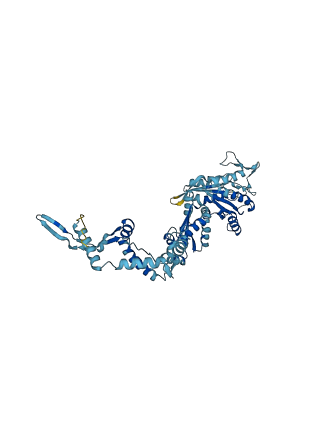
Descriptions
The autoinhibited protein was predicted that may have potential autoinhibitory elements via cis-regPred.
Autoinhibitory domains (AIDs)
Target domain |
|
Relief mechanism |
|
Assay |
cis-regPred |
Accessory elements
No accessory elements
Autoinhibited structure

Activated structure
1 structures for P35149
| Entry ID | Method | Resolution | Chain | Position | Source |
|---|---|---|---|---|---|
| AF-P35149-F1 | Predicted | AlphaFoldDB |
No variants for P35149
| Variant ID(s) | Position | Change | Description | Diseaes Association | Provenance |
|---|---|---|---|---|---|
| No variants for P35149 | |||||
No associated diseases with P35149
Functions
4 GO annotations of cellular component
| Name | Definition |
|---|---|
| cytoplasm | The contents of a cell excluding the plasma membrane and nucleus, but including other subcellular structures. |
| endospore cortex | A layer surrounding a bacterial endospore found inside the outer endospore membrane, but outside the membrane surrounding the endospore core. It consists of peptidoglycan of a different chemical nature than that found in vegetative cell walls which results in less cross-linking of peptidoglycan. |
| endospore-forming forespore | Portion of the cell formed during the process of bacterial sporulation that will ultimately become the core of the endospore. An endospore is a type of dormant cell that is resistant to adverse conditions. |
| spore wall | The specialized envelope lying outside the cell membrane of a spore. |
2 GO annotations of molecular function
| Name | Definition |
|---|---|
| ATP binding | Binding to ATP, adenosine 5'-triphosphate, a universally important coenzyme and enzyme regulator. |
| ATP hydrolysis activity | Catalysis of the reaction: ATP + H2O = ADP + H+ phosphate. ATP hydrolysis is used in some reactions as an energy source, for example to catalyze a reaction or drive transport against a concentration gradient. |
8 GO annotations of biological process
| Name | Definition |
|---|---|
| peptidoglycan metabolic process | The chemical reactions and pathways involving peptidoglycans, any of a class of glycoconjugates found only in bacterial cell walls and consisting of strands of glycosaminoglycan cross-linked by oligopeptides to form a huge and rigid network. |
| protein complex oligomerization | The process of creating protein oligomers, compounds composed of a small number, usually between three and ten, of component monomers; protein oligomers may be composed of different or identical monomers. Oligomers may be formed by the polymerization of a number of monomers or the depolymerization of a large protein polymer. |
| protein polymerization | The process of creating protein polymers, compounds composed of a large number of component monomers; polymeric proteins may be made up of different or identical monomers. Polymerization occurs by the addition of extra monomers to an existing poly- or oligomeric protein. |
| spore germination | The physiological and developmental changes that occur in a spore following release from dormancy up to the earliest signs of growth (e.g. emergence from a spore wall). |
| spore wall assembly | The aggregation, arrangement and bonding together of a set of components to form a spore wall; a spore wall is the specialized envelope lying outside the cell membrane of a spore. |
| spore wall biogenesis | A cellular process that results in the biosynthesis of constituent macromolecules, assembly, and arrangement of constituent parts of a spore wall. A spore wall is the specialized cell wall lying outside the cell membrane of a spore. |
| sporulation | The process whose specific outcome is the progression of a spore over time, from its initiation to the mature structure. A spore is a structure that can be used for dissemination, for survival of adverse conditions because of its heat and dessication resistance, and/or for reproduction. |
| sporulation resulting in formation of a cellular spore | The process in which a relatively unspecialized cell acquires the specialized features of a cellular spore, a cell form that can be used for dissemination, for survival of adverse conditions because of its heat and dessication resistance, and/or for reproduction. |
No homologous proteins in AiPD
| UniProt AC | Gene Name | Protein Name | Species | Evidence Code |
|---|---|---|---|---|
| No homologous proteins | ||||
| 10 | 20 | 30 | 40 | 50 | 60 |
| MEKVDIFKDI | AERTGGDIYL | GVVGAVRTGK | STFIKKFMEL | VVLPNISNEA | DRARAQDELP |
| 70 | 80 | 90 | 100 | 110 | 120 |
| QSAAGKTIMT | TEPKFVPNQA | MSVHVSDGLD | VNIRLVDCVG | YTVPGAKGYE | DENGPRMINT |
| 130 | 140 | 150 | 160 | 170 | 180 |
| PWYEEPIPFH | EAAEIGTRKV | IQEHSTIGVV | ITTDGTIGDI | ARSDYIEAEE | RVIEELKEVG |
| 190 | 200 | 210 | 220 | 230 | 240 |
| KPFIMVINSV | RPYHPETEAM | RQDLSEKYDI | PVLAMSVESM | RESDVLSVLR | EALYEFPVLE |
| 250 | 260 | 270 | 280 | 290 | 300 |
| VNVNLPSWVM | VLKENHWLRE | SYQESVKETV | KDIKRLRDVD | RVVGQFSEFE | FIESAGLAGI |
| 310 | 320 | 330 | 340 | 350 | 360 |
| ELGQGVAEID | LYAPDHLYDQ | ILKEVVGVEI | RGRDHLLELM | QDFAHAKTEY | DQVSDALKMV |
| 370 | 380 | 390 | 400 | 410 | 420 |
| KQTGYGIAAP | ALADMSLDEP | EIIRQGSRFG | VRLKAVAPSI | HMIKVDVESE | FAPIIGTEKQ |
| 430 | 440 | 450 | 460 | 470 | 480 |
| SEELVRYLMQ | DFEDDPLSIW | NSDIFGRSLS | SIVREGIQAK | LSLMPENARY | KLKETLERII |
| 490 | |||||
| NEGSGGLIAI | IL |