P34908
Gene name |
BRAF |
Protein name |
Serine/threonine-protein kinase B-raf |
Names |
Proto-oncogene B-Raf, Proto-oncogene c-Rmil, Serine/threonine-protein kinase Rmil |
Species |
Coturnix japonica (Japanese quail) (Coturnix coturnix japonica) |
KEGG Pathway |
cjo:107315883 |
EC number |
2.7.11.1: Protein-serine/threonine kinases |
Protein Class |
|
Descriptions
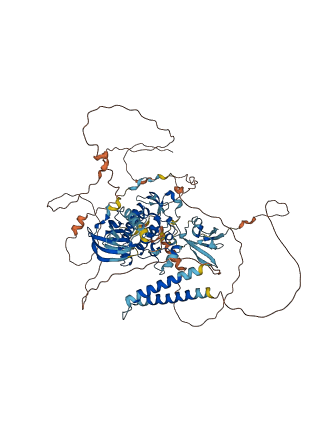
The autoinhibited protein was predicted that may have potential autoinhibitory elements via cis-regPred.
Autoinhibitory domains (AIDs)
Target domain |
|
Relief mechanism |
|
Assay |
cis-regPred |
Accessory elements
633-658 (Activation loop from InterPro)
Target domain |
497-757 (Protein kinase domain) |
Relief mechanism |
|
Assay |
|
Autoinhibited structure

Activated structure
1 structures for P34908
| Entry ID | Method | Resolution | Chain | Position | Source |
|---|---|---|---|---|---|
| AF-P34908-F1 | Predicted | AlphaFoldDB |
No variants for P34908
| Variant ID(s) | Position | Change | Description | Diseaes Association | Provenance |
|---|---|---|---|---|---|
| No variants for P34908 | |||||
No associated diseases with P34908
Functions
| Description | ||
|---|---|---|
| EC Number | 2.7.11.1 | Protein-serine/threonine kinases |
| Subcellular Localization |
|
|
| PANTHER Family | ||
| PANTHER Subfamily | ||
| PANTHER Protein Class | ||
| PANTHER Pathway Category | No pathway information available | |
7 GO annotations of cellular component
| Name | Definition |
|---|---|
| cell body | The portion of a cell bearing surface projections such as axons, dendrites, cilia, or flagella that includes the nucleus, but excludes all cell projections. |
| cytosol | The part of the cytoplasm that does not contain organelles but which does contain other particulate matter, such as protein complexes. |
| mitochondrion | A semiautonomous, self replicating organelle that occurs in varying numbers, shapes, and sizes in the cytoplasm of virtually all eukaryotic cells. It is notably the site of tissue respiration. |
| neuron projection | A prolongation or process extending from a nerve cell, e.g. an axon or dendrite. |
| nucleus | A membrane-bounded organelle of eukaryotic cells in which chromosomes are housed and replicated. In most cells, the nucleus contains all of the cell's chromosomes except the organellar chromosomes, and is the site of RNA synthesis and processing. In some species, or in specialized cell types, RNA metabolism or DNA replication may be absent. |
| plasma membrane | The membrane surrounding a cell that separates the cell from its external environment. It consists of a phospholipid bilayer and associated proteins. |
| presynapse | The part of a synapse that is part of the presynaptic cell. |
7 GO annotations of molecular function
| Name | Definition |
|---|---|
| ATP binding | Binding to ATP, adenosine 5'-triphosphate, a universally important coenzyme and enzyme regulator. |
| calcium ion binding | Binding to a calcium ion (Ca2+). |
| identical protein binding | Binding to an identical protein or proteins. |
| MAP kinase kinase activity | Catalysis of the concomitant phosphorylation of threonine (T) and tyrosine (Y) residues in a Thr-Glu-Tyr (TEY) thiolester sequence in a MAP kinase (MAPK) substrate. |
| protein serine kinase activity | Catalysis of the reactions: ATP + protein serine = ADP + protein serine phosphate. |
| protein serine/threonine kinase activity | Catalysis of the reactions: ATP + protein serine = ADP + protein serine phosphate, and ATP + protein threonine = ADP + protein threonine phosphate. |
| scaffold protein binding | Binding to a scaffold protein. Scaffold proteins are crucial regulators of many key signaling pathways. Although not strictly defined in function, they are known to interact and/or bind with multiple members of a signaling pathway, tethering them into complexes. |
37 GO annotations of biological process
| Name | Definition |
|---|---|
| CD4-positive or CD8-positive, alpha-beta T cell lineage commitment | The process in which an immature T cell commits to CD4-positive T cell lineage or the CD8-positive lineage of alpha-beta T cells. |
| CD4-positive, alpha-beta T cell differentiation | The process in which a relatively unspecialized T cell acquires specialized features of a mature CD4-positive, alpha-beta T cell. |
| cellular response to calcium ion | Any process that results in a change in state or activity of a cell (in terms of movement, secretion, enzyme production, gene expression, etc.) as a result of a calcium ion stimulus. |
| cellular response to xenobiotic stimulus | Any process that results in a change in state or activity of a cell (in terms of movement, secretion, enzyme production, gene expression, etc.) as a result of a stimulus from a xenobiotic, a compound foreign to the organism exposed to it. It may be synthesized by another organism (like ampicilin) or it can be a synthetic chemical. |
| endothelial cell apoptotic process | Any apoptotic process in an endothelial cell. An endothelial cell comprises the outermost layer or lining of anatomical structures and can be squamous or cuboidal. |
| epidermal growth factor receptor signaling pathway | The series of molecular signals initiated by binding of a ligand to the tyrosine kinase receptor EGFR (ERBB1) on the surface of a cell. The pathway ends with regulation of a downstream cellular process, e.g. transcription. |
| ERK1 and ERK2 cascade | An intracellular protein kinase cascade containing at least ERK1 or ERK2 (MAPKs), a MEK (a MAPKK) and a MAP3K. The cascade may involve 4 different kinases, as it can also contain an additional tier: the upstream MAP4K. The kinases in each tier phosphorylate and activate the kinase in the downstream tier to transmit a signal within a cell. |
| establishment of protein localization to membrane | The directed movement of a protein to a specific location in a membrane. |
| face development | The biological process whose specific outcome is the progression of a face from an initial condition to its mature state. The face is the ventral division of the head. |
| head morphogenesis | The process in which the anatomical structures of the head are generated and organized. The head is the anterior-most division of the body. |
| long-term synaptic potentiation | A process that modulates synaptic plasticity such that synapses are changed resulting in the increase in the rate, or frequency of synaptic transmission at the synapse. |
| myeloid progenitor cell differentiation | The process in which a precursor cell type acquires the specialized features of a myeloid progenitor cell. Myeloid progenitor cells include progenitor cells for any of the myeloid lineages. |
| negative regulation of endothelial cell apoptotic process | Any process that stops, prevents or reduces the frequency, rate or extent of endothelial cell apoptotic process. |
| negative regulation of fibroblast migration | Any process that decreases the rate, frequency or extent of fibroblast cell migration. Fibroblast cell migration is accomplished by extension and retraction of a pseudopodium. |
| negative regulation of neuron apoptotic process | Any process that stops, prevents, or reduces the frequency, rate or extent of cell death by apoptotic process in neurons. |
| negative regulation of synaptic vesicle exocytosis | Any process that stops, prevents or reduces the frequency, rate or extent of synaptic vesicle exocytosis. |
| positive regulation of axon regeneration | Any process that activates, maintains or increases the rate of axon regeneration. |
| positive regulation of axonogenesis | Any process that activates or increases the frequency, rate or extent of axonogenesis. |
| positive regulation of ERK1 and ERK2 cascade | Any process that activates or increases the frequency, rate or extent of signal transduction mediated by the ERK1 and ERK2 cascade. |
| positive regulation of gene expression | Any process that increases the frequency, rate or extent of gene expression. Gene expression is the process in which a gene's coding sequence is converted into a mature gene product (protein or RNA). |
| positive regulation of glucose transmembrane transport | Any process that increases the frequency, rate or extent of glucose transport across a membrane. Glucose transport is the directed movement of the hexose monosaccharide glucose into, out of or within a cell, or between cells, by means of some agent such as a transporter or pore. |
| positive regulation of peptidyl-serine phosphorylation | Any process that activates or increases the frequency, rate or extent of the phosphorylation of peptidyl-serine. |
| positive regulation of stress fiber assembly | Any process that activates or increases the frequency, rate or extent of the assembly of a stress fiber, a bundle of microfilaments and other proteins found in fibroblasts. |
| positive regulation of substrate adhesion-dependent cell spreading | Any process that activates or increases the frequency, rate or extent of substrate adhesion-dependent cell spreading. |
| protein phosphorylation | The process of introducing a phosphate group on to a protein. |
| regulation of cell population proliferation | Any process that modulates the frequency, rate or extent of cell proliferation. |
| regulation of T cell differentiation | Any process that modulates the frequency, rate or extent of T cell differentiation. |
| somatic stem cell population maintenance | Any process by which an organism retains a population of somatic stem cells, undifferentiated cells in the embryo or adult which can undergo unlimited division and give rise to cell types of the body other than those of the germ-line. |
| stress fiber assembly | The aggregation, arrangement and bonding together of a set of components to form a stress fiber. A stress fiber is a contractile actin filament bundle that consists of short actin filaments with alternating polarity. |
| substrate adhesion-dependent cell spreading | The morphogenetic process that results in flattening of a cell as a consequence of its adhesion to a substrate. |
| synaptic vesicle exocytosis | Fusion of intracellular membrane-bounded vesicles with the pre-synaptic membrane of the neuronal cell resulting in release of neurotransmitter into the synaptic cleft. |
| T cell differentiation in thymus | The process in which a precursor cell type acquires the specialized features of a T cell via a differentiation pathway dependent upon transit through the thymus. |
| T cell receptor signaling pathway | The series of molecular signals initiated by the cross-linking of an antigen receptor on a T cell. |
| thymus development | The process whose specific outcome is the progression of the thymus over time, from its formation to the mature structure. The thymus is a symmetric bi-lobed organ involved primarily in the differentiation of immature to mature T cells, with unique vascular, nervous, epithelial, and lymphoid cell components. |
| thyroid gland development | The process whose specific outcome is the progression of the thyroid gland over time, from its formation to the mature structure. The thyroid gland is an endoderm-derived gland that produces thyroid hormone. |
| trehalose metabolism in response to stress | The chemical reactions and pathways involving trehalose that occur as a result of a stimulus indicating the organism is under stress. |
| visual learning | Any process in an organism in which a change in behavior of an individual occurs in response to repeated exposure to a visual cue. |
No homologous proteins in AiPD
| UniProt AC | Gene Name | Protein Name | Species | Evidence Code |
|---|---|---|---|---|
| No homologous proteins | ||||
| 10 | 20 | 30 | 40 | 50 | 60 |
| MAALSSGSSA | EGASLFNGDM | EPEPPPPVLG | ACYAGSGGGD | PAIPEEVWNI | KQMIKLTQEH |
| 70 | 80 | 90 | 100 | 110 | 120 |
| IEALLDKFGG | EHNPPSIYLE | AYEEYTSKLD | ALQQREQQLL | ESMGNGTDFS | VSSSASTDTV |
| 130 | 140 | 150 | 160 | 170 | 180 |
| ASSSSSSLSV | APSSLSVYQN | PTDMSRNNPK | SPQKPIVRVF | LPNKQRTVVP | ARCGVTVRDS |
| 190 | 200 | 210 | 220 | 230 | 240 |
| LKKALMMRGL | IPECCAVYRI | QDGEKKPIGW | DTDISWLTGE | ELHVEVLENV | PLTTHNFVRK |
| 250 | 260 | 270 | 280 | 290 | 300 |
| TFFTLAFCDF | CRKLLFQGFR | CQTCGYKFHQ | RCSTEVPLMC | VNYDQLDLLF | VSKFFEHHPI |
| 310 | 320 | 330 | 340 | 350 | 360 |
| SQEETTLGET | TPASGSYPSV | PPSDSVGPPI | LPSPSPSKSI | PIPQPFRPAD | EDHRNQFGQR |
| 370 | 380 | 390 | 400 | 410 | 420 |
| DRSSSAPNVH | INTIEPVNID | DLIRDQGVRG | EGAPLNQLMR | CLRKYQSRTP | SPLLHSVPSE |
| 430 | 440 | 450 | 460 | 470 | 480 |
| IVFDFEPGPV | FRGSTAGLSA | TPPASLPGSL | TNVKALQKSP | GPQRERKSSS | SSEDRNRMKT |
| 490 | 500 | 510 | 520 | 530 | 540 |
| LGRRDSSDDW | EIPDGQITVG | QRIGSGSFGT | VYKGKWHGDV | AVKMLNVTAP | TPQQLQAFKN |
| 550 | 560 | 570 | 580 | 590 | 600 |
| EVGVLRKTRH | VNILLFMGYS | TKPQLAIVTQ | WCEGSSLYHH | LHIIETKFEM | IKLIDIARQT |
| 610 | 620 | 630 | 640 | 650 | 660 |
| AQGMDYLHAK | SIIHRDLKSN | NIFLHEDLTV | KIGDFGLATV | KSRWSGSHQF | EQLSGSILWM |
| 670 | 680 | 690 | 700 | 710 | 720 |
| APEVIRMQDK | NPYSFQSDVY | AFGIVLYELM | TGQLPYSNIN | NRDQIIFMVG | RGYLSPDLSK |
| 730 | 740 | 750 | 760 | 770 | 780 |
| VRSNCPKAMK | RLMAECLKKK | RDERPLFPQI | LASIELLARS | LPKIHRSASE | PSLNRAGFQT |
| 790 | 800 | ||||
| EDFSLYACAS | PKTPIQAGGY | GEFAAFK |