P34900
Gene name |
Sdc2 (Hspg1, Synd2) |
Protein name |
Syndecan-2 |
Names |
|
Species |
Rattus norvegicus (Rat) |
KEGG Pathway |
rno:25615 |
EC number |
|
Protein Class |
|
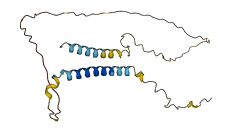
Descriptions
The autoinhibited protein was predicted that may have potential autoinhibitory elements via cis-regPred.
Autoinhibitory domains (AIDs)
Target domain |
|
Relief mechanism |
|
Assay |
cis-regPred |
Accessory elements
No accessory elements
Autoinhibited structure

Activated structure
1 structures for P34900
| Entry ID | Method | Resolution | Chain | Position | Source |
|---|---|---|---|---|---|
| AF-P34900-F1 | Predicted | AlphaFoldDB |
No variants for P34900
| Variant ID(s) | Position | Change | Description | Diseaes Association | Provenance |
|---|---|---|---|---|---|
| No variants for P34900 | |||||
No associated diseases with P34900
5 GO annotations of cellular component
| Name | Definition |
|---|---|
| cell surface | The external part of the cell wall and/or plasma membrane. |
| integral component of membrane | The component of a membrane consisting of the gene products and protein complexes having at least some part of their peptide sequence embedded in the hydrophobic region of the membrane. |
| neuronal cell body | The portion of a neuron that includes the nucleus, but excludes cell projections such as axons and dendrites. |
| plasma membrane | The membrane surrounding a cell that separates the cell from its external environment. It consists of a phospholipid bilayer and associated proteins. |
| synapse | The junction between an axon of one neuron and a dendrite of another neuron, a muscle fiber or a glial cell. As the axon approaches the synapse it enlarges into a specialized structure, the presynaptic terminal bouton, which contains mitochondria and synaptic vesicles. At the tip of the terminal bouton is the presynaptic membrane; facing it, and separated from it by a minute cleft (the synaptic cleft) is a specialized area of membrane on the receiving cell, known as the postsynaptic membrane. In response to the arrival of nerve impulses, the presynaptic terminal bouton secretes molecules of neurotransmitters into the synaptic cleft. These diffuse across the cleft and transmit the signal to the postsynaptic membrane. |
2 GO annotations of molecular function
| Name | Definition |
|---|---|
| identical protein binding | Binding to an identical protein or proteins. |
| PDZ domain binding | Binding to a PDZ domain of a protein, a domain found in diverse signaling proteins. |
6 GO annotations of biological process
| Name | Definition |
|---|---|
| cell migration | The controlled self-propelled movement of a cell from one site to a destination guided by molecular cues. Cell migration is a central process in the development and maintenance of multicellular organisms. |
| dendrite morphogenesis | The process in which the anatomical structures of a dendrite are generated and organized. |
| regulation of dendrite morphogenesis | Any process that modulates the frequency, rate or extent of dendrite morphogenesis. |
| response to caffeine | Any process that results in a change in state or activity of a cell or an organism (in terms of movement, secretion, enzyme production, gene expression, etc.) as a result of a caffeine stimulus. Caffeine is an alkaloid found in numerous plant species, where it acts as a natural pesticide that paralyzes and kills certain insects feeding upon them. |
| response to hypoxia | Any process that results in a change in state or activity of a cell or an organism (in terms of movement, secretion, enzyme production, gene expression, etc.) as a result of a stimulus indicating lowered oxygen tension. Hypoxia, defined as a decline in O2 levels below normoxic levels of 20.8 - 20.95%, results in metabolic adaptation at both the cellular and organismal level. |
| wound healing | The series of events that restore integrity to a damaged tissue, following an injury. |
No homologous proteins in AiPD
| UniProt AC | Gene Name | Protein Name | Species | Evidence Code |
|---|---|---|---|---|
| No homologous proteins | ||||
| 10 | 20 | 30 | 40 | 50 | 60 |
| MQRAWILLTL | GLMACVSAET | RAELTSDKDM | YLDSSSIEEA | SGLYPIDDDD | YSSASGSGAY |
| 70 | 80 | 90 | 100 | 110 | 120 |
| EDKGSPDLTT | SQLIPRISLT | SAAPEVETMT | LKTQSITPTQ | TESPEETDKK | EFEISEAEEK |
| 130 | 140 | 150 | 160 | 170 | 180 |
| QDPAVKSTDV | YTEKHSDNLF | KRTEVLAAVI | AGGVIGFLFA | IFLILLLVYR | MRKKDEGSYD |
| 190 | 200 | ||||
| LGERKPSSAA | YQKAPTKEFY | A |