P34232
Gene name |
MTR2 (YKL186C) |
Protein name |
mRNA transport regulator MTR2 |
Names |
|
Species |
Saccharomyces cerevisiae (strain ATCC 204508 / S288c) (Baker's yeast) |
KEGG Pathway |
sce:YKL186C |
EC number |
|
Protein Class |
|
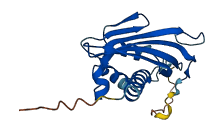
Descriptions
The autoinhibited protein was predicted that may have potential autoinhibitory elements via cis-regPred.
Autoinhibitory domains (AIDs)
Target domain |
|
Relief mechanism |
|
Assay |
cis-regPred |
Accessory elements
No accessory elements
Autoinhibited structure

Activated structure
5 structures for P34232
| Entry ID | Method | Resolution | Chain | Position | Source |
|---|---|---|---|---|---|
| 1OF5 | X-ray | 280 A | B | 1-184 | PDB |
| 4WWU | X-ray | 330 A | C/F/I/L | 1-184 | PDB |
| 8HBN | EM | 381 A | B | 1-184 | PDB |
| 8HFR | EM | 264 A | Bt/DK/FR | 1-184 | PDB |
| AF-P34232-F1 | Predicted | AlphaFoldDB |
No variants for P34232
| Variant ID(s) | Position | Change | Description | Diseaes Association | Provenance |
|---|---|---|---|---|---|
| No variants for P34232 | |||||
No associated diseases with P34232
No regional properties for P34232
| Type | Name | Position | InterPro Accession |
|---|---|---|---|
| No domain, repeats, and functional sites for P34232 | |||
3 GO annotations of cellular component
| Name | Definition |
|---|---|
| nuclear pore central transport channel | The central substructure of the nuclear pore complex (NPC), through which nucleocytoplasmic transport of RNAs, proteins and small molecules occurs. The central transport channel is filled with FG-nucleoporins, which form a selective barrier and provide a series of binding sites for transporter proteins. Characterized S. cerevisiae FG-nucleoporins include Nup159p, Nup145Np, Nup116p, Nup100p, Nsp1p, Nup57p, Nup49p, Nup42p, Nup53p, Nup59p/Asm4p, Nup60p and Nup1. Characterized vertebrate FG-nucleoporins include Nup214, Nup98, Nup62, Nup54, Nup58/45, NLP1, and Nup153. |
| nuclear RNA export factor complex | A protein complex that contains two proteins (know in several organisms, including Drosophila, as NXF1 and NXF2) and is required for the export of the majority of mRNAs from the nucleus to the cytoplasm; localized in the nucleoplasm and at both the nucleoplasmic and cytoplasmic faces of the nuclear pore complex; shuttles between the nucleus and the cytoplasm. |
| nucleus | A membrane-bounded organelle of eukaryotic cells in which chromosomes are housed and replicated. In most cells, the nucleus contains all of the cell's chromosomes except the organellar chromosomes, and is the site of RNA synthesis and processing. In some species, or in specialized cell types, RNA metabolism or DNA replication may be absent. |
No GO annotations of molecular function
| Name | Definition |
|---|---|
| No GO annotations for molecular function |
6 GO annotations of biological process
| Name | Definition |
|---|---|
| mRNA export from nucleus | The directed movement of mRNA from the nucleus to the cytoplasm. |
| nucleocytoplasmic transport | The directed movement of molecules between the nucleus and the cytoplasm. |
| poly(A)+ mRNA export from nucleus | The directed movement of poly(A)+ mRNA out of the nucleus into the cytoplasm. |
| protein import into nucleus | The directed movement of a protein from the cytoplasm to the nucleus. |
| ribosomal large subunit export from nucleus | The directed movement of a ribosomal large subunit from the nucleus into the cytoplasm. |
| ribosomal small subunit export from nucleus | The directed movement of a ribosomal small subunit from the nucleus into the cytoplasm. |
No homologous proteins in AiPD
| UniProt AC | Gene Name | Protein Name | Species | Evidence Code |
|---|---|---|---|---|
| No homologous proteins | ||||
| 10 | 20 | 30 | 40 | 50 | 60 |
| MNTNSNTMVM | NDANQAQITA | TFTKKILAHL | DDPDSNKLAQ | FVQLFNPNNC | RIIFNATPFA |
| 70 | 80 | 90 | 100 | 110 | 120 |
| QATVFLQMWQ | NQVVQTQHAL | TGVDYHAIPG | SGTLICNVNC | KVRFDESGRD | KMGQDATVPI |
| 130 | 140 | 150 | 160 | 170 | 180 |
| QPNNTGNRNR | PNDMNKPRPL | WGPYFGISLQ | LIIDDRIFRN | DFNGVISGFN | YNMVYKPEDS |
| LLKI |