P33950
Gene name |
hbpA (dppA, HI_0853) |
Protein name |
Heme-binding protein A |
Names |
Hemin-binding lipoprotein |
Species |
Haemophilus influenzae (strain ATCC 51907 / DSM 11121 / KW20 / Rd) |
KEGG Pathway |
hin:HI_0853 |
EC number |
|
Protein Class |
|
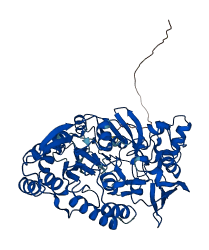
Descriptions
The autoinhibited protein was predicted that may have potential autoinhibitory elements via cis-regPred.
Autoinhibitory domains (AIDs)
Target domain |
|
Relief mechanism |
|
Assay |
cis-regPred |
Accessory elements
No accessory elements
Autoinhibited structure

Activated structure
1 structures for P33950
| Entry ID | Method | Resolution | Chain | Position | Source |
|---|---|---|---|---|---|
| AF-P33950-F1 | Predicted | AlphaFoldDB |
5 variants for P33950
| Variant ID(s) | Position | Change | Description | Diseaes Association | Provenance |
|---|---|---|---|---|---|
| 48 | K>NS | strain: DL42 [UniProt] | No | ||
| 181 | T>N | strain: DL42 [UniProt] | No | ||
| 240 | H>N | strain: DL42 [UniProt] | No | ||
| 343 | T>I | strain: DL42 [UniProt] | No | ||
| 375 | A>V | strain: DL42 [UniProt] | No |
No associated diseases with P33950
2 GO annotations of cellular component
| Name | Definition |
|---|---|
| ATP-binding cassette (ABC) transporter complex | A complex for the transport of metabolites into and out of the cell, typically comprised of four domains; two membrane-associated domains and two ATP-binding domains at the intracellular face of the membrane, that form a central pore through the plasma membrane. Each of the four core domains may be encoded as a separate polypeptide or the domains can be fused in any one of a number of ways into multidomain polypeptides. In Bacteria and Archaebacteria, ABC transporters also include substrate binding proteins to bind substrate external to the cytoplasm and deliver it to the transporter. |
| outer membrane-bounded periplasmic space | The region between the inner (cytoplasmic or plasma) membrane and outer membrane of organisms with two membranes such as Gram negative bacteria. These periplasmic spaces are relatively thick and contain a thin peptidoglycan layer (PGL), also referred to as a thin cell wall. |
1 GO annotations of molecular function
| Name | Definition |
|---|---|
| peptide transmembrane transporter activity | Enables the transfer of a peptide from one side of a membrane to the other. |
2 GO annotations of biological process
| Name | Definition |
|---|---|
| dipeptide transport | The directed movement of a dipeptide, a combination of two amino acids by means of a peptide (-CO-NH-) link, into, out of or within a cell, or between cells, by means of some agent such as a transporter or pore. |
| peptide transport | The directed movement of peptides, compounds of two or more amino acids where the alpha carboxyl group of one is bound to the alpha amino group of another, into, out of or within a cell, or between cells, by means of some agent such as a transporter or pore. |
No homologous proteins in AiPD
| UniProt AC | Gene Name | Protein Name | Species | Evidence Code |
|---|---|---|---|---|
| No homologous proteins | ||||
| 10 | 20 | 30 | 40 | 50 | 60 |
| MKLKATLTLA | AATLVLAACD | QSSSANKSTA | QTEAKSSSNN | TFVYCTAKAP | LGFSPALIIE |
| 70 | 80 | 90 | 100 | 110 | 120 |
| GTSYNASSQQ | VYNRLVEFKK | GSTDIEPALA | ESWEISDDGL | SYTFHLRKGV | KFHTTKEFTP |
| 130 | 140 | 150 | 160 | 170 | 180 |
| TRDFNADDVV | FSFQRQLDPN | HPYHNVSKGT | YPYFKAMKFP | ELLKSVEKVD | DNTIRITLNK |
| 190 | 200 | 210 | 220 | 230 | 240 |
| TDATFLASLG | MDFISIYSAE | YADSMLKAGK | PETLDSRPVG | TGPFVFVDYK | TDQAIQYVAH |
| 250 | 260 | 270 | 280 | 290 | 300 |
| ENYWKGRTPL | DRLVISIVPD | ATTRYAKLQA | GTCDLILFPN | VADLAKMKTD | PKVQLLEQKG |
| 310 | 320 | 330 | 340 | 350 | 360 |
| LNVAYIAFNT | EKAPFDNVKV | RQALNYAVDK | KAIIEAVYQG | AGTSAKNPLP | PTIWSYNDEI |
| 370 | 380 | 390 | 400 | 410 | 420 |
| QDYPYDPEKA | KQLLAEAGYP | NGFETDFWIQ | PVIRASNPNP | KRMAELIMAD | WAKIGVKTNP |
| 430 | 440 | 450 | 460 | 470 | 480 |
| VTYEWADYRK | RAKEGELTAG | IFGWSGDNGD | PDNFLSPLLG | SSNIGNSNMA | RFNNSEFDAL |
| 490 | 500 | 510 | 520 | 530 | 540 |
| LNEAIGLTNK | EERAKLYKQA | QVIVHNQAPW | IPVAHSVGFA | PLSPRVKGYV | QSPFGYDAFY |
| GVSVDGK |