P33441
Gene name |
MFT1 (YML062C) |
Protein name |
THO complex subunit MFT1 |
Names |
Mitochondrial fusion target protein 1 |
Species |
Saccharomyces cerevisiae (strain ATCC 204508 / S288c) (Baker's yeast) |
KEGG Pathway |
sce:YML062C |
EC number |
|
Protein Class |
|
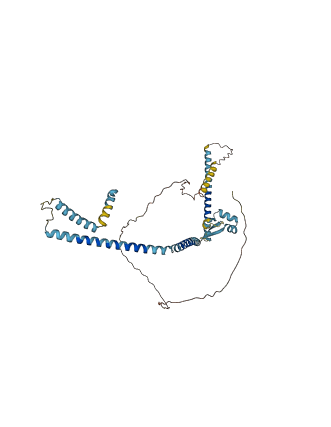
Descriptions
The autoinhibited protein was predicted that may have potential autoinhibitory elements via cis-regPred.
Autoinhibitory domains (AIDs)
Target domain |
|
Relief mechanism |
|
Assay |
cis-regPred |
Accessory elements
No accessory elements

6 variants for P33441
| Variant ID(s) | Position | Change | Description | Diseaes Association | Provenance |
|---|---|---|---|---|---|
| s13-148638 | 16 | H>Y | No | SGRP | |
| s13-148528 | 52 | K>N | No | SGRP | |
| s13-147966 | 240 | I>V | No | SGRP | |
| s13-147927 | 253 | N>D | No | SGRP | |
| s13-147864 | 274 | E>K | No | SGRP | |
| s13-147708 | 326 | N>H | No | SGRP |
No associated diseases with P33441
No regional properties for P33441
| Type | Name | Position | InterPro Accession |
|---|---|---|---|
| No domain, repeats, and functional sites for P33441 | |||
4 GO annotations of cellular component
| Name | Definition |
|---|---|
| chromosome, telomeric region | The end of a linear chromosome, required for the integrity and maintenance of the end. A chromosome telomere usually includes a region of telomerase-encoded repeats the length of which rarely exceeds 20 bp each and that permits the formation of a telomeric loop (T-loop). The telomeric repeat region is usually preceded by a sub-telomeric region that is gene-poor but rich in repetitive elements. Some telomeres only consist of the latter part (for eg. D. melanogaster telomeres). |
| nucleoplasmic THO complex | The THO complex when it is acting as a nuclear complex that is required for transcription elongation through genes containing tandemly repeated DNA sequences. In S. cerevisiae, it is composed of four subunits: Hpr1, Tho2, Thp2, and Mft1, while the human complex is composed of 7 subunits. |
| THO complex part of transcription export complex | The THO complex when it is part of the TREX (TRanscription EXport) complex that is involved in coupling transcription to export of mRNAs to the cytoplasm. In S. cerevisiae, it is composed of four subunits: Hpr1, Tho2, Thp1, and Mft1, while the human complex is composed of 7 subunits. |
| transcription export complex | The transcription export (TREX) complex couples transcription elongation by RNA polymerase II to mRNA export. The complex associates with the polymerase and travels with it along the length of the transcribed gene. TREX is composed of the THO transcription elongation complex as well as other proteins that couple THO to mRNA export proteins. The TREX complex is known to be found in a wide range of eukaryotes, including S. cerevisiae and metazoans. |
2 GO annotations of molecular function
| Name | Definition |
|---|---|
| molecular adaptor activity | The binding activity of a molecule that brings together two or more molecules through a selective, non-covalent, often stoichiometric interaction, permitting those molecules to function in a coordinated way. |
| nucleic acid binding | Binding to a nucleic acid. |
5 GO annotations of biological process
| Name | Definition |
|---|---|
| DNA recombination | Any process in which a new genotype is formed by reassortment of genes resulting in gene combinations different from those that were present in the parents. In eukaryotes genetic recombination can occur by chromosome assortment, intrachromosomal recombination, or nonreciprocal interchromosomal recombination. Interchromosomal recombination occurs by crossing over. In bacteria it may occur by genetic transformation, conjugation, transduction, or F-duction. |
| mRNA export from nucleus | The directed movement of mRNA from the nucleus to the cytoplasm. |
| mRNA processing | Any process involved in the conversion of a primary mRNA transcript into one or more mature mRNA(s) prior to translation into polypeptide. |
| stress granule assembly | The aggregation, arrangement and bonding together of proteins and RNA molecules to form a stress granule. |
| transcription elongation by RNA polymerase II promoter | The extension of an RNA molecule after transcription initiation and promoter clearance at an RNA polymerase II promoter by the addition of ribonucleotides catalyzed by RNA polymerase II. |
No homologous proteins in AiPD
| UniProt AC | Gene Name | Protein Name | Species | Evidence Code |
|---|---|---|---|---|
| No homologous proteins | ||||
| 10 | 20 | 30 | 40 | 50 | 60 |
| MPLSQKQIDQ | VRTKVHYSEV | DTPFNKYLDI | LGKVTKLTGS | IINGTLSNDD | SKIEKLTEQN |
| 70 | 80 | 90 | 100 | 110 | 120 |
| ISQLKESAHL | RFLDLQSSID | TKKVADENWE | TCQQETLAKL | ENLKDKLPDI | KSIHSKLLLR |
| 130 | 140 | 150 | 160 | 170 | 180 |
| IGKLQGLYDS | VQVINREVEG | LSEGRTSLVV | TRAEWEKELG | TDLVKFLIEK | NYLKLVDPGL |
| 190 | 200 | 210 | 220 | 230 | 240 |
| KKDSSEERYR | IYDDFSKGPK | ELESINASMK | SDIENVRQEV | SSYKEKWLRD | AEIFGKITSI |
| 250 | 260 | 270 | 280 | 290 | 300 |
| FKEELLKRDG | LLNEAEGDNI | DEDYESDEDE | ERKERFKRQR | SMVEVNTIEN | VDEKEESDHE |
| 310 | 320 | 330 | 340 | 350 | 360 |
| YDDQEDEENE | EEDDMEVDVE | DIKEDNEVDG | ESSQQEDNSR | QGNNEETDKE | TGVIEEPDAV |
| 370 | 380 | 390 | |||
| NDAEEADSDH | SSRKLGGTTS | DFSASSSVEE | VK |