P33231
Gene name |
lldP |
Protein name |
L-lactate permease |
Names |
|
Species |
Escherichia coli (strain K12) |
KEGG Pathway |
eco:b3603 |
EC number |
|
Protein Class |
|
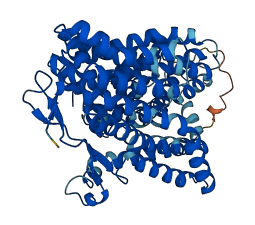
Descriptions
The autoinhibited protein was predicted that may have potential autoinhibitory elements via cis-regPred.
Autoinhibitory domains (AIDs)
Target domain |
|
Relief mechanism |
|
Assay |
cis-regPred |
Accessory elements
No accessory elements
Autoinhibited structure

Activated structure
1 structures for P33231
| Entry ID | Method | Resolution | Chain | Position | Source |
|---|---|---|---|---|---|
| AF-P33231-F1 | Predicted | AlphaFoldDB |
No variants for P33231
| Variant ID(s) | Position | Change | Description | Diseaes Association | Provenance |
|---|---|---|---|---|---|
| No variants for P33231 | |||||
No associated diseases with P33231
No regional properties for P33231
| Type | Name | Position | InterPro Accession |
|---|---|---|---|
| No domain, repeats, and functional sites for P33231 | |||
2 GO annotations of cellular component
| Name | Definition |
|---|---|
| integral component of plasma membrane | The component of the plasma membrane consisting of the gene products and protein complexes having at least some part of their peptide sequence embedded in the hydrophobic region of the membrane. |
| plasma membrane | The membrane surrounding a cell that separates the cell from its external environment. It consists of a phospholipid bilayer and associated proteins. |
2 GO annotations of molecular function
| Name | Definition |
|---|---|
| lactate transmembrane transporter activity | Enables the transfer of lactate from one side of a membrane to the other. Lactate is 2-hydroxypropanoate, CH3-CHOH-COOH; L(+)-lactate is formed by anaerobic glycolysis in animal tissues, and DL-lactate is found in sour milk, molasses and certain fruit juices. |
| solute:proton symporter activity | Enables the transfer of a solute or solutes from one side of a membrane to the other according to the reaction: solute(out) + H+(out) = solute(in) + H+(in). |
1 GO annotations of biological process
| Name | Definition |
|---|---|
| cellular response to DNA damage stimulus | Any process that results in a change in state or activity of a cell (in terms of movement, secretion, enzyme production, gene expression, etc.) as a result of a stimulus indicating damage to its DNA from environmental insults or errors during metabolism. |
No homologous proteins in AiPD
| UniProt AC | Gene Name | Protein Name | Species | Evidence Code |
|---|---|---|---|---|
| No homologous proteins | ||||
| 10 | 20 | 30 | 40 | 50 | 60 |
| MNLWQQNYDP | AGNIWLSSLI | ASLPILFFFF | ALIKLKLKGY | VAASWTVAIA | LAVALLFYKM |
| 70 | 80 | 90 | 100 | 110 | 120 |
| PVANALASVV | YGFFYGLWPI | AWIIIAAVFV | YKISVKTGQF | DIIRSSILSI | TPDQRLQMLI |
| 130 | 140 | 150 | 160 | 170 | 180 |
| VGFCFGAFLE | GAAGFGAPVA | ITAALLVGLG | FKPLYAAGLC | LIVNTAPVAF | GAMGIPILVA |
| 190 | 200 | 210 | 220 | 230 | 240 |
| GQVTGIDSFE | IGQMVGRQLP | FMTIIVLFWI | MAIMDGWRGI | KETWPAVVVA | GGSFAIAQYL |
| 250 | 260 | 270 | 280 | 290 | 300 |
| SSNFIGPELP | DIISSLVSLL | CLTLFLKRWQ | PVRVFRFGDL | GASQVDMTLA | HTGYTAGQVL |
| 310 | 320 | 330 | 340 | 350 | 360 |
| RAWTPFLFLT | ATVTLWSIPP | FKALFASGGA | LYEWVINIPV | PYLDKLVARM | PPVVSEATAY |
| 370 | 380 | 390 | 400 | 410 | 420 |
| AAVFKFDWFS | ATGTAILFAA | LLSIVWLKMK | PSDAISTFGS | TLKELALPIY | SIGMVLAFAF |
| 430 | 440 | 450 | 460 | 470 | 480 |
| ISNYSGLSST | LALALAHTGH | AFTFFSPFLG | WLGVFLTGSD | TSSNALFAAL | QATAAQQIGV |
| 490 | 500 | 510 | 520 | 530 | 540 |
| SDLLLVAANT | TGGVTGKMIS | PQSIAIACAA | VGLVGKESDL | FRFTVKHSLI | FTCIVGVITT |
| 550 | |||||
| LQAYVLTWMI | P |