P32839
Gene name |
BCS1 (YDR375C, D9481.17) |
Protein name |
Mitochondrial chaperone BCS1 |
Names |
|
Species |
Saccharomyces cerevisiae (strain ATCC 204508 / S288c) (Baker's yeast) |
KEGG Pathway |
sce:YDR375C |
EC number |
|
Protein Class |
|
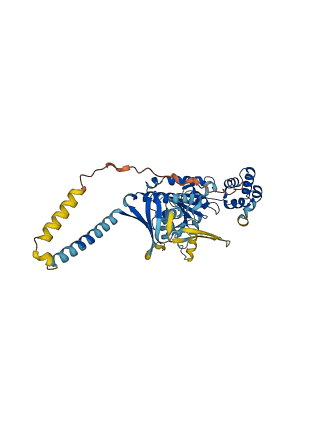
Descriptions
The autoinhibited protein was predicted that may have potential autoinhibitory elements via cis-regPred.
Autoinhibitory domains (AIDs)
Target domain |
|
Relief mechanism |
|
Assay |
cis-regPred |
Accessory elements
No accessory elements
Autoinhibited structure

Activated structure
4 structures for P32839
| Entry ID | Method | Resolution | Chain | Position | Source |
|---|---|---|---|---|---|
| 6SH3 | EM | 340 A | A/B/C/D/E/F/G | 1-456 | PDB |
| 6SH4 | EM | 440 A | A/B/C/D/E/F/G | 1-456 | PDB |
| 6SH5 | EM | 460 A | A/B/C/D/E/F/G | 1-456 | PDB |
| AF-P32839-F1 | Predicted | AlphaFoldDB |
4 variants for P32839
| Variant ID(s) | Position | Change | Description | Diseaes Association | Provenance |
|---|---|---|---|---|---|
| s04-1226435 | 32 | D>Y | No | SGRP | |
| s04-1225584 | 315 | I>M | No | SGRP | |
| s04-1225534 | 332 | G>D | No | SGRP | |
| s04-1225190 | 447 | S>A | No | SGRP |
No associated diseases with P32839
5 GO annotations of cellular component
| Name | Definition |
|---|---|
| cytosol | The part of the cytoplasm that does not contain organelles but which does contain other particulate matter, such as protein complexes. |
| integral component of membrane | The component of a membrane consisting of the gene products and protein complexes having at least some part of their peptide sequence embedded in the hydrophobic region of the membrane. |
| mitochondrial inner membrane | The inner, i.e. lumen-facing, lipid bilayer of the mitochondrial envelope. It is highly folded to form cristae. |
| mitochondrial intermembrane space | The region between the inner and outer lipid bilayers of the mitochondrial envelope. |
| mitochondrion | A semiautonomous, self replicating organelle that occurs in varying numbers, shapes, and sizes in the cytoplasm of virtually all eukaryotic cells. It is notably the site of tissue respiration. |
4 GO annotations of molecular function
| Name | Definition |
|---|---|
| ATP binding | Binding to ATP, adenosine 5'-triphosphate, a universally important coenzyme and enzyme regulator. |
| ATP hydrolysis activity | Catalysis of the reaction: ATP + H2O = ADP + H+ phosphate. ATP hydrolysis is used in some reactions as an energy source, for example to catalyze a reaction or drive transport against a concentration gradient. |
| ATPase-coupled transmembrane transporter activity | Primary active transporter of a solute across a membrane, via the reaction: ATP + H2O = ADP + phosphate, to directly drive the transport of a substance across a membrane. The transport protein may be transiently phosphorylated (P-type transporters), or not (ABC-type transporters and other families of transporters). Primary active transport occurs up the solute's concentration gradient and is driven by a primary energy source. |
| protein transmembrane transporter activity | Enables the transfer of a protein from one side of a membrane to the other. |
3 GO annotations of biological process
| Name | Definition |
|---|---|
| chaperone-mediated protein complex assembly | The aggregation, arrangement and bonding together of a set of components to form a protein complex, mediated by chaperone molecules that do not form part of the finished complex. |
| mitochondrial respiratory chain complex III assembly | The aggregation, arrangement and bonding together of a set of components to form the cytochrome bc(1) complex (also known as ubiquinol-cytochrome c reductase), in the mitochondrial inner membrane. |
| protein insertion into mitochondrial inner membrane from matrix | The process in which a protein is incorporated into the mitochondrial inner membrane from the matrix side. This includes membrane insertion of newly synthesized mitochondrially-encoded proteins, and insertion of nuclear-encoded proteins after their import into the mitochondrial matrix. |
No homologous proteins in AiPD
| UniProt AC | Gene Name | Protein Name | Species | Evidence Code |
|---|---|---|---|---|
| No homologous proteins | ||||
| 10 | 20 | 30 | 40 | 50 | 60 |
| MSDKPIDIQY | DKQATPNLSG | VITPPTNETG | NDSVREKLSK | LVGDAMSNNP | YFAAGGGLMI |
| 70 | 80 | 90 | 100 | 110 | 120 |
| LGTGLAVARS | GIIKASRVLY | RQMIVDLEIQ | SKDKSYAWFL | TWMAKHPQRV | SRHLSVRTNY |
| 130 | 140 | 150 | 160 | 170 | 180 |
| IQHDNGSVST | KFSLVPGPGN | HWIRYKGAFI | LIKRERSAKM | IDIANGSPFE | TVTLTTLYRD |
| 190 | 200 | 210 | 220 | 230 | 240 |
| KHLFDDILNE | AKDIALKTTE | GKTVIYTSFG | PEWRKFGQPK | AKRMLPSVIL | DSGIKEGILD |
| 250 | 260 | 270 | 280 | 290 | 300 |
| DVYDFMKNGK | WYSDRGIPYR | RGYLLYGPPG | SGKTSFIQAL | AGELDYNICI | LNLSENNLTD |
| 310 | 320 | 330 | 340 | 350 | 360 |
| DRLNHLMNNM | PERSILLLED | IDAAFNKRSQ | TGEQGFHSSV | TFSGLLNALD | GVTSSEETIT |
| 370 | 380 | 390 | 400 | 410 | 420 |
| FMTTNHPEKL | DAAIMRPGRI | DYKVFVGNAT | PYQVEKMFMK | FYPGETDICK | KFVNSVKELD |
| 430 | 440 | 450 | |||
| ITVSTAQLQG | LFVMNKDAPH | DALKMVSSLR | NANHIF |