P32829
Gene name |
MRE11 (YMR224C, YM9959.06C) |
Protein name |
Double-strand break repair protein MRE11 |
Names |
|
Species |
Saccharomyces cerevisiae (strain ATCC 204508 / S288c) (Baker's yeast) |
KEGG Pathway |
sce:YMR224C |
EC number |
|
Protein Class |
|
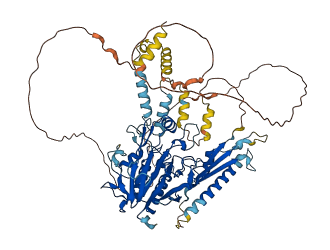
Descriptions
The autoinhibited protein was predicted that may have potential autoinhibitory elements via cis-regPred.
Autoinhibitory domains (AIDs)
Target domain |
|
Relief mechanism |
|
Assay |
cis-regPred |
Accessory elements
No accessory elements
Autoinhibited structure

Activated structure
1 structures for P32829
| Entry ID | Method | Resolution | Chain | Position | Source |
|---|---|---|---|---|---|
| AF-P32829-F1 | Predicted | AlphaFoldDB |
16 variants for P32829
| Variant ID(s) | Position | Change | Description | Diseaes Association | Provenance |
|---|---|---|---|---|---|
| s13-720532 | 41 | M>V | No | SGRP | |
| s13-719571 | 361 | P>Q | No | SGRP | |
| s13-719515 | 380 | P>S | strain: SK1 [UniProt] | No | SGRP |
| s13-719242 | 471 | V>I | No | SGRP | |
| s13-718972 | 561 | P>S | No | SGRP | |
| s13-718953 | 567 | H>R | No | SGRP | |
| s13-718920 | 578 | S>N | No | SGRP | |
| s13-718854 | 600 | I>T | No | SGRP | |
| s13-718855 | 600 | I>V | No | SGRP | |
| s13-718790 | 621 | D>E | No | SGRP | |
| s13-718762 | 631 | N>D | No | SGRP | |
| s13-718704 | 650 | G>D | No | SGRP | |
| s13-718678 | 659 | P>S | strain: SK1 [UniProt] | No | SGRP |
| s13-718674 | 660 | A>V | No | SGRP | |
| s13-718644 | 670 | G>E | No | SGRP | |
| s13-718590 | 688 | A>V | No | SGRP |
No associated diseases with P32829
5 GO annotations of cellular component
| Name | Definition |
|---|---|
| mitochondrion | A semiautonomous, self replicating organelle that occurs in varying numbers, shapes, and sizes in the cytoplasm of virtually all eukaryotic cells. It is notably the site of tissue respiration. |
| Mre11 complex | Trimeric protein complex that possesses endonuclease activity; involved in meiotic recombination, DNA repair and checkpoint signaling. In Saccharomyces cerevisiae, the complex comprises Mre11p, Rad50p, and Xrs2p; complexes identified in other species generally contain proteins orthologous to the Saccharomyces cerevisiae proteins. |
| nucleoplasm | That part of the nuclear content other than the chromosomes or the nucleolus. |
| nucleus | A membrane-bounded organelle of eukaryotic cells in which chromosomes are housed and replicated. In most cells, the nucleus contains all of the cell's chromosomes except the organellar chromosomes, and is the site of RNA synthesis and processing. In some species, or in specialized cell types, RNA metabolism or DNA replication may be absent. |
| site of double-strand break | A region of a chromosome at which a DNA double-strand break has occurred. DNA damage signaling and repair proteins accumulate at the lesion to respond to the damage and repair the DNA to form a continuous DNA helix. |
11 GO annotations of molecular function
| Name | Definition |
|---|---|
| 3'-5' exonuclease activity | Catalysis of the hydrolysis of ester linkages within nucleic acids by removing nucleotide residues from the 3' end. |
| 3'-5'-exodeoxyribonuclease activity | Catalysis of the sequential cleavage of mononucleotides from a free 3' terminus of a DNA molecule. |
| double-stranded telomeric DNA binding | Binding to double-stranded telomere-associated DNA. |
| endodeoxyribonuclease activity | Catalysis of the hydrolysis of ester linkages within deoxyribonucleic acid by creating internal breaks. |
| endonuclease activity | Catalysis of the hydrolysis of ester linkages within nucleic acids by creating internal breaks. |
| G-quadruplex DNA binding | Binding to G-quadruplex DNA structures, in which groups of four guanines adopt a flat, cyclic Hoogsteen hydrogen-bonding arrangement known as a guanine tetrad. The stacking of guanine tetrads results in G-quadruplex DNA structures. G-quadruplex DNA can form under physiological conditions from some G-rich sequences, such as those found in telomeres, immunoglobulin switch regions, gene promoters, fragile X repeats, and the dimerization domain in the human immunodeficiency virus (HIV) genome. |
| manganese ion binding | Binding to a manganese ion (Mn). |
| molecular adaptor activity | The binding activity of a molecule that brings together two or more molecules through a selective, non-covalent, often stoichiometric interaction, permitting those molecules to function in a coordinated way. |
| single-stranded DNA endodeoxyribonuclease activity | Catalysis of the hydrolysis of ester linkages within a single-stranded deoxyribonucleic acid molecule by creating internal breaks. |
| single-stranded telomeric DNA binding | Binding to single-stranded telomere-associated DNA. |
| telomeric DNA binding | Binding to a telomere, a specific structure at the end of a linear chromosome required for the integrity and maintenance of the end. |
19 GO annotations of biological process
| Name | Definition |
|---|---|
| ascospore formation | The process in which cells that are products of meiosis acquire the specialized features of ascospores. Ascospores are generally found in clusters of four or eight spores within a single mother cell, the ascus, and are characteristic of the ascomycete fungi (phylum Ascomycota). |
| base-excision repair | In base excision repair, an altered base is removed by a DNA glycosylase enzyme, followed by excision of the resulting sugar phosphate. The small gap left in the DNA helix is filled in by the sequential action of DNA polymerase and DNA ligase. |
| DNA double-strand break processing involved in repair via synthesis-dependent strand annealing | The 5' to 3' exonucleolytic resection of the DNA at the site of the break to form a 3' single-strand DNA overhang that results in the repair of a double strand break via synthesis-dependent strand annealing. |
| DNA repair | The process of restoring DNA after damage. Genomes are subject to damage by chemical and physical agents in the environment (e.g. UV and ionizing radiations, chemical mutagens, fungal and bacterial toxins, etc.) and by free radicals or alkylating agents endogenously generated in metabolism. DNA is also damaged because of errors during its replication. A variety of different DNA repair pathways have been reported that include direct reversal, base excision repair, nucleotide excision repair, photoreactivation, bypass, double-strand break repair pathway, and mismatch repair pathway. |
| double-strand break repair | The repair of double-strand breaks in DNA via homologous and nonhomologous mechanisms to reform a continuous DNA helix. |
| double-strand break repair via break-induced replication | The error-free repair of a double-strand break in DNA in which the centromere-proximal end of a broken chromosome searches for a homologous region in an intact chromosome. DNA synthesis initiates from the 3' end of the invading DNA strand, using the intact chromosome as the template, and progresses to the end of the chromosome. |
| double-strand break repair via homologous recombination | The error-free repair of a double-strand break in DNA in which the broken DNA molecule is repaired using homologous sequences. A strand in the broken DNA searches for a homologous region in an intact chromosome to serve as the template for DNA synthesis. The restoration of two intact DNA molecules results in the exchange, reciprocal or nonreciprocal, of genetic material between the intact DNA molecule and the broken DNA molecule. |
| double-strand break repair via nonhomologous end joining | The repair of a double-strand break in DNA in which the two broken ends are rejoined with little or no sequence complementarity. Information at the DNA ends may be lost due to the modification of broken DNA ends. This term covers instances of separate pathways, called classical (or canonical) and alternative nonhomologous end joining (C-NHEJ and A-NHEJ). These in turn may further branch into sub-pathways, but evidence is still unclear. |
| maintenance of DNA trinucleotide repeats | Any process involved in sustaining the fidelity and copy number of DNA trinucleotide repeats. DNA trinucleotide repeats are naturally occurring runs of three base-pairs. |
| meiotic DNA double-strand break formation | The cell cycle process in which double-strand breaks are generated at defined hotspots throughout the genome during meiosis I. This results in the initiation of meiotic recombination. |
| meiotic DNA double-strand break formation involved in reciprocal meiotic recombination | The cell cycle process in which double-strand breaks are generated at defined hotspots throughout the genome during meiosis I resulting in meiotic recombination. Meiotic recombination is the cell cycle process in which double strand breaks are formed and repaired through a double Holliday junction intermediate. |
| meiotic DNA double-strand break processing | The cell cycle process in which the 5' to 3' exonucleolytic resection of the DNA at the site of the break to form a 3' single-strand DNA overhang occurs. This takes place during meiosis. |
| mitochondrial double-strand break repair via homologous recombination | The repair of a double-strand break in mitochondrial DNA in which the broken DNA molecule is repaired using homologous sequences. |
| mitotic G2 DNA damage checkpoint signaling | A mitotic cell cycle checkpoint that detects and negatively regulates progression through the G2/M transition of the cell cycle in response to DNA damage. |
| mitotic intra-S DNA damage checkpoint signaling | A mitotic cell cycle checkpoint that slows DNA synthesis in response to DNA damage by the prevention of new origin firing and the stabilization of slow replication fork progression. |
| nucleoside monophosphate phosphorylation | The process of introducing one or more phosphate groups into a nucleoside monophosphate to produce a polyphosphorylated nucleoside. |
| reciprocal meiotic recombination | The cell cycle process in which double strand breaks are formed and repaired through a single or double Holliday junction intermediate. This results in the equal exchange of genetic material between non-sister chromatids in a pair of homologous chromosomes. These reciprocal recombinant products ensure the proper segregation of homologous chromosomes during meiosis I and create genetic diversity. |
| regulation of transcription involved in meiotic cell cycle | Any process that modulates the frequency, rate or extent of transcription as part of a meiotic cell cycle. |
| telomere maintenance | Any process that contributes to the maintenance of proper telomeric length and structure by affecting and monitoring the activity of telomeric proteins, the length of telomeric DNA and the replication and repair of the DNA. These processes includes those that shorten, lengthen, replicate and repair the telomeric DNA sequences. |
No homologous proteins in AiPD
| UniProt AC | Gene Name | Protein Name | Species | Evidence Code |
|---|---|---|---|---|
| No homologous proteins | ||||
| 10 | 20 | 30 | 40 | 50 | 60 |
| MDYPDPDTIR | ILITTDNHVG | YNENDPITGD | DSWKTFHEVM | MLAKNNNVDM | VVQSGDLFHV |
| 70 | 80 | 90 | 100 | 110 | 120 |
| NKPSKKSLYQ | VLKTLRLCCM | GDKPCELELL | SDPSQVFHYD | EFTNVNYEDP | NFNISIPVFG |
| 130 | 140 | 150 | 160 | 170 | 180 |
| ISGNHDDASG | DSLLCPMDIL | HATGLINHFG | KVIESDKIKV | VPLLFQKGST | KLALYGLAAV |
| 190 | 200 | 210 | 220 | 230 | 240 |
| RDERLFRTFK | DGGVTFEVPT | MREGEWFNLM | CVHQNHTGHT | NTAFLPEQFL | PDFLDMVIWG |
| 250 | 260 | 270 | 280 | 290 | 300 |
| HEHECIPNLV | HNPIKNFDVL | QPGSSVATSL | CEAEAQPKYV | FILDIKYGEA | PKMTPIPLET |
| 310 | 320 | 330 | 340 | 350 | 360 |
| IRTFKMKSIS | LQDVPHLRPH | DKDATSKYLI | EQVEEMIRDA | NEETKQKLAD | DGEGDMVAEL |
| 370 | 380 | 390 | 400 | 410 | 420 |
| PKPLIRLRVD | YSAPSNTQSP | IDYQVENPRR | FSNRFVGRVA | NGNNVVQFYK | KRSPVTRSKK |
| 430 | 440 | 450 | 460 | 470 | 480 |
| SGINGTSISD | RDVEKLFSES | GGELEVQTLV | NDLLNKMQLS | LLPEVGLNEA | VKKFVDKDEK |
| 490 | 500 | 510 | 520 | 530 | 540 |
| TALKEFISHE | ISNEVGILST | NEEFLRTDDA | EEMKALIKQV | KRANSVRPTP | PKENDETNFA |
| 550 | 560 | 570 | 580 | 590 | 600 |
| FNGNGLDSFR | SSNREVRTGS | PDITQSHVDN | ESRITHISQA | ESSKPTSKPK | RVRTATKKKI |
| 610 | 620 | 630 | 640 | 650 | 660 |
| PAFSDSTVIS | DAENELGDNN | DAQDDVDIDE | NDIIMVSTDE | EDASYGLLNG | RKTKTKTRPA |
| 670 | 680 | 690 | |||
| ASTKTASRRG | KGRASRTPKT | DILGSLLAKK | RK |