P32453
Gene name |
ATP11 (YNL315C, N0357) |
Protein name |
Protein ATP11, mitochondrial |
Names |
|
Species |
Saccharomyces cerevisiae (strain ATCC 204508 / S288c) (Baker's yeast) |
KEGG Pathway |
sce:YNL315C |
EC number |
|
Protein Class |
|
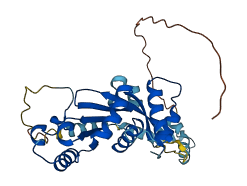
Descriptions
The autoinhibited protein was predicted that may have potential autoinhibitory elements via cis-regPred.
Autoinhibitory domains (AIDs)
Target domain |
|
Relief mechanism |
|
Assay |
cis-regPred |
Accessory elements
No accessory elements
Autoinhibited structure

Activated structure
1 structures for P32453
| Entry ID | Method | Resolution | Chain | Position | Source |
|---|---|---|---|---|---|
| AF-P32453-F1 | Predicted | AlphaFoldDB |
6 variants for P32453
| Variant ID(s) | Position | Change | Description | Diseaes Association | Provenance |
|---|---|---|---|---|---|
| s14-44272 | 3 | R>K | No | SGRP | |
| s14-44255 | 9 | G>S | No | SGRP | |
| s14-44252 | 10 | T>A | No | SGRP | |
| s14-44215 | 22 | F>S | No | SGRP | |
| s14-43820 | 154 | T>A | No | SGRP | |
| s14-43748 | 178 | V>L | No | SGRP |
No associated diseases with P32453
No regional properties for P32453
| Type | Name | Position | InterPro Accession |
|---|---|---|---|
| No domain, repeats, and functional sites for P32453 | |||
1 GO annotations of cellular component
| Name | Definition |
|---|---|
| mitochondrion | A semiautonomous, self replicating organelle that occurs in varying numbers, shapes, and sizes in the cytoplasm of virtually all eukaryotic cells. It is notably the site of tissue respiration. |
1 GO annotations of molecular function
| Name | Definition |
|---|---|
| unfolded protein binding | Binding to an unfolded protein. |
2 GO annotations of biological process
| Name | Definition |
|---|---|
| mitochondrial proton-transporting ATP synthase complex assembly | The aggregation, arrangement and bonding together of a proton-transporting ATP synthase in the mitochondrial inner membrane. |
| mitochondrion organization | A process that is carried out at the cellular level which results in the assembly, arrangement of constituent parts, or disassembly of a mitochondrion; includes mitochondrial morphogenesis and distribution, and replication of the mitochondrial genome as well as synthesis of new mitochondrial components. |
No homologous proteins in AiPD
| UniProt AC | Gene Name | Protein Name | Species | Evidence Code |
|---|---|---|---|---|
| No homologous proteins | ||||
| 10 | 20 | 30 | 40 | 50 | 60 |
| MWRLTRKIGT | RIHISNQLSP | IFNKAIGTVP | VFRFYSSSPE | QKYRKKLLEE | AQKQGFNSIE |
| 70 | 80 | 90 | 100 | 110 | 120 |
| ELKNHLKETI | ESKKREFNKI | DPLKELEDYQ | QKTQMENNNS | KHLMTKSRSP | LDPSAPKVPF |
| 130 | 140 | 150 | 160 | 170 | 180 |
| KTLDSFLDVG | KLKDLSKQEV | EFLWRARWAQ | KDNTLCAVIP | VSVYDKMMAN | ARNNPIFVLP |
| 190 | 200 | 210 | 220 | 230 | 240 |
| LPRQVQSEDA | KPNEEQGMEL | HYIQWQFVGP | QTTHCMMTSL | AEYKLHQEFA | RPHTTLQFHS |
| 250 | 260 | 270 | 280 | 290 | 300 |
| DLVKDKGIVF | MNGHVEPDTN | VNVQDAQLLL | LNVQRFYGAM | GEETPVAKQR | VQLLRDFSKA |
| 310 | |||||
| SPGFTVEKLI | SLSQSMEN |