P32372
Gene name |
rad4 (cut5, SPAC23C4.18c) |
Protein name |
S-M checkpoint control protein rad4 |
Names |
P74, Protein cut5 |
Species |
Schizosaccharomyces pombe (strain 972 / ATCC 24843) (Fission yeast) |
KEGG Pathway |
spo:SPAC23C4.18c |
EC number |
|
Protein Class |
|
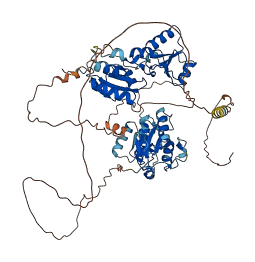
Descriptions
The autoinhibited protein was predicted that may have potential autoinhibitory elements via cis-regPred.
Autoinhibitory domains (AIDs)
Target domain |
|
Relief mechanism |
|
Assay |
cis-regPred |
Accessory elements
No accessory elements
Autoinhibited structure

Activated structure
7 variants for P32372
| Variant ID(s) | Position | Change | Description | Diseaes Association | Provenance |
|---|---|---|---|---|---|
| I_1062513_G_T | 76 | P>T | No | Jeffares_SNPs | |
| I_1062086_T_C | 218 | K>R | No | Jeffares_SNPs | |
| I_1061875_G_C | 288 | N>K | No | Jeffares_SNPs | |
| I_1061821_C_A | 306 | L>F | No | Jeffares_SNPs | |
| I_1061795_T_C | 315 | N>S | No | Jeffares_SNPs | |
| I_1061055_T_G | 562 | T>P | No | Jeffares_SNPs | |
| I_1061015_T_C | 575 | K>R | No | Jeffares_SNPs |
No associated diseases with P32372
4 regional properties for P32372
| Type | Name | Position | InterPro Accession |
|---|---|---|---|
| domain | BRCT domain | 2 - 82 | IPR001357-1 |
| domain | BRCT domain | 100 - 185 | IPR001357-2 |
| domain | BRCT domain | 298 - 384 | IPR001357-3 |
| domain | BRCT domain | 392 - 480 | IPR001357-4 |
8 GO annotations of cellular component
| Name | Definition |
|---|---|
| chromatin | The ordered and organized complex of DNA, protein, and sometimes RNA, that forms the chromosome. |
| cytosol | The part of the cytoplasm that does not contain organelles but which does contain other particulate matter, such as protein complexes. |
| DNA replication preinitiation complex | A protein-DNA complex assembled at eukaryotic DNA replication origins immediately prior to the initiation of DNA replication. The preinitiation complex is formed by the assembly of additional proteins onto an existing prereplicative complex. In budding yeast, the additional proteins might include Cdc45p, Sld2p, Sld3p, Dpb11p, DNA polymerases, and others; in fission yeast the GINS complex is present. |
| mitotic spindle | A spindle that forms as part of mitosis. Mitotic and meiotic spindles contain distinctive complements of proteins associated with microtubules. |
| mitotic spindle pole body | The microtubule organizing center that forms as part of the mitotic cell cycle; functionally homologous to the animal cell centrosome. |
| nuclear replication fork | The Y-shaped region of a nuclear replicating DNA molecule, resulting from the separation of the DNA strands and in which the synthesis of new strands takes place. Also includes associated protein complexes. |
| nucleus | A membrane-bounded organelle of eukaryotic cells in which chromosomes are housed and replicated. In most cells, the nucleus contains all of the cell's chromosomes except the organellar chromosomes, and is the site of RNA synthesis and processing. In some species, or in specialized cell types, RNA metabolism or DNA replication may be absent. |
| site of double-strand break | A region of a chromosome at which a DNA double-strand break has occurred. DNA damage signaling and repair proteins accumulate at the lesion to respond to the damage and repair the DNA to form a continuous DNA helix. |
1 GO annotations of molecular function
| Name | Definition |
|---|---|
| signaling adaptor activity | The binding activity of a molecule that brings together two or more molecules in a signaling pathway, permitting those molecules to function in a coordinated way. Adaptor molecules themselves do not have catalytic activity. |
4 GO annotations of biological process
| Name | Definition |
|---|---|
| DNA replication initiation | The process in which DNA-dependent DNA replication is started; this begins with the ATP dependent loading of an initiator complex onto the DNA, this is followed by DNA melting and helicase activity. In bacteria, the gene products that enable the helicase activity are loaded after the initial melting and in archaea and eukaryotes, the gene products that enable the helicase activity are inactive when they are loaded and subsequently activate. |
| mitotic DNA damage checkpoint signaling | A signal transduction process involved in mitotic DNA damage checkpoint. |
| mitotic DNA replication checkpoint signaling | A signal transduction process that contributes to a mitotic DNA replication checkpoint. |
| mitotic G2 DNA damage checkpoint signaling | A mitotic cell cycle checkpoint that detects and negatively regulates progression through the G2/M transition of the cell cycle in response to DNA damage. |
No homologous proteins in AiPD
| UniProt AC | Gene Name | Protein Name | Species | Evidence Code |
|---|---|---|---|---|
| No homologous proteins | ||||
| 10 | 20 | 30 | 40 | 50 | 60 |
| MGSSKPLKGF | VICCTSIDLK | QRTEISTKAT | KLGAAYRSDF | TKDVTHLIAG | DFDTPKYKFA |
| 70 | 80 | 90 | 100 | 110 | 120 |
| AKSRPDIKIM | SSEWIPVLYE | SWVQGEDLDD | GLLVDKHFLP | TLFKCRVCLT | NIGQPERSRI |
| 130 | 140 | 150 | 160 | 170 | 180 |
| ENYVLKHGGT | FCPDLTRDVT | HLIAGTSSGR | KYEYALKWKI | NVVCVEWLWQ | SIQRNAVLEP |
| 190 | 200 | 210 | 220 | 230 | 240 |
| QYFQLDMPAE | KIGLGAYVRL | DPNTTEAKSY | SENQKISKNK | EKSGQSLAAL | AEEADLEPVI |
| 250 | 260 | 270 | 280 | 290 | 300 |
| MKRGKKRDRS | ILWEELNNGK | FEFSSRSEEN | SVLLDDFTPE | TVQPLEENEL | DTELNIENEA |
| 310 | 320 | 330 | 340 | 350 | 360 |
| KLFKNLTFYL | YEFPNTKVSR | LHKCLSDNGG | QISEFLSSTI | DFVVIPHYFP | VDELPIFSFP |
| 370 | 380 | 390 | 400 | 410 | 420 |
| TVNEWWIERC | LYYKKIFGID | EHALAKPFFR | PSLVPYFNGL | SIHLTGFKGE | ELSHLKKALT |
| 430 | 440 | 450 | 460 | 470 | 480 |
| ILGAVVHEFL | GVQRSILLVN | TNEPFSMKTR | FKIQHATEWN | VRVVGVAWLW | NIIQSGKFID |
| 490 | 500 | 510 | 520 | 530 | 540 |
| QVSPWAIDKK | ENQEIKKFTN | QNNMVFPTSD | RDTRLQNSLA | QQPIGHSTPH | NSPSLLSVKK |
| 550 | 560 | 570 | 580 | 590 | 600 |
| RQNNHIRSNT | LIQLNSNSKD | STIFPRRSVT | VPGDKIDTVW | KSSVTKPETP | TSPQEHVSYI |
| 610 | 620 | 630 | 640 | ||
| DPDAQREKHK | LYAQLTSNVD | AIPPANDLQN | QENGLLLITE | SHRKLRRR |