P32354
Gene name |
MCM10 (DNA43, YIL150C) |
Protein name |
Minichromosome maintenance protein 10 |
Names |
Protein DNA43 |
Species |
Saccharomyces cerevisiae (strain ATCC 204508 / S288c) (Baker's yeast) |
KEGG Pathway |
sce:YIL150C |
EC number |
|
Protein Class |
|
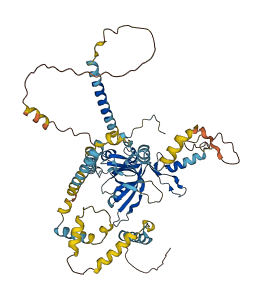
Descriptions
The autoinhibited protein was predicted that may have potential autoinhibitory elements via cis-regPred.
Autoinhibitory domains (AIDs)
Target domain |
|
Relief mechanism |
|
Assay |
cis-regPred |
Accessory elements
No accessory elements
Autoinhibited structure

Activated structure
1 structures for P32354
| Entry ID | Method | Resolution | Chain | Position | Source |
|---|---|---|---|---|---|
| AF-P32354-F1 | Predicted | AlphaFoldDB |
10 variants for P32354
| Variant ID(s) | Position | Change | Description | Diseaes Association | Provenance |
|---|---|---|---|---|---|
| s09-62514 | 72 | V>A | No | SGRP | |
| s09-62481 | 83 | G>D | No | SGRP | |
| s09-62207 | 174 | D>E | No | SGRP | |
| s09-62116 | 205 | A>S | No | SGRP | |
| s09-61692 | 346 | K>R | No | SGRP | |
| s09-61608 | 374 | E>V | No | SGRP | |
| s09-61495 | 412 | D>N | No | SGRP | |
| s09-61347 | 461 | V>A | No | SGRP | |
| s09-61323 | 469 | R>Q | No | SGRP | |
| s09-61180 | 517 | I>V | No | SGRP |
No associated diseases with P32354
1 regional properties for P32354
| Type | Name | Position | InterPro Accession |
|---|---|---|---|
| domain | Synaptotagmin-like mitochondrial-lipid-binding domain | 1 - 298 | IPR031468 |
Functions
4 GO annotations of cellular component
| Name | Definition |
|---|---|
| chromosome, telomeric region | The end of a linear chromosome, required for the integrity and maintenance of the end. A chromosome telomere usually includes a region of telomerase-encoded repeats the length of which rarely exceeds 20 bp each and that permits the formation of a telomeric loop (T-loop). The telomeric repeat region is usually preceded by a sub-telomeric region that is gene-poor but rich in repetitive elements. Some telomeres only consist of the latter part (for eg. D. melanogaster telomeres). |
| nucleus | A membrane-bounded organelle of eukaryotic cells in which chromosomes are housed and replicated. In most cells, the nucleus contains all of the cell's chromosomes except the organellar chromosomes, and is the site of RNA synthesis and processing. In some species, or in specialized cell types, RNA metabolism or DNA replication may be absent. |
| replication fork | The Y-shaped region of a replicating DNA molecule, resulting from the separation of the DNA strands and in which the synthesis of new strands takes place. Also includes associated protein complexes. |
| replication fork protection complex | A protein complex conserved in eukaryotes and associated with the replication fork; the complex stabilizes stalled replication forks and is thought to be involved in coordinating leading- and lagging-strand synthesis and in replication checkpoint signaling. |
4 GO annotations of molecular function
| Name | Definition |
|---|---|
| DNA replication origin binding | Binding to a DNA replication origin, a unique DNA sequence of a replicon at which DNA replication is initiated and proceeds bidirectionally or unidirectionally. |
| double-stranded DNA binding | Binding to double-stranded DNA. |
| metal ion binding | Binding to a metal ion. |
| single-stranded DNA binding | Binding to single-stranded DNA. |
6 GO annotations of biological process
| Name | Definition |
|---|---|
| cell cycle | The progression of biochemical and morphological phases and events that occur in a cell during successive cell replication or nuclear replication events. Canonically, the cell cycle comprises the replication and segregation of genetic material followed by the division of the cell, but in endocycles or syncytial cells nuclear replication or nuclear division may not be followed by cell division. |
| DNA replication initiation | The process in which DNA-dependent DNA replication is started; this begins with the ATP dependent loading of an initiator complex onto the DNA, this is followed by DNA melting and helicase activity. In bacteria, the gene products that enable the helicase activity are loaded after the initial melting and in archaea and eukaryotes, the gene products that enable the helicase activity are inactive when they are loaded and subsequently activate. |
| DNA strand elongation involved in DNA replication | The process in which an existing DNA strand is extended by activities including the addition of nucleotides to the 3' end of the strand, complementary to an existing template, as part of DNA replication. |
| double-strand break repair via break-induced replication | The error-free repair of a double-strand break in DNA in which the centromere-proximal end of a broken chromosome searches for a homologous region in an intact chromosome. DNA synthesis initiates from the 3' end of the invading DNA strand, using the intact chromosome as the template, and progresses to the end of the chromosome. |
| silent mating-type cassette heterochromatin assembly | Repression of transcription at silent mating-type loci by alteration of the structure of chromatin. |
| subtelomeric heterochromatin assembly | The compaction of chromatin into heterochromatin at the subtelomeric region. |
1 homologous proteins in AiPD
| UniProt AC | Gene Name | Protein Name | Species | Evidence Code |
|---|---|---|---|---|
| Q7L590 | MCM10 | Protein MCM10 homolog | Homo sapiens (Human) | PR |
| 10 | 20 | 30 | 40 | 50 | 60 |
| MNDPREILAV | DPYNNITSDE | EDEQAIAREL | EFMERKRQAL | VERLKRKQEF | KKPQDPNFEA |
| 70 | 80 | 90 | 100 | 110 | 120 |
| IEVPQSPTKN | RVKVGSHNAT | QQGTKFEGSN | INEVRLSQLQ | QQPKPPASTT | TYFMEKFQNA |
| 130 | 140 | 150 | 160 | 170 | 180 |
| KKNEDKQIAK | FESMMNARVH | TFSTDEKKYV | PIITNELESF | SNLWVKKRYI | PEDDLKRALH |
| 190 | 200 | 210 | 220 | 230 | 240 |
| EIKILRLGKL | FAKIRPPKFQ | EPEYANWATV | GLISHKSDIK | FTSSEKPVKF | FMFTITDFQH |
| 250 | 260 | 270 | 280 | 290 | 300 |
| TLDVYIFGKK | GVERYYNLRL | GDVIAILNPE | VLPWRPSGRG | NFIKSFNLRI | SHDFKCILEI |
| 310 | 320 | 330 | 340 | 350 | 360 |
| GSSRDLGWCP | IVNKKTHKKC | GSPINISLHK | CCDYHREVQF | RGTSAKRIEL | NGGYALGAPT |
| 370 | 380 | 390 | 400 | 410 | 420 |
| KVDSQPSLYK | AKGENGFNII | KGTRKRLSEE | EERLKKSSHN | FTNSNSAKAF | FDEKFQNPDM |
| 430 | 440 | 450 | 460 | 470 | 480 |
| LANLDNKRRK | IIETKKSTAL | SRELGKIMRR | RESSGLEDKS | VGERQKMKRT | TESALQTGLI |
| 490 | 500 | 510 | 520 | 530 | 540 |
| QRLGFDPTHG | KISQVLKSSV | SGSEPKNNLL | GKKKTVINDL | LHYKKEKVIL | APSKNEWFKK |
| 550 | 560 | 570 | |||
| RSHREEVWQK | HFGSKETKET | SDGSASDLEI | I |