P32262
Gene name |
SERPINC1 (AT3) |
Protein name |
Antithrombin-III |
Names |
ATIII, Serpin C1 |
Species |
Ovis aries (Sheep) |
KEGG Pathway |
oas:443407 |
EC number |
|
Protein Class |
|
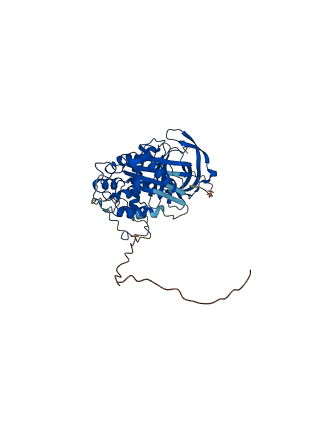
Descriptions
The autoinhibited protein was predicted that may have potential autoinhibitory elements via cis-regPred.
Autoinhibitory domains (AIDs)
Target domain |
|
Relief mechanism |
|
Assay |
cis-regPred |
Accessory elements
No accessory elements
Autoinhibited structure

Activated structure
1 structures for P32262
| Entry ID | Method | Resolution | Chain | Position | Source |
|---|---|---|---|---|---|
| AF-P32262-F1 | Predicted | AlphaFoldDB |
No variants for P32262
| Variant ID(s) | Position | Change | Description | Diseaes Association | Provenance |
|---|---|---|---|---|---|
| No variants for P32262 | |||||
No associated diseases with P32262
1 GO annotations of cellular component
| Name | Definition |
|---|---|
| extracellular space | That part of a multicellular organism outside the cells proper, usually taken to be outside the plasma membranes, and occupied by fluid. |
4 GO annotations of molecular function
| Name | Definition |
|---|---|
| heparin binding | Binding to heparin, a member of a group of glycosaminoglycans found mainly as an intracellular component of mast cells and which consist predominantly of alternating alpha-(1->4)-linked D-galactose and N-acetyl-D-glucosamine-6-sulfate residues. |
| identical protein binding | Binding to an identical protein or proteins. |
| protease binding | Binding to a protease or a peptidase. |
| serine-type endopeptidase inhibitor activity | Binds to and stops, prevents or reduces the activity of serine-type endopeptidases, enzymes that catalyze the hydrolysis of nonterminal peptide bonds in a polypeptide chain; a serine residue (and a histidine residue) are at the active center of the enzyme. |
2 GO annotations of biological process
| Name | Definition |
|---|---|
| blood coagulation | The sequential process in which the multiple coagulation factors of the blood interact, ultimately resulting in the formation of an insoluble fibrin clot; it may be divided into three stages: stage 1, the formation of intrinsic and extrinsic prothrombin converting principle; stage 2, the formation of thrombin; stage 3, the formation of stable fibrin polymers. |
| regulation of blood coagulation, intrinsic pathway | Any process that modulates the frequency, rate or extent of blood coagulation, intrinsic pathway. |
No homologous proteins in AiPD
| UniProt AC | Gene Name | Protein Name | Species | Evidence Code |
|---|---|---|---|---|
| No homologous proteins | ||||
| 10 | 20 | 30 | 40 | 50 | 60 |
| MISNGIGTVT | TGKRSMCLFP | LLLIGLWGCV | TCHRSPVEDI | CTAKPRDIPV | NPMCIYRSPE |
| 70 | 80 | 90 | 100 | 110 | 120 |
| KKATEGEGSE | QKIPGATNRR | VWELSKANSH | FATAFYQHLA | DSKNNNDNIF | LSPLSISTAF |
| 130 | 140 | 150 | 160 | 170 | 180 |
| AMTKLGACNN | TLKQLMEVFK | FDTISEKTSD | QIHFFFAKLN | CRLYRKANKS | SELVSANRLF |
| 190 | 200 | 210 | 220 | 230 | 240 |
| GDKSITFNET | YQDISEVVYG | AKLQPLDFKG | NAEQSRLTIN | QWISNKTEGR | ITDVIPPQAI |
| 250 | 260 | 270 | 280 | 290 | 300 |
| DEFTVLVLVN | TIYFKGLWKS | KFSPENTKKE | LFYKADGESC | SVPMMYQEGK | FRYRRVAEGT |
| 310 | 320 | 330 | 340 | 350 | 360 |
| QVLELPFKGD | DITMVLILPK | LEKPLAKVER | ELTPDMLQEW | LDELTETLLV | VHMPHFRIED |
| 370 | 380 | 390 | 400 | 410 | 420 |
| SFSVKEQLQD | MGLEDLFSPE | KSRLPGIVAE | GRNDLYVSDA | FHKAFLEVNE | EGSEAAASTV |
| 430 | 440 | 450 | 460 | ||
| ISIAGRSLNL | NRVTFQANRP | FLVLIREVAL | NTIIFMGRVA | NPCVN |