P31742
Gene name |
xpsE (pefE, XCC0660) |
Protein name |
Type II secretion system protein E |
Names |
T2SS protein E, General secretion pathway protein E, Type II traffic warden ATPase |
Species |
Xanthomonas campestris pv. campestris (strain ATCC 33913 / DSM 3586 / NCPPB 528 / LMG 568 / P 25) |
KEGG Pathway |
xcc:XCC0660 |
EC number |
7.4.2.8: Linked to the hydrolysis of a nucleoside triphosphate |
Protein Class |
|
Descriptions
The autoinhibited protein was predicted that may have potential autoinhibitory elements via cis-regPred.
Autoinhibitory domains (AIDs)
Target domain |
|
Relief mechanism |
|
Assay |
cis-regPred |
Accessory elements
No accessory elements
Autoinhibited structure

Activated structure
3 structures for P31742
| Entry ID | Method | Resolution | Chain | Position | Source |
|---|---|---|---|---|---|
| 2D27 | X-ray | 221 A | A | 1-149 | PDB |
| 2D28 | X-ray | 200 A | C | 1-149 | PDB |
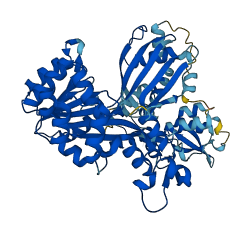
| AF-P31742-F1 | Predicted | AlphaFoldDB |
No variants for P31742
| Variant ID(s) | Position | Change | Description | Diseaes Association | Provenance |
|---|---|---|---|---|---|
| No variants for P31742 | |||||
No associated diseases with P31742
Functions
| Description | ||
|---|---|---|
| EC Number | 7.4.2.8 | Linked to the hydrolysis of a nucleoside triphosphate |
| Subcellular Localization |
|
|
| PANTHER Family | ||
| PANTHER Subfamily | ||
| PANTHER Protein Class | ||
| PANTHER Pathway Category | No pathway information available | |
2 GO annotations of cellular component
| Name | Definition |
|---|---|
| plasma membrane | The membrane surrounding a cell that separates the cell from its external environment. It consists of a phospholipid bilayer and associated proteins. |
| type II protein secretion system complex | A large protein complex, containing 12-15 subunits, that spans the cell envelope of Gram-negative bacteria and mediates the movement of proteins into the extracellular environment. The complex includes a component in the cytoplasm, an inner membrane subcomplex that reaches into the periplasmic compartment and a secretion pore in the outer membrane. Proteins using the Type II pathway are transported across the cytoplasmic membrane by the Sec or Tat complex. |
3 GO annotations of molecular function
| Name | Definition |
|---|---|
| ATP binding | Binding to ATP, adenosine 5'-triphosphate, a universally important coenzyme and enzyme regulator. |
| identical protein binding | Binding to an identical protein or proteins. |
| protein-exporting ATPase activity | Enables the transfer of a solute or solutes from one side of a membrane to the other according to the reaction: ATP + H2O + protein+(in) -> ADP + phosphate + protein+(out); drives the concomitant secretion of proteins. |
1 GO annotations of biological process
| Name | Definition |
|---|---|
| protein secretion by the type II secretion system | The process in which proteins are secreted across the outer membrane of Gram-negative bacteria by the type II secretion system. Proteins using this pathway are first translocated across the cytoplasmic membrane via the Sec or Tat pathways. |
No homologous proteins in AiPD
| UniProt AC | Gene Name | Protein Name | Species | Evidence Code |
|---|---|---|---|---|
| No homologous proteins | ||||
| 10 | 20 | 30 | 40 | 50 | 60 |
| MEQRSAETRI | VEALLERRRL | KDTDLVRARQ | LQAESGMGLL | ALLGRLGLVS | ERDHAETCAE |
| 70 | 80 | 90 | 100 | 110 | 120 |
| VLGLPLVDAR | QLGDTPPEML | PEVQGLSLRF | LKQFHLCPVG | ERDGRLDLWI | ADPYDDYAID |
| 130 | 140 | 150 | 160 | 170 | 180 |
| AVRLATGLPL | LLQVGLRSEI | DDLIERWYGQ | GRSAMGTIVE | TADGDASSTD | DIEALRDLAS |
| 190 | 200 | 210 | 220 | 230 | 240 |
| EAPVIRLVNL | VIQHAVELRA | SDIHIEPFES | RLKVRYRVDG | VLVEGESPPA | KLTAAVISRI |
| 250 | 260 | 270 | 280 | 290 | 300 |
| KIMAKLNIAE | RRLPQDGRIM | LRVQGKELDL | RVSTVPTAHG | ESVVMRLLDR | ETVVFDFYKL |
| 310 | 320 | 330 | 340 | 350 | 360 |
| GFTEDFLPQF | RKVLEQPHGI | MLVTGPTGSG | KTTTLYTALS | QLNTSDVKII | TVEDPVEYQI |
| 370 | 380 | 390 | 400 | 410 | 420 |
| EGINQIQAKP | QIGLDFANAL | RSIVRQDPDI | IMIGEMRDLE | TARIAIQSAL | TGHLVLSTLH |
| 430 | 440 | 450 | 460 | 470 | 480 |
| TNNAAGGITR | LLDMGVEDYL | LTSTINGILA | QRLVRKLDLA | NAERYAASPE | EIERFDLRRL |
| 490 | 500 | 510 | 520 | 530 | 540 |
| QPDGEIFLYR | PRATAAAPTG | YLGRTTIVEF | LVMNDELRRA | VMRRAGMGEI | EQLARKSGMR |
| 550 | 560 | ||||
| TMYEDGLSKA | LRGETTIEEV | LRVTEDA |