P30919
Gene name |
Aga |
Protein name |
N(4)-(Beta-N-acetylglucosaminyl)-L-asparaginase |
Names |
Aspartylglucosaminidase, AGA, Glycosylasparaginase, N4-(N-acetyl-beta-glucosaminyl)-L-asparagine amidase |
Species |
Rattus norvegicus (Rat) |
KEGG Pathway |
rno:290923 |
EC number |
3.5.1.26: In linear amides |
Protein Class |
|
Descriptions
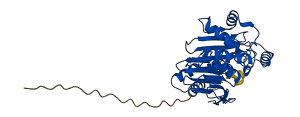
The autoinhibited protein was predicted that may have potential autoinhibitory elements via cis-regPred.
Autoinhibitory domains (AIDs)
Target domain |
|
Relief mechanism |
|
Assay |
cis-regPred |
Accessory elements
No accessory elements
Autoinhibited structure

Activated structure
1 structures for P30919
| Entry ID | Method | Resolution | Chain | Position | Source |
|---|---|---|---|---|---|
| AF-P30919-F1 | Predicted | AlphaFoldDB |
No variants for P30919
| Variant ID(s) | Position | Change | Description | Diseaes Association | Provenance |
|---|---|---|---|---|---|
| No variants for P30919 | |||||
No associated diseases with P30919
No regional properties for P30919
| Type | Name | Position | InterPro Accession |
|---|---|---|---|
| No domain, repeats, and functional sites for P30919 | |||
Functions
| Description | ||
|---|---|---|
| EC Number | 3.5.1.26 | In linear amides |
| Subcellular Localization |
|
|
| PANTHER Family | ||
| PANTHER Subfamily | ||
| PANTHER Protein Class | ||
| PANTHER Pathway Category | No pathway information available | |
4 GO annotations of cellular component
| Name | Definition |
|---|---|
| cytoplasm | The contents of a cell excluding the plasma membrane and nucleus, but including other subcellular structures. |
| endoplasmic reticulum | The irregular network of unit membranes, visible only by electron microscopy, that occurs in the cytoplasm of many eukaryotic cells. The membranes form a complex meshwork of tubular channels, which are often expanded into slitlike cavities called cisternae. The ER takes two forms, rough (or granular), with ribosomes adhering to the outer surface, and smooth (with no ribosomes attached). |
| extracellular space | That part of a multicellular organism outside the cells proper, usually taken to be outside the plasma membranes, and occupied by fluid. |
| lysosome | A small lytic vacuole that has cell cycle-independent morphology found in most animal cells and that contains a variety of hydrolases, most of which have their maximal activities in the pH range 5-6. The contained enzymes display latency if properly isolated. About 40 different lysosomal hydrolases are known and lysosomes have a great variety of morphologies and functions. |
3 GO annotations of molecular function
| Name | Definition |
|---|---|
| N4-(beta-N-acetylglucosaminyl)-L-asparaginase activity | Catalysis of the reaction: N(4)-(beta-N-acetyl-D-glucosaminyl)-L-asparagine + H(2)O = N-acetyl-beta-D-glucosaminylamine + L-aspartate + H(+). |
| peptidase activity | Catalysis of the hydrolysis of a peptide bond. A peptide bond is a covalent bond formed when the carbon atom from the carboxyl group of one amino acid shares electrons with the nitrogen atom from the amino group of a second amino acid. |
| protein self-association | Binding to a domain within the same polypeptide. |
2 GO annotations of biological process
| Name | Definition |
|---|---|
| protein deglycosylation | The removal of sugar residues from a glycosylated protein. |
| proteolysis | The hydrolysis of proteins into smaller polypeptides and/or amino acids by cleavage of their peptide bonds. |
| 10 | 20 | 30 | 40 | 50 | 60 |
| MARKWNLPFL | LLPLVLGIPL | VRGSNPLPLV | VNTWPFKNAT | EAAWWTLVSG | GSALDAVEKG |
| 70 | 80 | 90 | 100 | 110 | 120 |
| CAMCEKEQCG | GTVGFGGSPD | EVGETTLDAM | IMDGTAMDVG | AVGGLRRIKN | AIGVARKVLE |
| 130 | 140 | 150 | 160 | 170 | 180 |
| HTTHTLLVGD | SATKFAVSMG | FTSEDLSTNT | SRALHSDWLS | RNCQPNYWRN | VIPDPSKYCG |
| 190 | 200 | 210 | 220 | 230 | 240 |
| PYKPPDFLEQ | NNRAHKEVDI | HSHDTIGMVV | IHKTGHTAAG | TSTNGLKFKI | PGRVGDSPIP |
| 250 | 260 | 270 | 280 | 290 | 300 |
| GAGAYADDMA | GAAAATGDGD | TLLRFLPSYQ | AVEYMRGGDD | PARACQKVIS | RIQKYYPKFF |
| 310 | 320 | 330 | 340 | ||
| GAVICANVTG | SYGAACNRLP | TFTQFSFMVY | NSLHNQAIEE | KVDCM |