P30886
Gene name |
bmp7 |
Protein name |
Bone morphogenetic protein 7 |
Names |
BMP-7, xBMP7, Osteogenic protein 1, OP-1 |
Species |
Xenopus laevis (African clawed frog) |
KEGG Pathway |
xla:379625 |
EC number |
|
Protein Class |
|
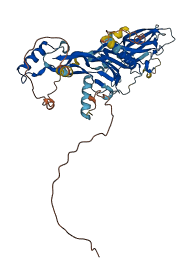
Descriptions
The autoinhibited protein was predicted that may have potential autoinhibitory elements via cis-regPred.
Autoinhibitory domains (AIDs)
Target domain |
|
Relief mechanism |
|
Assay |
cis-regPred |
Accessory elements
No accessory elements
Autoinhibited structure

Activated structure
1 structures for P30886
| Entry ID | Method | Resolution | Chain | Position | Source |
|---|---|---|---|---|---|
| AF-P30886-F1 | Predicted | AlphaFoldDB |
No variants for P30886
| Variant ID(s) | Position | Change | Description | Diseaes Association | Provenance |
|---|---|---|---|---|---|
| No variants for P30886 | |||||
No associated diseases with P30886
1 GO annotations of cellular component
| Name | Definition |
|---|---|
| extracellular space | That part of a multicellular organism outside the cells proper, usually taken to be outside the plasma membranes, and occupied by fluid. |
2 GO annotations of molecular function
| Name | Definition |
|---|---|
| cytokine activity | The activity of a soluble extracellular gene product that interacts with a receptor to effect a change in the activity of the receptor to control the survival, growth, differentiation and effector function of tissues and cells. |
| growth factor activity | The function that stimulates a cell to grow or proliferate. Most growth factors have other actions besides the induction of cell growth or proliferation. |
3 GO annotations of biological process
| Name | Definition |
|---|---|
| cartilage development | The process whose specific outcome is the progression of a cartilage element over time, from its formation to the mature structure. Cartilage elements are skeletal elements that consist of connective tissue dominated by extracellular matrix containing collagen type II and large amounts of proteoglycan, particularly chondroitin sulfate. |
| cell differentiation | The process in which relatively unspecialized cells, e.g. embryonic or regenerative cells, acquire specialized structural and/or functional features that characterize the cells, tissues, or organs of the mature organism or some other relatively stable phase of the organism's life history. Differentiation includes the processes involved in commitment of a cell to a specific fate and its subsequent development to the mature state. |
| ossification | The formation of bone or of a bony substance, or the conversion of fibrous tissue or of cartilage into bone or a bony substance. |
No homologous proteins in AiPD
| UniProt AC | Gene Name | Protein Name | Species | Evidence Code |
|---|---|---|---|---|
| No homologous proteins | ||||
| 10 | 20 | 30 | 40 | 50 | 60 |
| MNALTVKRRL | PVLLFLFHIS | LSSISSNTIL | ENDFHSSFVQ | RRLKGHERRE | IQKEILTILG |
| 70 | 80 | 90 | 100 | 110 | 120 |
| LQHRPRPYLP | EKKKSAPLFM | MDLYNAVNIE | EMHAEDVSYS | NKPISLNEAF | SLATDQENGF |
| 130 | 140 | 150 | 160 | 170 | 180 |
| LAHADTVMSF | ANLVDNDNEL | HKNSYRQKFK | FDLTDIPLGD | ELTAAEFRIY | KDYVQNNETY |
| 190 | 200 | 210 | 220 | 230 | 240 |
| QVTIYQVLKK | QADKDPYLFQ | VDSRTIWGTE | KGWLTFDITA | TGNHWVMNPH | YNLGLQLSVE |
| 250 | 260 | 270 | 280 | 290 | 300 |
| SMDMQNVNPR | LVGLVGKNGP | QDKQPFMVAF | FKTSDIHLRS | VRSTSNKHWN | QERAKTYKEQ |
| 310 | 320 | 330 | 340 | 350 | 360 |
| DNLPPANITD | GIMPPGKRRF | LKQACKKHEL | FVSFRDLGWQ | DWIIAPEGYA | AYYCDGECAF |
| 370 | 380 | 390 | 400 | 410 | 420 |
| PLNSFMNATN | HAIVQTLVHF | INPETVPKPC | CAPTQLNGIS | VLYFDDSANV | ILKKYKNMVV |
| QACGCH |