P30620
Gene name |
PSO2 (SNM1, YMR137C, YM9375.06C) |
Protein name |
DNA cross-link repair protein PSO2/SNM1 |
Names |
|
Species |
Saccharomyces cerevisiae (strain ATCC 204508 / S288c) (Baker's yeast) |
KEGG Pathway |
sce:YMR137C |
EC number |
|
Protein Class |
|
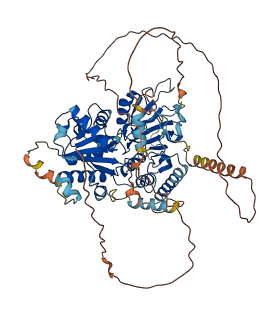
Descriptions
The autoinhibited protein was predicted that may have potential autoinhibitory elements via cis-regPred.
Autoinhibitory domains (AIDs)
Target domain |
|
Relief mechanism |
|
Assay |
cis-regPred |
Accessory elements
No accessory elements
Autoinhibited structure

Activated structure
1 structures for P30620
| Entry ID | Method | Resolution | Chain | Position | Source |
|---|---|---|---|---|---|
| AF-P30620-F1 | Predicted | AlphaFoldDB |
10 variants for P30620
| Variant ID(s) | Position | Change | Description | Diseaes Association | Provenance |
|---|---|---|---|---|---|
| s13-544896 | 23 | S>G | No | SGRP | |
| s13-544878 | 29 | K>E | No | SGRP | |
| s13-544601 | 121 | E>V | No | SGRP | |
| s13-544578 | 129 | V>I | No | SGRP | |
| s13-544380 | 195 | A>S | No | SGRP | |
| s13-543971 | 331 | L>P | No | SGRP | |
| s13-543761 | 401 | L>S | No | SGRP | |
| s13-543705 | 420 | F>V | No | SGRP | |
| s13-543273 | 564 | S>G | No | SGRP | |
| s13-543223 | 580 | N>K | No | SGRP |
No associated diseases with P30620
1 GO annotations of cellular component
| Name | Definition |
|---|---|
| nucleus | A membrane-bounded organelle of eukaryotic cells in which chromosomes are housed and replicated. In most cells, the nucleus contains all of the cell's chromosomes except the organellar chromosomes, and is the site of RNA synthesis and processing. In some species, or in specialized cell types, RNA metabolism or DNA replication may be absent. |
4 GO annotations of molecular function
| Name | Definition |
|---|---|
| 5'-3' exodeoxyribonuclease activity | Catalysis of the sequential cleavage of mononucleotides from a free 5' terminus of a DNA molecule. |
| 5'-3' exonuclease activity | Catalysis of the hydrolysis of ester linkages within nucleic acids by removing nucleotide residues from the 5' end. |
| damaged DNA binding | Binding to damaged DNA. |
| metal ion binding | Binding to a metal ion. |
4 GO annotations of biological process
| Name | Definition |
|---|---|
| DNA repair | The process of restoring DNA after damage. Genomes are subject to damage by chemical and physical agents in the environment (e.g. UV and ionizing radiations, chemical mutagens, fungal and bacterial toxins, etc.) and by free radicals or alkylating agents endogenously generated in metabolism. DNA is also damaged because of errors during its replication. A variety of different DNA repair pathways have been reported that include direct reversal, base excision repair, nucleotide excision repair, photoreactivation, bypass, double-strand break repair pathway, and mismatch repair pathway. |
| double-strand break repair via nonhomologous end joining | The repair of a double-strand break in DNA in which the two broken ends are rejoined with little or no sequence complementarity. Information at the DNA ends may be lost due to the modification of broken DNA ends. This term covers instances of separate pathways, called classical (or canonical) and alternative nonhomologous end joining (C-NHEJ and A-NHEJ). These in turn may further branch into sub-pathways, but evidence is still unclear. |
| interstrand cross-link repair | Removal of a DNA interstrand crosslink (a covalent attachment of DNA bases on opposite strands of the DNA) and restoration of the DNA. DNA interstrand crosslinks occur when both strands of duplex DNA are covalently tethered together (e.g. by an exogenous or endogenous agent), thus preventing the strand unwinding necessary for essential DNA functions such as transcription and replication. |
| protection from non-homologous end joining at telomere | A process that prevents non-homologous end joining at telomere, thereby ensuring that telomeres do not fuse. |
No homologous proteins in AiPD
| UniProt AC | Gene Name | Protein Name | Species | Evidence Code |
|---|---|---|---|---|
| No homologous proteins | ||||
| 10 | 20 | 30 | 40 | 50 | 60 |
| MSRKSIVQIR | RSEVKRKRSS | TASSTSEGKT | LHKNTHTSSK | RQRTLTEFNI | PTSSNLPVRS |
| 70 | 80 | 90 | 100 | 110 | 120 |
| SSYSFSRFSC | STSNKNTEPV | IINDDDHNSI | CLEDTAKVEI | TIDTDEEELV | SLHDNEVSAI |
| 130 | 140 | 150 | 160 | 170 | 180 |
| ENRTEDRIVT | ELEEQVNVKV | STEVIQCPIC | LENLSHLELY | ERETHCDTCI | GSDPSNMGTP |
| 190 | 200 | 210 | 220 | 230 | 240 |
| KKNIRSFISN | PSSPAKTKRD | IATSKKPTRV | KLVLPSFKII | KFNNGHEIVV | DGFNYKASET |
| 250 | 260 | 270 | 280 | 290 | 300 |
| ISQYFLSHFH | SDHYIGLKKS | WNNPDENPIK | KTLYCSKITA | ILVNLKFKIP | MDEIQILPMN |
| 310 | 320 | 330 | 340 | 350 | 360 |
| KRFWITDTIS | VVTLDANHCP | GAIIMLFQEF | LANSYDKPIR | QILHTGDFRS | NAKMIETIQK |
| 370 | 380 | 390 | 400 | 410 | 420 |
| WLAETANETI | DQVYLDTTYM | TMGYNFPSQH | SVCETVADFT | LRLIKHGKNK | TFGDSQRNLF |
| 430 | 440 | 450 | 460 | 470 | 480 |
| HFQRKKTLTT | HRYRVLFLVG | TYTIGKEKLA | IKICEFLKTK | LFVMPNSVKF | SMMLTVLQNN |
| 490 | 500 | 510 | 520 | 530 | 540 |
| ENQNDMWDES | LLTSNLHESS | VHLVPIRVLK | SQETIEAYLK | SLKELETDYV | KDIEDVVGFI |
| 550 | 560 | 570 | 580 | 590 | 600 |
| PTGWSHNFGL | KYQKKNDDDE | NEMSGNTEYC | LELMKNDRDN | DDENGFEISS | ILRQYKKYNK |
| 610 | 620 | 630 | 640 | 650 | 660 |
| FQVFNVPYSE | HSSFNDLVKF | GCKLKCSEVI | PTVNLNNLWK | VRYMTNWFQC | WENVRKTRAA |
| K |