P30583
Gene name |
chsC (chs1, AN4566) |
Protein name |
Chitin synthase C |
Names |
Chitin-UDP acetyl-glucosaminyl transferase C, Class-I chitin synthase C |
Species |
Emericella nidulans (strain FGSC A4 / ATCC 38163 / CBS 112.46 / NRRL 194 / M139) (Aspergillus nidulans) |
KEGG Pathway |
ani:AN4566.2 |
EC number |
2.4.1.16: Hexosyltransferases |
Protein Class |
|
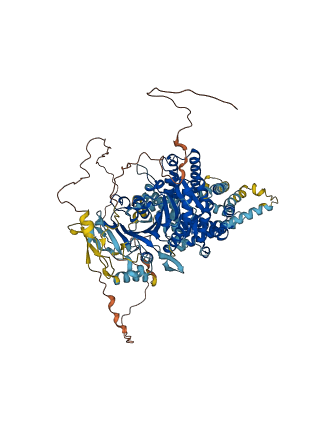
Descriptions
The autoinhibited protein was predicted that may have potential autoinhibitory elements via cis-regPred.
Autoinhibitory domains (AIDs)
Target domain |
|
Relief mechanism |
|
Assay |
cis-regPred |
Accessory elements
No accessory elements
Autoinhibited structure

Activated structure
1 structures for P30583
| Entry ID | Method | Resolution | Chain | Position | Source |
|---|---|---|---|---|---|
| AF-P30583-F1 | Predicted | AlphaFoldDB |
No variants for P30583
| Variant ID(s) | Position | Change | Description | Diseaes Association | Provenance |
|---|---|---|---|---|---|
| No variants for P30583 | |||||
No associated diseases with P30583
10 regional properties for P30583
| Type | Name | Position | InterPro Accession |
|---|---|---|---|
| domain | UVR domain | 419 - 454 | IPR001943 |
| domain | AAA+ ATPase domain | 202 - 346 | IPR003593-1 |
| domain | AAA+ ATPase domain | 541 - 722 | IPR003593-2 |
| domain | ATPase, AAA-type, core | 207 - 337 | IPR003959-1 |
| domain | ATPase, AAA-type, core | 540 - 715 | IPR003959-2 |
| domain | Clp, repeat (R) domain | 2 - 144 | IPR004176 |
| conserved_site | ClpA/B, conserved site 1 | 297 - 309 | IPR018368 |
| domain | Clp ATPase, C-terminal | 721 - 811 | IPR019489 |
| conserved_site | ClpA/B, conserved site 2 | 575 - 593 | IPR028299 |
| domain | ClpA/ClpB, AAA lid domain | 345 - 445 | IPR041546 |
Functions
| Description | ||
|---|---|---|
| EC Number | 2.4.1.16 | Hexosyltransferases |
| Subcellular Localization |
|
|
| PANTHER Family | ||
| PANTHER Subfamily | ||
| PANTHER Protein Class | ||
| PANTHER Pathway Category | No pathway information available | |
5 GO annotations of cellular component
| Name | Definition |
|---|---|
| cell periphery | The part of a cell encompassing the cell cortex, the plasma membrane, and any external encapsulating structures. |
| cell septum | A structure composed of peptidoglycan and often chitin in addition to other materials. It usually forms perpendicular to the long axis of a cell or hypha and grows centripetally from the cell wall to the center of the cell and often functions in the compartmentalization of a cell into two daughter cells. |
| hyphal tip | The end, or tip, of a fungal hypha, where polarized growth occurs during hyphal elongation. |
| integral component of membrane | The component of a membrane consisting of the gene products and protein complexes having at least some part of their peptide sequence embedded in the hydrophobic region of the membrane. |
| plasma membrane | The membrane surrounding a cell that separates the cell from its external environment. It consists of a phospholipid bilayer and associated proteins. |
1 GO annotations of molecular function
| Name | Definition |
|---|---|
| chitin synthase activity | Catalysis of the reaction: UDP-N-acetyl-D-glucosamine + [->4)-N-acetyl-beta-D-glucosaminyl-(1-](n) = UDP + [->4)-N-acetyl-beta-D-glucosaminyl-(1-](n+1). |
6 GO annotations of biological process
| Name | Definition |
|---|---|
| cell septum assembly | The assembly and arrangement of a cellular component that is composed of peptidoglycan and often chitin in addition to other materials and usually forms perpendicular to the long axis of a cell or hypha. It grows centripetally from the cell wall to the center of the cell and often functions in the compartmentalization of a cell into two daughter cells. |
| cell wall chitin biosynthetic process | The chemical reactions and pathways resulting in the formation of cell wall chitin, a linear polysaccharide consisting of beta-(1->4)-linked N-acetyl-D-glucosamine residues, found in the walls of cells. |
| conidium formation | The process of producing non-motile spores, called conidia, via mitotic asexual reproduction in higher fungi. Conidia are haploid cells genetically identical to their haploid parent. They are produced by conversion of hyphal elements, or are borne on sporogenous cells on or within specialized structures termed conidiophores, and participate in dispersal of the fungus. |
| division septum site selection | The process of marking the site where a division septum will form. |
| fungal-type cell wall organization | A process that is carried out at the cellular level which results in the assembly, arrangement of constituent parts, or disassembly of the fungal-type cell wall. |
| hyphal growth | Growth of fungi as threadlike, tubular structures that may contain multiple nuclei and may or may not be divided internally by septa, or cross-walls. |
No homologous proteins in AiPD
| UniProt AC | Gene Name | Protein Name | Species | Evidence Code |
|---|---|---|---|---|
| No homologous proteins | ||||
| 10 | 20 | 30 | 40 | 50 | 60 |
| MSYNRLGDPY | GDDRDARSPI | MNPSSLSNRS | PSPGRPLDGY | QLSDAPYGHH | HHIEMPSSDR |
| 70 | 80 | 90 | 100 | 110 | 120 |
| LAEQPTYSVE | RIPQSYGHNE | AYEAQHQHYP | GYEYSVDPEA | HHDAYYTQPY | QPTVTPGHDD |
| 130 | 140 | 150 | 160 | 170 | 180 |
| YDLGQYPGHQ | HSYQDDEPIL | QPEDPFQAQN | PYSDDYQEDM | TIAPTPSPAP | LRRWKTVKEV |
| 190 | 200 | 210 | 220 | 230 | 240 |
| QLFQGNLVLD | CPIAPKLLNQ | IPHAENGQRD | EFTHMRYSAA | TCDPKDFFEE | RFTLRQKLFA |
| 250 | 260 | 270 | 280 | 290 | 300 |
| KPRHTELFIV | VTMYNEDDFL | FARTMVGVFK | NIEHMCSRTR | SKTWGKDAWK | KIVVCVISDG |
| 310 | 320 | 330 | 340 | 350 | 360 |
| RAKINPRTRA | VLAGLGCYQD | GIAKQQVNGK | DVTAHIYEYT | TQVGMELKGN | QVHLKPRSGV |
| 370 | 380 | 390 | 400 | 410 | 420 |
| PVQMIFCLKE | KNQKKINSHR | WFFQAFGRVL | DPNICVLLDA | GTQPGKDSIY | RLWKAFDVEP |
| 430 | 440 | 450 | 460 | 470 | 480 |
| MCGGACGEIK | VMLDHGKKLF | NPLVAGQNFE | YKLSNILDKP | LESAFGFISV | LPGAFSAYRY |
| 490 | 500 | 510 | 520 | 530 | 540 |
| IALQNDKNGQ | GPLERYFLGE | KMHGANAGIF | TANMYLAEDR | ILCFEIVTKR | NCRWLLQYVK |
| 550 | 560 | 570 | 580 | 590 | 600 |
| SSTGETDVPD | QMAEFILQRR | RWLNGSFFAA | VYAITHFYQL | WRSDHSFIRK | FMLLIETIYQ |
| 610 | 620 | 630 | 640 | 650 | 660 |
| TINMLFAWFG | IGNFFLVFHI | LTTYLGDADL | LGTAGKVLGV | VFEWLYLATL | VTCFVLSLGN |
| 670 | 680 | 690 | 700 | 710 | 720 |
| RPGGSNKLYM | TMVYLWVFIM | IYLAFAAVFV | TVRSIQEEVK | DGSFTFSTLF | TNSTFFSIIV |
| 730 | 740 | 750 | 760 | 770 | 780 |
| SLGSTYVMWF | IASIIFMDPW | HMFTCFIQYI | LLTPTYINVL | NIYAFCNTHD | ITWGTKGDDK |
| 790 | 800 | 810 | 820 | 830 | 840 |
| AEKLPSANLK | PGGKVDVNIP | QDDGDLNAQY | EAELMKFAQK | PPKEIKTISE | EERQADYYKG |
| 850 | 860 | 870 | 880 | 890 | 900 |
| FRSSVVLVWV | FCNFALGAVV | LSSAGLDRFS | DDAEAAETDR | NNRAMIYMAV | VLWSVAGLSI |
| 910 | |||||
| FKFLGAMWFL | VVRMFRGV |