P29534
Gene name |
Vcam1 (Vcam-1) |
Protein name |
Vascular cell adhesion protein 1 |
Names |
|
Species |
Rattus norvegicus (Rat) |
KEGG Pathway |
rno:25361 |
EC number |
|
Protein Class |
|
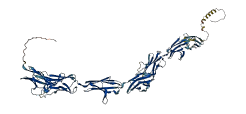
Descriptions
The autoinhibited protein was predicted that may have potential autoinhibitory elements via cis-regPred.
Autoinhibitory domains (AIDs)
Target domain |
|
Relief mechanism |
|
Assay |
cis-regPred |
Accessory elements
No accessory elements
Autoinhibited structure

Activated structure
1 structures for P29534
| Entry ID | Method | Resolution | Chain | Position | Source |
|---|---|---|---|---|---|
| AF-P29534-F1 | Predicted | AlphaFoldDB |
1 variants for P29534
| Variant ID(s) | Position | Change | Description | Diseaes Association | Provenance |
|---|---|---|---|---|---|
| rs105254972 | 166 | D>N | No | EVA |
No associated diseases with P29534
24 regional properties for P29534
| Type | Name | Position | InterPro Accession |
|---|---|---|---|
| domain | Immunoglobulin subtype 2 | 38 - 102 | IPR003598-1 |
| domain | Immunoglobulin subtype 2 | 237 - 298 | IPR003598-2 |
| domain | Immunoglobulin subtype 2 | 326 - 390 | IPR003598-3 |
| domain | Immunoglobulin subtype 2 | 525 - 586 | IPR003598-4 |
| domain | Immunoglobulin subtype 2 | 614 - 675 | IPR003598-5 |
| domain | Immunoglobulin subtype | 32 - 113 | IPR003599-1 |
| domain | Immunoglobulin subtype | 231 - 309 | IPR003599-2 |
| domain | Immunoglobulin subtype | 320 - 401 | IPR003599-3 |
| domain | Immunoglobulin subtype | 519 - 597 | IPR003599-4 |
| domain | Immunoglobulin subtype | 608 - 686 | IPR003599-5 |
| domain | Intercellular adhesion molecule/vascular cell adhesion molecule, N-terminal | 34 - 50 | IPR003987-1 |
| domain | Intercellular adhesion molecule/vascular cell adhesion molecule, N-terminal | 113 - 126 | IPR003987-2 |
| domain | Intercellular adhesion molecule/vascular cell adhesion molecule, N-terminal | 129 - 144 | IPR003987-3 |
| domain | Intercellular adhesion molecule/vascular cell adhesion molecule, N-terminal | 432 - 450 | IPR003987-4 |
| domain | Immunoglobulin-like domain | 25 - 111 | IPR007110-1 |
| domain | Immunoglobulin-like domain | 223 - 309 | IPR007110-2 |
| domain | Immunoglobulin-like domain | 312 - 397 | IPR007110-3 |
| domain | Immunoglobulin-like domain | 514 - 595 | IPR007110-4 |
| domain | Immunoglobulin-like domain | 601 - 682 | IPR007110-5 |
| domain | Immunoglobulin C2-set | 133 - 221 | IPR008424-1 |
| domain | Immunoglobulin C2-set | 421 - 509 | IPR008424-2 |
| domain | Immunoglobulin I-set | 33 - 111 | IPR013098-1 |
| domain | Immunoglobulin I-set | 319 - 400 | IPR013098-2 |
| domain | Immunoglobulin | 230 - 304 | IPR013151 |
15 GO annotations of cellular component
| Name | Definition |
|---|---|
| alpha9-beta1 integrin-vascular cell adhesion molecule-1 complex | A protein complex that consists of an alpha9-beta1 integrin complex bound to vascular cell adhesion molecule-1. |
| apical part of cell | The region of a polarized cell that forms a tip or is distal to a base. For example, in a polarized epithelial cell, the apical region has an exposed surface and lies opposite to the basal lamina that separates the epithelium from other tissue. |
| apical plasma membrane | The region of the plasma membrane located at the apical end of the cell. |
| cell periphery | The part of a cell encompassing the cell cortex, the plasma membrane, and any external encapsulating structures. |
| cell surface | The external part of the cell wall and/or plasma membrane. |
| early endosome | A membrane-bounded organelle that receives incoming material from primary endocytic vesicles that have been generated by clathrin-dependent and clathrin-independent endocytosis; vesicles fuse with the early endosome to deliver cargo for sorting into recycling or degradation pathways. |
| endoplasmic reticulum | The irregular network of unit membranes, visible only by electron microscopy, that occurs in the cytoplasm of many eukaryotic cells. The membranes form a complex meshwork of tubular channels, which are often expanded into slitlike cavities called cisternae. The ER takes two forms, rough (or granular), with ribosomes adhering to the outer surface, and smooth (with no ribosomes attached). |
| external side of plasma membrane | The leaflet of the plasma membrane that faces away from the cytoplasm and any proteins embedded or anchored in it or attached to its surface. |
| extracellular space | That part of a multicellular organism outside the cells proper, usually taken to be outside the plasma membranes, and occupied by fluid. |
| filopodium | Thin, stiff, actin-based protrusion extended by the leading edge of a motile cell such as a crawling fibroblast or amoeba, or an axonal or dendritic growth cone, or a dendritic shaft. |
| Golgi apparatus | A membrane-bound cytoplasmic organelle of the endomembrane system that further processes the core oligosaccharides (e.g. N-glycans) added to proteins in the endoplasmic reticulum and packages them into membrane-bound vesicles. The Golgi apparatus operates at the intersection of the secretory, lysosomal, and endocytic pathways. |
| integral component of plasma membrane | The component of the plasma membrane consisting of the gene products and protein complexes having at least some part of their peptide sequence embedded in the hydrophobic region of the membrane. |
| microvillus | Thin cylindrical membrane-covered projections on the surface of an animal cell containing a core bundle of actin filaments. Present in especially large numbers on the absorptive surface of intestinal cells. |
| podosome | An actin-rich adhesion structure characterized by formation upon cell substrate contact and localization at the substrate-attached part of the cell, contain an F-actin-rich core surrounded by a ring structure containing proteins such as vinculin and talin, and have a diameter of 0.5 mm. |
| sarcolemma | The outer membrane of a muscle cell, consisting of the plasma membrane, a covering basement membrane (about 100 nm thick and sometimes common to more than one fiber), and the associated loose network of collagen fibers. |
3 GO annotations of molecular function
| Name | Definition |
|---|---|
| cell adhesion molecule binding | Binding to a cell adhesion molecule. |
| integrin binding | Binding to an integrin. |
| primary amine oxidase activity | Catalysis of the reaction: a primary amine + H2O + O2 = an aldehyde + NH3 + hydrogen peroxide. |
31 GO annotations of biological process
| Name | Definition |
|---|---|
| acute inflammatory response | Inflammation which comprises a rapid, short-lived, relatively uniform response to acute injury or antigenic challenge and is characterized by accumulations of fluid, plasma proteins, and granulocytic leukocytes. An acute inflammatory response occurs within a matter of minutes or hours, and either resolves within a few days or becomes a chronic inflammatory response. |
| aging | A developmental process that is a deterioration and loss of function over time. Aging includes loss of functions such as resistance to disease, homeostasis, and fertility, as well as wear and tear. Aging includes cellular senescence, but is more inclusive. May precede death and may succeed developmental maturation (GO:0021700). |
| amine metabolic process | The chemical reactions and pathways involving any organic compound that is weakly basic in character and contains an amino or a substituted amino group. Amines are called primary, secondary, or tertiary according to whether one, two, or three carbon atoms are attached to the nitrogen atom. |
| calcium-mediated signaling using intracellular calcium source | The series of molecular signals in which a cell uses calcium ions released from an intracellular store to convert a signal into a response. |
| cardiac neuron differentiation | The process in which a relatively unspecialized cell acquires specialized features of a neuron of the heart. |
| cell adhesion | The attachment of a cell, either to another cell or to an underlying substrate such as the extracellular matrix, via cell adhesion molecules. |
| cell chemotaxis | The directed movement of a motile cell guided by a specific chemical concentration gradient. Movement may be towards a higher concentration (positive chemotaxis) or towards a lower concentration (negative chemotaxis). |
| cell-cell adhesion in response to extracellular stimulus | The attachment of one cell to another cell via adhesion molecules as a result of an extracellular stimulus. |
| cell-matrix adhesion | The binding of a cell to the extracellular matrix via adhesion molecules. |
| cellular response to amyloid-beta | Any process that results in a change in state or activity of a cell (in terms of movement, secretion, enzyme production, gene expression, etc.) as a result of a amyloid-beta stimulus. |
| cellular response to glucose stimulus | Any process that results in a change in state or activity of a cell (in terms of movement, secretion, enzyme production, gene expression, etc.) as a result of a glucose stimulus. |
| cellular response to tumor necrosis factor | Any process that results in a change in state or activity of a cell (in terms of movement, secretion, enzyme production, gene expression, etc.) as a result of a tumor necrosis factor stimulus. |
| cellular response to vascular endothelial growth factor stimulus | Any process that results in a change in state or activity of a cell (in terms of movement, secretion, enzyme production, gene expression, etc.) as a result of a vascular endothelial growth factor stimulus. |
| chorio-allantoic fusion | The cell-cell adhesion process in which the cells of the chorion fuse to the cells of the allantois. |
| chronic inflammatory response | Inflammation of prolonged duration (weeks or months) in which active inflammation, tissue destruction, and attempts at repair are proceeding simultaneously. Although it may follow acute inflammation, chronic inflammation frequently begins insidiously, as a low-grade, smoldering, often asymptomatic response. |
| embryonic placenta morphogenesis | The process in which the embryonic placenta is generated and organized. |
| heart development | The process whose specific outcome is the progression of the heart over time, from its formation to the mature structure. The heart is a hollow, muscular organ, which, by contracting rhythmically, keeps up the circulation of the blood. |
| heterophilic cell-cell adhesion via plasma membrane cell adhesion molecules | The attachment of an adhesion molecule in one cell to a nonidentical adhesion molecule in an adjacent cell. |
| heterotypic cell-cell adhesion | The attachment of a cell to a cell of a different type via adhesion molecules. |
| innervation | The process in which a nerve invades a tissue and makes functional synaptic connection within the tissue. |
| leukocyte cell-cell adhesion | The attachment of a leukocyte to another cell via adhesion molecules. |
| leukocyte tethering or rolling | Transient adhesive interactions between leukocytes and endothelial cells lining blood vessels. Carbohydrates on circulating leukocytes bind selectins on the vessel wall causing the leukocytes to slow down and roll along the inner surface of the vessel wall. During this rolling motion, transitory bonds are formed and broken between selectins and their ligands. Typically the first step in cellular extravasation (the movement of leukocytes out of the circulatory system, towards the site of tissue damage or infection). |
| membrane to membrane docking | The initial attachment of a membrane to a target membrane, mediated by proteins protruding from the two membranes. Docking requires only that the membranes come close enough for the proteins to interact and adhere. |
| positive regulation of T cell proliferation | Any process that activates or increases the rate or extent of T cell proliferation. |
| response to ethanol | Any process that results in a change in state or activity of a cell or an organism (in terms of movement, secretion, enzyme production, gene expression, etc.) as a result of an ethanol stimulus. |
| response to hypoxia | Any process that results in a change in state or activity of a cell or an organism (in terms of movement, secretion, enzyme production, gene expression, etc.) as a result of a stimulus indicating lowered oxygen tension. Hypoxia, defined as a decline in O2 levels below normoxic levels of 20.8 - 20.95%, results in metabolic adaptation at both the cellular and organismal level. |
| response to ionizing radiation | Any process that results in a change in state or activity of a cell or an organism (in terms of movement, secretion, enzyme production, gene expression, etc.) as a result of a ionizing radiation stimulus. Ionizing radiation is radiation with sufficient energy to remove electrons from atoms and may arise from spontaneous decay of unstable isotopes, resulting in alpha and beta particles and gamma rays. Ionizing radiation also includes X-rays. |
| response to lipopolysaccharide | Any process that results in a change in state or activity of an organism (in terms of movement, secretion, enzyme production, gene expression, etc.) as a result of a lipopolysaccharide stimulus; lipopolysaccharide is a major component of the cell wall of gram-negative bacteria. |
| response to nicotine | Any process that results in a change in state or activity of a cell or an organism (in terms of movement, secretion, enzyme production, gene expression, etc.) as a result of a nicotine stimulus. |
| response to nutrient | Any process that results in a change in state or activity of a cell or an organism (in terms of movement, secretion, enzyme production, gene expression, etc.) as a result of a nutrient stimulus. |
| response to zinc ion | Any process that results in a change in state or activity of a cell or an organism (in terms of movement, secretion, enzyme production, gene expression, etc.) as a result of a zinc ion stimulus. |
1 homologous proteins in AiPD
| UniProt AC | Gene Name | Protein Name | Species | Evidence Code |
|---|---|---|---|---|
| P29533 | Vcam1 | Vascular cell adhesion protein 1 | Mus musculus (Mouse) | PR |
| 10 | 20 | 30 | 40 | 50 | 60 |
| MPVKMVAIFG | ASTVLWILFA | VSQAFKIEIS | PEYKTLAQIG | DSMLLTCSTT | GCESPSFSWR |
| 70 | 80 | 90 | 100 | 110 | 120 |
| TQIDSPLNGK | VKTEGAKSVL | TMDPVSFENE | HSYLCTATCN | SGKLERGIQV | DIYSFPKDPE |
| 130 | 140 | 150 | 160 | 170 | 180 |
| IQFSGPLEVG | KPVMVKCLAP | DVYPIDRLEI | ELFKGDRLMK | KQDFVDEMAK | KSLETKSLEV |
| 190 | 200 | 210 | 220 | 230 | 240 |
| IFTPVIEDIE | KALVCRAKLY | IDQTDSIPKE | RETVRELQVY | TSPKNTEISV | HPSTRLHEGA |
| 250 | 260 | 270 | 280 | 290 | 300 |
| AVTMTCASEG | LPAPEIFWSK | KLDNGVLQLL | SGNATLTLIA | MRMEDSGIYV | CEGVNLVGRD |
| 310 | 320 | 330 | 340 | 350 | 360 |
| KTEVELIVQE | KPFTVDISPG | SQVAAQVGDS | VVLTCAAVGC | DSPSFSWRTQ | TDSPLNGEVR |
| 370 | 380 | 390 | 400 | 410 | 420 |
| DEGATSTLTL | SPVGVEDEHS | YLCTVTCQRR | KLEKTIQVEV | YSFPEDPEIE | ISGPLVHGRP |
| 430 | 440 | 450 | 460 | 470 | 480 |
| VTVNCTVPNV | YPFDHLEIEL | LKGETTLLNK | FLREEIGTKS | LETKSLEMTF | IPTAEDTGKA |
| 490 | 500 | 510 | 520 | 530 | 540 |
| LVCLAKLHSS | QMESEPKQRQ | STQTLYVNVA | PKEPTIWVSP | SPVPEEGSPV | NLTCSSDGFP |
| 550 | 560 | 570 | 580 | 590 | 600 |
| TPKILWSRQL | KNGELQPLSQ | NTTLSFMATK | MEDSGIYVCE | GINEAGISKK | SVELIIQGSS |
| 610 | 620 | 630 | 640 | 650 | 660 |
| KDIQLTVFPS | KSVKEGDTVI | ISCTCGSVPE | IWIILKKKAK | TGDMVLKSVN | GSYTIRKAQL |
| 670 | 680 | 690 | 700 | 710 | 720 |
| QDAGVYECES | KTEVGSQLRS | LTLDVKGKEN | NKDYFSPELL | ALYFASSLVI | PAIGMIIYFA |
| 730 | |||||
| RKANMKGSYS | LVEAQKSKV |