P29303
Gene name |
h |
Protein name |
Protein hairy |
Names |
|
Species |
Drosophila virilis (Fruit fly) |
KEGG Pathway |
dvi:6623507 |
EC number |
|
Protein Class |
|
Descriptions
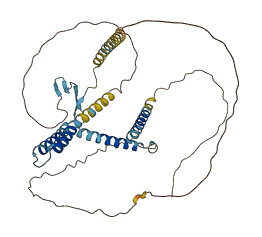
The autoinhibited protein was predicted that may have potential autoinhibitory elements via cis-regPred.
Autoinhibitory domains (AIDs)
Target domain |
|
Relief mechanism |
|
Assay |
cis-regPred |
Accessory elements
No accessory elements
Autoinhibited structure

Activated structure
1 structures for P29303
| Entry ID | Method | Resolution | Chain | Position | Source |
|---|---|---|---|---|---|
| AF-P29303-F1 | Predicted | AlphaFoldDB |
No variants for P29303
| Variant ID(s) | Position | Change | Description | Diseaes Association | Provenance |
|---|---|---|---|---|---|
| No variants for P29303 | |||||
No associated diseases with P29303
1 GO annotations of cellular component
| Name | Definition |
|---|---|
| nucleus | A membrane-bounded organelle of eukaryotic cells in which chromosomes are housed and replicated. In most cells, the nucleus contains all of the cell's chromosomes except the organellar chromosomes, and is the site of RNA synthesis and processing. In some species, or in specialized cell types, RNA metabolism or DNA replication may be absent. |
3 GO annotations of molecular function
| Name | Definition |
|---|---|
| DNA-binding transcription repressor activity, RNA polymerase II-specific | A DNA-binding transcription factor activity that represses or decreases the transcription of specific gene sets transcribed by RNA polymerase II. |
| E-box binding | Binding to an E-box, a DNA motif with the consensus sequence CANNTG that is found in the promoters of a wide array of genes expressed in neurons, muscle and other tissues. |
| protein dimerization activity | The formation of a protein dimer, a macromolecular structure consists of two noncovalently associated identical or nonidentical subunits. |
6 GO annotations of biological process
| Name | Definition |
|---|---|
| cell morphogenesis | The developmental process in which the size or shape of a cell is generated and organized. |
| open tracheal system development | The process whose specific outcome is the progression of an open tracheal system over time, from its formation to the mature structure. An open tracheal system is a respiratory system, a branched network of epithelial tubes that supplies oxygen to target tissues via spiracles. An example of this is found in Drosophila melanogaster. |
| periodic partitioning by pair rule gene | Allocation of cells to parasegments in the embryo, through the action of overlapping series of pair rule gene activities. |
| response to hypoxia | Any process that results in a change in state or activity of a cell or an organism (in terms of movement, secretion, enzyme production, gene expression, etc.) as a result of a stimulus indicating lowered oxygen tension. Hypoxia, defined as a decline in O2 levels below normoxic levels of 20.8 - 20.95%, results in metabolic adaptation at both the cellular and organismal level. |
| salivary gland morphogenesis | The process in which the anatomical structures of the salivary gland are generated and organized. |
| tube morphogenesis | The process in which the anatomical structures of a tube are generated and organized. Epithelial and endothelial tubes transport gases, liquids and cells from one site to another and form the basic structure of many organs and tissues, with tube shape and organization varying from the single-celled excretory organ in Caenorhabditis elegans to the branching trees of the mammalian kidney and insect tracheal system. |
No homologous proteins in AiPD
| UniProt AC | Gene Name | Protein Name | Species | Evidence Code |
|---|---|---|---|---|
| No homologous proteins | ||||
| 10 | 20 | 30 | 40 | 50 | 60 |
| MVTGITTTMS | PNVLGTAVVS | TQQQQQQQQH | KEAPIKSDRR | SNKPIMEKRR | RARINNCLNE |
| 70 | 80 | 90 | 100 | 110 | 120 |
| LKTLILDATK | KDPARHSKLE | KADILEKTVK | HLQELQRQQA | AMQQAADPKI | INKFKAGFAD |
| 130 | 140 | 150 | 160 | 170 | 180 |
| CANEVSRFPG | LDSTQRRRLL | QHLSNCINGV | KTELHHQQRQ | QALAQAQSLH | AQVVLPSPPS |
| 190 | 200 | 210 | 220 | 230 | 240 |
| SPEQEPSVTP | VAASGNNNSS | SNNTNTTAPY | LFGQIQQNAN | GYFLPNGMQV | IPTKLPNGSI |
| 250 | 260 | 270 | 280 | 290 | 300 |
| ALVLPQSLPQ | QQQQQLLQQH | QHHQQQQQLA | AAAAAAAAAA | AAVAQQHQQS | PLLVAMPQRT |
| 310 | 320 | 330 | 340 | 350 | 360 |
| ASTGSASSHS | SAGYESAPSS | SSSRGSYAPP | SPANSAYEPM | DVKPSVIQRV | PHMHLEQQPL |
| 370 | |||||
| SLVIKKQIKV | EEEQPWRPW |