P27656
Gene name |
Lipc (Hpl) |
Protein name |
Hepatic triacylglycerol lipase |
Names |
HL, Hepatic lipase, Lipase member C, Lysophospholipase, Phospholipase A1 |
Species |
Mus musculus (Mouse) |
KEGG Pathway |
mmu:15450 |
EC number |
3.1.1.3: Carboxylic ester hydrolases |
Protein Class |
|
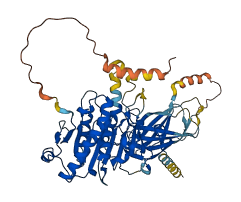
Descriptions
The autoinhibited protein was predicted that may have potential autoinhibitory elements via cis-regPred.
Autoinhibitory domains (AIDs)
Target domain |
|
Relief mechanism |
|
Assay |
cis-regPred |
Accessory elements
No accessory elements
Autoinhibited structure

Activated structure
1 structures for P27656
| Entry ID | Method | Resolution | Chain | Position | Source |
|---|---|---|---|---|---|
| AF-P27656-F1 | Predicted | AlphaFoldDB |
29 variants for P27656
| Variant ID(s) | Position | Change | Description | Diseaes Association | Provenance |
|---|---|---|---|---|---|
| rs3389051841 | 62 | G>A | No | EVA | |
| rs49265789 | 106 | S>G | No | EVA | |
| rs242333596 | 106 | S>N | No | EVA | |
| rs3389037701 | 108 | L>P | No | EVA | |
| rs3389064807 | 111 | R>L | No | EVA | |
| rs3389056735 | 122 | D>Y | No | EVA | |
| rs3389037778 | 127 | A>V | No | EVA | |
| rs3389055099 | 136 | Q>H | No | EVA | |
| rs46038991 | 156 | A>S | No | EVA | |
| rs219766398 | 156 | A>V | No | EVA | |
| rs3400324018 | 166 | I>T | No | EVA | |
| rs3400324032 | 167 | G>R | No | EVA | |
| rs3389031817 | 262 | K>R | No | EVA | |
| rs3389056701 | 276 | I>F | No | EVA | |
| rs3389056669 | 283 | S>Y | No | EVA | |
| rs3389055164 | 288 | I>T | No | EVA | |
| rs3389055097 | 331 | K>M | No | EVA | |
| rs3389058846 | 341 | F>Y | No | EVA | |
| rs3389056671 | 368 | P>S | No | EVA | |
| rs3389044022 | 372 | T>I | No | EVA | |
| rs1132059289 | 396 | T>S | No | EVA | |
| rs239743440 | 416 | L>V | No | EVA | |
| rs3389064750 | 427 | W>C | No | EVA | |
| rs245568551 | 436 | T>N | No | EVA | |
| rs3389037754 | 471 | N>I | No | EVA | |
| rs235036489 | 475 | L>I | No | EVA | |
| rs215179515 | 480 | S>T | No | EVA | |
| rs3389051811 | 484 | V>F | No | EVA | |
| rs3389037732 | 502 | M>I | No | EVA |
No associated diseases with P27656
Functions
| Description | ||
|---|---|---|
| EC Number | 3.1.1.3 | Carboxylic ester hydrolases |
| Subcellular Localization |
|
|
| PANTHER Family | ||
| PANTHER Subfamily | ||
| PANTHER Protein Class | ||
| PANTHER Pathway Category | No pathway information available | |
6 GO annotations of cellular component
| Name | Definition |
|---|---|
| cell surface | The external part of the cell wall and/or plasma membrane. |
| early endosome | A membrane-bounded organelle that receives incoming material from primary endocytic vesicles that have been generated by clathrin-dependent and clathrin-independent endocytosis; vesicles fuse with the early endosome to deliver cargo for sorting into recycling or degradation pathways. |
| extracellular space | That part of a multicellular organism outside the cells proper, usually taken to be outside the plasma membranes, and occupied by fluid. |
| high-density lipoprotein particle | A lipoprotein particle with a high density (typically 1.063-1.21 g/ml) and a diameter of 5-10 nm that contains APOAs and may contain APOCs and APOE; found in blood and carries lipids from body tissues to the liver as part of the reverse cholesterol transport process. |
| late endosome | A prelysosomal endocytic organelle differentiated from early endosomes by lower lumenal pH and different protein composition. Late endosomes are more spherical than early endosomes and are mostly juxtanuclear, being concentrated near the microtubule organizing center. |
| microvillus | Thin cylindrical membrane-covered projections on the surface of an animal cell containing a core bundle of actin filaments. Present in especially large numbers on the absorptive surface of intestinal cells. |
19 GO annotations of molecular function
| Name | Definition |
|---|---|
| 1-acyl-2-lysophosphatidylserine acylhydrolase activity | Catalysis of the reaction: 1-acyl-2-lysophosphatidylserine + H2O = sn-glycerol-phosphoserine + a carboxylate. |
| acylglycerol lipase activity | Catalysis of the reaction: H2O + acylglycerol = a fatty acid + glycerol. |
| acyltransferase activity | Catalysis of the transfer of an acyl group from one compound (donor) to another (acceptor). |
| apolipoprotein binding | Binding to an apolipoprotein, the protein component of a lipoprotein complex. |
| carboxylic ester hydrolase activity | Catalysis of the hydrolysis of a carboxylic ester bond. |
| chylomicron binding | Binding to a chylomicron, a large lipoprotein particle (diameter 75-1200 nm) composed of a central core of triglycerides and cholesterol surrounded by a protein-phospholipid coating. The proteins include one molecule of apolipoprotein B-48 and may include a variety of apolipoproteins, including APOAs, APOCs and APOE. |
| heparan sulfate proteoglycan binding | Binding to a heparan sulfate proteoglycan, any proteoglycan containing heparan sulfate as the glycosaminoglycan carbohydrate unit. |
| heparin binding | Binding to heparin, a member of a group of glycosaminoglycans found mainly as an intracellular component of mast cells and which consist predominantly of alternating alpha-(1->4)-linked D-galactose and N-acetyl-D-glucosamine-6-sulfate residues. |
| identical protein binding | Binding to an identical protein or proteins. |
| lipase activity | Catalysis of the hydrolysis of a lipid or phospholipid. |
| lipid binding | Binding to a lipid. |
| lipoprotein lipase activity | Catalysis of the reaction: triacylglycerol + H2O = diacylglycerol + a carboxylate, where the triacylglycerol is part of a lipoprotein. |
| low-density lipoprotein particle binding | Binding to a low-density lipoprotein particle, a lipoprotein particle that is rich in cholesterol esters and low in triglycerides, is typically composed of APOB100 and APOE, and has a density of 1.02-1.06 g/ml and a diameter of between 20-25 nm. |
| lysophospholipase activity | Catalysis of the reaction: 2-lysophosphatidylcholine + H2O = glycerophosphocholine + a carboxylate. |
| phosphatidyl phospholipase B activity | Catalysis of the reaction: 2 H2O + a phosphatidylcholine = sn-glycero-3-phosphocholine + 2 H+ + 2 a carboxylate. |
| phosphatidylserine 1-acylhydrolase activity | Catalysis of the reaction: phosphatidylserine + H2O = 2-acyl-sn-glycero-3-phosphoserine + fatty acid. |
| phospholipase A1 activity | Catalysis of the reaction: phosphatidylcholine + H2O = 2-acylglycerophosphocholine + a carboxylate. |
| phospholipase activity | Catalysis of the hydrolysis of a glycerophospholipid. |
| triglyceride lipase activity | Catalysis of the reaction: triacylglycerol + H2O = diacylglycerol + a carboxylate. |
23 GO annotations of biological process
| Name | Definition |
|---|---|
| cholesterol homeostasis | Any process involved in the maintenance of an internal steady state of cholesterol within an organism or cell. |
| cholesterol metabolic process | The chemical reactions and pathways involving cholesterol, cholest-5-en-3 beta-ol, the principal sterol of vertebrates and the precursor of many steroids, including bile acids and steroid hormones. It is a component of the plasma membrane lipid bilayer and of plasma lipoproteins and can be found in all animal tissues. |
| cholesterol transport | The directed movement of cholesterol, cholest-5-en-3-beta-ol, into, out of or within a cell, or between cells, by means of some agent such as a transporter or pore. |
| chylomicron remnant clearance | The process in which a chylomicron remnant is removed from the blood via receptor-mediated endocytosis into liver cells and its constituent parts degraded. |
| chylomicron remodeling | The acquisition, loss or modification of a protein or lipid within a chylomicron, including the hydrolysis of triglyceride by lipoprotein lipase and the subsequent loss of free fatty acid. |
| fatty acid biosynthetic process | The chemical reactions and pathways resulting in the formation of a fatty acid, any of the aliphatic monocarboxylic acids that can be liberated by hydrolysis from naturally occurring fats and oils. Fatty acids are predominantly straight-chain acids of 4 to 24 carbon atoms, which may be saturated or unsaturated; branched fatty acids and hydroxy fatty acids also occur, and very long chain acids of over 30 carbons are found in waxes. |
| fatty acid metabolic process | The chemical reactions and pathways involving fatty acids, aliphatic monocarboxylic acids liberated from naturally occurring fats and oils by hydrolysis. |
| glycerophospholipid catabolic process | The chemical reactions and pathways resulting in the breakdown of glycerophospholipids, any derivative of glycerophosphate that contains at least one O-acyl, O-alkyl, or O-alkenyl group attached to the glycerol residue. |
| heparan sulfate proteoglycan biosynthetic process | The chemical reactions and pathways resulting in the formation of the heparan sulfate proteoglycan, a glycosaminoglycan with repeat unit consisting of alternating alpha-(1->4)-linked hexuronic acid and glucosamine residues; the former are a mixture of sulfated and nonsulfated D-glucuronic acid and L-iduronic acid; the L-iduronic acid is either sulfated or acetylated on its amino group as well as being sulfated on one of its hydroxyl groups; heparan sulfate chains are covalently linked to peptidyl-serine by a glycosidic attachment through the trisaccharide galactosyl-galactosyl-xylosyl to serine residues. |
| high-density lipoprotein particle remodeling | The acquisition, loss or modification of a protein or lipid within a high-density lipoprotein particle, including the hydrolysis of triglyceride by hepatic lipase, with the subsequent loss of free fatty acid, and the transfer of cholesterol esters from LDL to a triglyceride-rich lipoprotein particle by cholesteryl ester transfer protein (CETP), with the simultaneous transfer of triglyceride to LDL. |
| lipid catabolic process | The chemical reactions and pathways resulting in the breakdown of lipids, compounds soluble in an organic solvent but not, or sparingly, in an aqueous solvent. |
| low-density lipoprotein particle clearance | The process in which a low-density lipoprotein particle is removed from the blood via receptor-mediated endocytosis and its constituent parts degraded. |
| low-density lipoprotein particle remodeling | The acquisition, loss or modification of a protein or lipid within a low-density lipoprotein particle, including the hydrolysis of triglyceride by hepatic lipase, with the subsequent loss of free fatty acid, and the transfer of cholesterol esters from LDL to a triglyceride-rich lipoprotein particle by cholesteryl ester transfer protein (CETP), with the simultaneous transfer of triglyceride to LDL. |
| neutral lipid catabolic process | The chemical reactions and pathways resulting in the breakdown of neutral lipids, lipids only soluble in solvents of very low polarity. |
| phosphatidic acid metabolic process | The chemical reactions and pathways involving phosphatidic acid, any derivative of glycerol phosphate in which both the remaining hydroxyl groups of the glycerol moiety are esterified with fatty acids. |
| phosphatidylcholine metabolic process | The chemical reactions and pathways involving phosphatidylcholines, any of a class of glycerophospholipids in which the phosphatidyl group is esterified to the hydroxyl group of choline. They are important constituents of cell membranes. |
| phosphatidylethanolamine metabolic process | The chemical reactions and pathways involving phosphatidylethanolamine, any of a class of glycerophospholipids in which a phosphatidyl group is esterified to the hydroxyl group of ethanolamine. It is a major structural phospholipid in mammalian systems. It tends to be more abundant than phosphatidylcholine in the internal membranes of the cell and is an abundant component of prokaryotic membranes. |
| phosphatidylserine metabolic process | The chemical reactions and pathways involving phosphatidylserines, any of a class of glycerophospholipids in which the phosphatidyl group is esterified to the hydroxyl group of L-serine. They are important constituents of cell membranes. |
| regulation of plasma lipoprotein particle levels | Any process involved in the maintenance of internal levels of plasma lipoprotein particles within an organism. |
| triglyceride catabolic process | The chemical reactions and pathways resulting in the breakdown of a triglyceride, any triester of glycerol. |
| triglyceride homeostasis | Any process involved in the maintenance of an internal steady state of triglyceride within an organism or cell. |
| triglyceride metabolic process | The chemical reactions and pathways involving triglyceride, any triester of glycerol. The three fatty acid residues may all be the same or differ in any permutation. Triglycerides are important components of plant oils, animal fats and animal plasma lipoproteins. |
| very-low-density lipoprotein particle remodeling | The acquisition, loss or modification of a protein or lipid within a very-low-density lipoprotein particle, including the hydrolysis of triglyceride by hepatic lipase or lipoprotein lipase and the subsequent loss of free fatty acid. |
No homologous proteins in AiPD
| UniProt AC | Gene Name | Protein Name | Species | Evidence Code |
|---|---|---|---|---|
| No homologous proteins | ||||
| 10 | 20 | 30 | 40 | 50 | 60 |
| MGNPLQISIF | LVFCIFIQSS | ACGQGVGTEP | FGRSLGATEA | SKPLKKPETR | FLLFQDENDR |
| 70 | 80 | 90 | 100 | 110 | 120 |
| LGCRLRPQHP | ETLQECGFNS | SQPLIMIIHG | WSVDGLLENW | IWKIVSALKS | RQSQPVNVGL |
| 130 | 140 | 150 | 160 | 170 | 180 |
| VDWISLAYQH | YTIAVQNTRI | VGQDVAALLL | WLEESAKFSR | SKVHLIGYSL | GAHVSGFAGS |
| 190 | 200 | 210 | 220 | 230 | 240 |
| SMDGKNKIGR | ITGLDPAGPM | FEGTSPNERL | SPDDANFVDA | IHTFTREHMG | LSVGIKQPIA |
| 250 | 260 | 270 | 280 | 290 | 300 |
| HYDFYPNGGS | FQPGCHFLEL | YKHIAEHGLN | AITQTIKCAH | ERSVHLFIDS | LQHSDLQSIG |
| 310 | 320 | 330 | 340 | 350 | 360 |
| FQCSDMGSFS | QGLCLSCKKG | RCNTLGYDIR | KDRSGKSKRL | FLITRAQSPF | KVYHYQFKIQ |
| 370 | 380 | 390 | 400 | 410 | 420 |
| FINQIEKPVE | PTFTMSLLGT | KEEIKRIPIT | LGEGITSNKT | YSFLITLDKD | IGELILLKFK |
| 430 | 440 | 450 | 460 | 470 | 480 |
| WENSAVWANV | WNTVQTIMLW | GIEPHHSGLI | LKTIWVKAGE | TQQRMTFCPE | NLDDLQLHPS |
| 490 | 500 | ||||
| QEKVFVNCEV | KSKRLTESKE | QMSQETHAKK |