P27638
Gene name |
spk1 (SPAC31G5.09c) |
Protein name |
Mitogen-activated protein kinase spk1 |
Names |
MAP kinase spk1, MAPK |
Species |
Schizosaccharomyces pombe (strain 972 / ATCC 24843) (Fission yeast) |
KEGG Pathway |
spo:SPAC31G5.09c |
EC number |
2.7.11.24: Protein-serine/threonine kinases |
Protein Class |
|
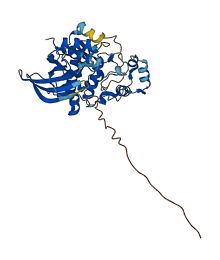
Descriptions
The autoinhibited protein was predicted that may have potential autoinhibitory elements via cis-regPred.
Autoinhibitory domains (AIDs)
Target domain |
|
Relief mechanism |
|
Assay |
cis-regPred |
Accessory elements
180-206 (Activation loop from InterPro)
Target domain |
39-327 (Protein kinase domain) |
Relief mechanism |
|
Assay |
|
Autoinhibited structure

Activated structure
1 structures for P27638
| Entry ID | Method | Resolution | Chain | Position | Source |
|---|---|---|---|---|---|
| AF-P27638-F1 | Predicted | AlphaFoldDB |
2 variants for P27638
| Variant ID(s) | Position | Change | Description | Diseaes Association | Provenance |
|---|---|---|---|---|---|
| I_3000155_C_T | 272 | A>T | No | Jeffares_SNPs | |
| I_3000103_A_C | 289 | F>C | No | Jeffares_SNPs |
No associated diseases with P27638
4 regional properties for P27638
| Type | Name | Position | InterPro Accession |
|---|---|---|---|
| domain | Protein kinase domain | 39 - 327 | IPR000719 |
| conserved_site | Mitogen-activated protein (MAP) kinase, conserved site | 73 - 175 | IPR003527 |
| active_site | Serine/threonine-protein kinase, active site | 159 - 171 | IPR008271 |
| binding_site | Protein kinase, ATP binding site | 45 - 69 | IPR017441 |
Functions
| Description | ||
|---|---|---|
| EC Number | 2.7.11.24 | Protein-serine/threonine kinases |
| Subcellular Localization |
|
|
| PANTHER Family | ||
| PANTHER Subfamily | ||
| PANTHER Protein Class | ||
| PANTHER Pathway Category | No pathway information available | |
4 GO annotations of cellular component
| Name | Definition |
|---|---|
| cytoplasm | The contents of a cell excluding the plasma membrane and nucleus, but including other subcellular structures. |
| cytosol | The part of the cytoplasm that does not contain organelles but which does contain other particulate matter, such as protein complexes. |
| mitotic spindle pole body | The microtubule organizing center that forms as part of the mitotic cell cycle; functionally homologous to the animal cell centrosome. |
| nucleus | A membrane-bounded organelle of eukaryotic cells in which chromosomes are housed and replicated. In most cells, the nucleus contains all of the cell's chromosomes except the organellar chromosomes, and is the site of RNA synthesis and processing. In some species, or in specialized cell types, RNA metabolism or DNA replication may be absent. |
4 GO annotations of molecular function
| Name | Definition |
|---|---|
| ATP binding | Binding to ATP, adenosine 5'-triphosphate, a universally important coenzyme and enzyme regulator. |
| MAP kinase activity | Catalysis of the reaction: protein + ATP = protein phosphate + ADP. This reaction is the phosphorylation of proteins. Mitogen-activated protein kinase; a family of protein kinases that perform a crucial step in relaying signals from the plasma membrane to the nucleus. They are activated by a wide range of proliferation- or differentiation-inducing signals; activation is strong with agonists such as polypeptide growth factors and tumor-promoting phorbol esters, but weak (in most cell backgrounds) by stress stimuli. |
| protein serine kinase activity | Catalysis of the reactions: ATP + protein serine = ADP + protein serine phosphate. |
| protein serine/threonine kinase activity | Catalysis of the reactions: ATP + protein serine = ADP + protein serine phosphate, and ATP + protein threonine = ADP + protein threonine phosphate. |
4 GO annotations of biological process
| Name | Definition |
|---|---|
| intracellular signal transduction | The process in which a signal is passed on to downstream components within the cell, which become activated themselves to further propagate the signal and finally trigger a change in the function or state of the cell. |
| pheromone response MAPK cascade | A MAPK cascade that is part of a pheromone response ending in conjugation with cellular fusion. |
| pheromone-dependent signal transduction involved in conjugation with cellular fusion | A signal transduction process resulting in the relay, amplification or dampening of a signal generated in response to pheromone exposure in organisms that undergo conjugation with cellular fusion. An example of this process is found in Saccharomyces cerevisiae. |
| protein phosphorylation | The process of introducing a phosphate group on to a protein. |
No homologous proteins in AiPD
| UniProt AC | Gene Name | Protein Name | Species | Evidence Code |
|---|---|---|---|---|
| No homologous proteins | ||||
| 10 | 20 | 30 | 40 | 50 | 60 |
| MASATSTPTI | ADGNSNKESV | ATSRSPHTHD | LNFELPEEYE | MINLIGQGAY | GVVCAALHKP |
| 70 | 80 | 90 | 100 | 110 | 120 |
| SGLKVAVKKI | HPFNHPVFCL | RTLREIKLLR | HFRHENIISI | LDILPPPSYQ | ELEDVYIVQE |
| 130 | 140 | 150 | 160 | 170 | 180 |
| LMETDLYRVI | RSQPLSDDHC | QYFTYQILRA | LKAMHSAGVV | HRDLKPSNLL | LNANCDLKVA |
| 190 | 200 | 210 | 220 | 230 | 240 |
| DFGLARSTTA | QGGNPGFMTE | YVATRWYRAP | EIMLSFREYS | KAIDLWSTGC | ILAEMLSARP |
| 250 | 260 | 270 | 280 | 290 | 300 |
| LFPGKDYHSQ | ITLILNILGT | PTMDDFSRIK | SARARKYIKS | LPFTPKVSFK | ALFPQASPDA |
| 310 | 320 | 330 | 340 | 350 | 360 |
| IDLLEKLLTF | NPDKRITAEE | ALKHPYVAAY | HDASDEPTAS | PMPPNLVDLY | CNKEDLEIPV |
| 370 | |||||
| LKALIFREVN | FR |