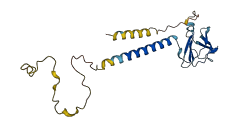
Descriptions
The autoinhibited protein was predicted that may have potential autoinhibitory elements via cis-regPred.
Autoinhibitory domains (AIDs)
Target domain |
|
Relief mechanism |
|
Assay |
cis-regPred |
Accessory elements
No accessory elements
Autoinhibited structure

Activated structure
1 structures for P27597
| Entry ID | Method | Resolution | Chain | Position | Source |
|---|---|---|---|---|---|
| AF-P27597-F1 | Predicted | AlphaFoldDB |
No variants for P27597
| Variant ID(s) | Position | Change | Description | Diseaes Association | Provenance |
|---|---|---|---|---|---|
| No variants for P27597 | |||||
No associated diseases with P27597
9 GO annotations of cellular component
| Name | Definition |
|---|---|
| alpha-beta T cell receptor complex | A T cell receptor complex in which the TCR heterodimer comprises alpha and beta chains, associated with the CD3 complex; recognizes a complex consisting of an antigen-derived peptide bound to a class I or class II MHC protein. |
| cell body | The portion of a cell bearing surface projections such as axons, dendrites, cilia, or flagella that includes the nucleus, but excludes all cell projections. |
| cell-cell junction | A cell junction that forms a connection between two or more cells of an organism; excludes direct cytoplasmic intercellular bridges, such as ring canals in insects. |
| dendritic spine | A small, membranous protrusion from a dendrite that forms a postsynaptic compartment, typically receiving input from a single presynapse. They function as partially isolated biochemical and an electrical compartments. Spine morphology is variable:they can be thin, stubby, mushroom, or branched, with a continuum of intermediate morphologies. They typically terminate in a bulb shape, linked to the dendritic shaft by a restriction. Spine remodeling is though to be involved in synaptic plasticity. |
| endoplasmic reticulum | The irregular network of unit membranes, visible only by electron microscopy, that occurs in the cytoplasm of many eukaryotic cells. The membranes form a complex meshwork of tubular channels, which are often expanded into slitlike cavities called cisternae. The ER takes two forms, rough (or granular), with ribosomes adhering to the outer surface, and smooth (with no ribosomes attached). |
| external side of plasma membrane | The leaflet of the plasma membrane that faces away from the cytoplasm and any proteins embedded or anchored in it or attached to its surface. |
| Golgi apparatus | A membrane-bound cytoplasmic organelle of the endomembrane system that further processes the core oligosaccharides (e.g. N-glycans) added to proteins in the endoplasmic reticulum and packages them into membrane-bound vesicles. The Golgi apparatus operates at the intersection of the secretory, lysosomal, and endocytic pathways. |
| immunological synapse | An area of close contact between a lymphocyte (T-, B-, or natural killer cell) and a target cell formed through the clustering of particular signaling and adhesion molecules and their associated membrane rafts on both the lymphocyte and the target cell and facilitating activation of the lymphocyte, transfer of membrane from the target cell to the lymphocyte, and in some situations killing of the target cell through release of secretory granules and/or death-pathway ligand-receptor interaction. |
| integral component of membrane | The component of a membrane consisting of the gene products and protein complexes having at least some part of their peptide sequence embedded in the hydrophobic region of the membrane. |
3 GO annotations of molecular function
| Name | Definition |
|---|---|
| identical protein binding | Binding to an identical protein or proteins. |
| SH3 domain binding | Binding to a SH3 domain (Src homology 3) of a protein, small protein modules containing approximately 50 amino acid residues found in a great variety of intracellular or membrane-associated proteins. |
| transmembrane signaling receptor activity | Combining with an extracellular or intracellular signal and transmitting the signal from one side of the membrane to the other to initiate a change in cell activity or state as part of signal transduction. |
25 GO annotations of biological process
| Name | Definition |
|---|---|
| adaptive immune response | An immune response mediated by cells expressing specific receptors for antigen produced through a somatic diversification process, and allowing for an enhanced secondary response to subsequent exposures to the same antigen (immunological memory). |
| apoptotic signaling pathway | The series of molecular signals which triggers the apoptotic death of a cell. The pathway starts with reception of a signal, and ends when the execution phase of apoptosis is triggered. |
| calcium-mediated signaling | Any intracellular signal transduction in which the signal is passed on within the cell via calcium ions. |
| CD4-positive, alpha-beta T cell proliferation | The expansion of a CD4-positive, alpha-beta T cell population by cell division. |
| cell surface receptor signaling pathway | The series of molecular signals initiated by activation of a receptor on the surface of a cell. The pathway begins with binding of an extracellular ligand to a cell surface receptor, or for receptors that signal in the absence of a ligand, by ligand-withdrawal or the activity of a constitutively active receptor. The pathway ends with regulation of a downstream cellular process, e.g. transcription. |
| cerebellum development | The process whose specific outcome is the progression of the cerebellum over time, from its formation to the mature structure. The cerebellum is the portion of the brain in the back of the head between the cerebrum and the pons. In mice, the cerebellum controls balance for walking and standing, modulates the force and range of movement and is involved in the learning of motor skills. |
| dendrite development | The process whose specific outcome is the progression of the dendrite over time, from its formation to the mature structure. |
| negative regulation of gene expression | Any process that decreases the frequency, rate or extent of gene expression. Gene expression is the process in which a gene's coding sequence is converted into a mature gene product (protein or RNA). |
| negative regulation of smoothened signaling pathway | Any process that stops, prevents, or reduces the frequency, rate or extent of smoothened signaling. |
| negative thymic T cell selection | The process of elimination of immature T cells in the thymus which react strongly with self-antigens. |
| peptidyl-tyrosine phosphorylation | The phosphorylation of peptidyl-tyrosine to form peptidyl-O4'-phospho-L-tyrosine. |
| positive regulation of calcium-mediated signaling | Any process that activates or increases the frequency, rate or extent of calcium-mediated signaling. |
| positive regulation of CD4-positive, alpha-beta T cell proliferation | Any process that activates or increases the frequency, rate or extent of CD4-positive, alpha-beta T cell proliferation. |
| positive regulation of cell-cell adhesion mediated by integrin | Any process that activates or increases the frequency, rate, or extent of cell-cell adhesion mediated by integrin. |
| positive regulation of cell-matrix adhesion | Any process that activates or increases the rate or extent of cell adhesion to an extracellular matrix. |
| positive regulation of interferon-gamma production | Any process that activates or increases the frequency, rate, or extent of interferon-gamma production. Interferon-gamma is also known as type II interferon. |
| positive regulation of interleukin-2 production | Any process that activates or increases the frequency, rate, or extent of interleukin-2 production. |
| positive regulation of interleukin-4 production | Any process that activates or increases the frequency, rate, or extent of interleukin-4 production. |
| positive regulation of peptidyl-tyrosine phosphorylation | Any process that activates or increases the frequency, rate or extent of the phosphorylation of peptidyl-tyrosine. |
| positive regulation of T cell anergy | Any process that activates or increases the frequency, rate, or extent of T cell anergy. |
| positive thymic T cell selection | The process of sparing immature T cells in the thymus which react with self-MHC protein complexes with low affinity levels from apoptotic death. |
| smoothened signaling pathway | The series of molecular signals generated as a consequence of activation of the transmembrane protein Smoothened. |
| T cell anergy | Any process contributing to anergy in T cells, a state of functional inactivation which is part of T cell tolerance induction. |
| T cell costimulation | The process of providing, via surface-bound receptor-ligand pairs, a second, antigen-independent, signal in addition to that provided by the T cell receptor to augment T cell activation. |
| T cell receptor signaling pathway | The series of molecular signals initiated by the cross-linking of an antigen receptor on a T cell. |
No homologous proteins in AiPD
| UniProt AC | Gene Name | Protein Name | Species | Evidence Code |
|---|---|---|---|---|
| No homologous proteins | ||||
| 10 | 20 | 30 | 40 | 50 | 60 |
| MQSRNLWRIL | GLCLLSVGAW | GQDEDFKASD | DLTSISPEKR | FKVSISGTEV | VVTCPDVFGY |
| 70 | 80 | 90 | 100 | 110 | 120 |
| DNIKWEKNDN | LVEGASNREL | SQKEFSEVDD | SGYYACYADS | IKEKSYLYLR | ARVCANCIEV |
| 130 | 140 | 150 | 160 | 170 | 180 |
| NLMAVVTIIV | ADICLTLGLL | LMVYYWSKTR | KANAKPVMRG | TGAGSRPRGQ | NKEKPPPVPN |
| 190 | 200 | ||||
| PDYEPIRKGQ | QDLYSGLNQR | GI |