P27088
Gene name |
xpa (xpac) |
Protein name |
DNA repair protein complementing XP-A cells homolog |
Names |
Xeroderma pigmentosum group A-complementing protein homolog |
Species |
Xenopus laevis (African clawed frog) |
KEGG Pathway |
xla:397790 |
EC number |
|
Protein Class |
|
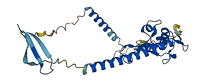
Descriptions
The autoinhibited protein was predicted that may have potential autoinhibitory elements via cis-regPred.
Autoinhibitory domains (AIDs)
Target domain |
|
Relief mechanism |
|
Assay |
cis-regPred |
Accessory elements
No accessory elements
Autoinhibited structure

Activated structure
1 structures for P27088
| Entry ID | Method | Resolution | Chain | Position | Source |
|---|---|---|---|---|---|
| AF-P27088-F1 | Predicted | AlphaFoldDB |
1 variants for P27088
| Variant ID(s) | Position | Change | Description | Diseaes Association | Provenance |
|---|---|---|---|---|---|
| 3 | P>del | one isoform [UniProt] | No |
No associated diseases with P27088
3 GO annotations of cellular component
| Name | Definition |
|---|---|
| DNA repair complex | A protein complex involved in DNA repair processes including direct reversal, base excision repair, nucleotide excision repair, photoreactivation, bypass, double-strand break repair pathway, and mismatch repair pathway. |
| DNA replication factor A complex | A conserved heterotrimeric complex that binds nonspecifically to single-stranded DNA and is required for multiple processes in eukaryotic DNA metabolism, including DNA replication, DNA repair, and recombination. In all eukaryotic organisms examined the complex is composed of subunits of approximately 70, 30, and 14 kDa. |
| nucleus | A membrane-bounded organelle of eukaryotic cells in which chromosomes are housed and replicated. In most cells, the nucleus contains all of the cell's chromosomes except the organellar chromosomes, and is the site of RNA synthesis and processing. In some species, or in specialized cell types, RNA metabolism or DNA replication may be absent. |
3 GO annotations of molecular function
| Name | Definition |
|---|---|
| damaged DNA binding | Binding to damaged DNA. |
| double-stranded DNA binding | Binding to double-stranded DNA. |
| zinc ion binding | Binding to a zinc ion (Zn). |
2 GO annotations of biological process
| Name | Definition |
|---|---|
| nucleotide-excision repair | A DNA repair process in which a small region of the strand surrounding the damage is removed from the DNA helix as an oligonucleotide. The small gap left in the DNA helix is filled in by the sequential action of DNA polymerase and DNA ligase. Nucleotide excision repair recognizes a wide range of substrates, including damage caused by UV irradiation (pyrimidine dimers and 6-4 photoproducts) and chemicals (intrastrand cross-links and bulky adducts). |
| UV-damage excision repair | A DNA repair process that is initiated by an endonuclease that introduces a single-strand incision immediately 5' of a UV-induced damage site. UV-damage excision repair acts on both cyclobutane pyrimidine dimers (CPDs) and pyrimidine-pyrimidone 6-4 photoproducts (6-4PPs). |
No homologous proteins in AiPD
| UniProt AC | Gene Name | Protein Name | Species | Evidence Code |
|---|---|---|---|---|
| No homologous proteins | ||||
| 10 | 20 | 30 | 40 | 50 | 60 |
| MEPEPEPEQE | ANKEEEKILS | AAVRAKIERN | RQRALMLRQA | RLACRPYPTG | EGISTVKAPP |
| 70 | 80 | 90 | 100 | 110 | 120 |
| KVIDSGGGFF | IEEEEAEEQH | VENVVRQPGP | VLECDYLICE | ECGKDFMDSY | LSNHFDLAVC |
| 130 | 140 | 150 | 160 | 170 | 180 |
| DSCRDAEEKH | KLITRTEAKQ | EYLLKDCDID | KREPVLKFIL | KKNPHNTHWG | DMKLYLKAQV |
| 190 | 200 | 210 | 220 | 230 | 240 |
| IKRSLEVWGS | EEALEEAKEV | RKDNRDKMKQ | KKFDKKVKEL | RRTVRSSLWK | KEASGHQHEY |
| 250 | 260 | ||||
| GPEEHVEEDS | YKKTCITCGY | EMNYEKM |