P26659
Gene name |
rad15 |
Protein name |
General transcription and DNA repair factor IIH helicase subunit XPD |
Names |
TFIIH subunit XPD, DNA repair helicase RAD3 homolog, Protein rhp3, DNA repair helicase rad15, RNA polymerase II transcription factor B subunit rad15, TFB subunit rad15 |
Species |
Schizosaccharomyces pombe (strain 972 / ATCC 24843) (Fission yeast) |
KEGG Pathway |
spo:SPAC1D4.12 |
EC number |
3.6.4.12: Acting on ATP; involved in cellular and subcellular movement |
Protein Class |
|
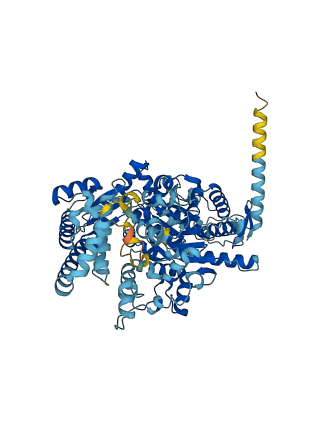
Descriptions
The autoinhibited protein was predicted that may have potential autoinhibitory elements via cis-regPred.
Autoinhibitory domains (AIDs)
Target domain |
|
Relief mechanism |
|
Assay |
cis-regPred |
Accessory elements
No accessory elements
Autoinhibited structure

Activated structure
1 structures for P26659
| Entry ID | Method | Resolution | Chain | Position | Source |
|---|---|---|---|---|---|
| AF-P26659-F1 | Predicted | AlphaFoldDB |
2 variants for P26659
| Variant ID(s) | Position | Change | Description | Diseaes Association | Provenance |
|---|---|---|---|---|---|
| I_665455_G_A | 225 | S>N | No | Jeffares_SNPs | |
| I_666248_C_G | 489 | F>L | No | Jeffares_SNPs |
No associated diseases with P26659
5 regional properties for P26659
| Type | Name | Position | InterPro Accession |
|---|---|---|---|
| domain | Helicase-like, DEXD box c2 type | 8 - 279 | IPR006554 |
| domain | ATP-dependent helicase, C-terminal | 523 - 698 | IPR006555 |
| domain | RAD3-like helicase, DEAD | 71 - 255 | IPR010614 |
| domain | Helical and beta-bridge domain | 269 - 411 | IPR010643 |
| domain | Helicase superfamily 1/2, ATP-binding domain, DinG/Rad3-type | 7 - 283 | IPR014013 |
Functions
| Description | ||
|---|---|---|
| EC Number | 3.6.4.12 | Acting on ATP; involved in cellular and subcellular movement |
| Subcellular Localization |
|
|
| PANTHER Family | ||
| PANTHER Subfamily | ||
| PANTHER Protein Class | ||
| PANTHER Pathway Category | No pathway information available | |
5 GO annotations of cellular component
| Name | Definition |
|---|---|
| cytosol | The part of the cytoplasm that does not contain organelles but which does contain other particulate matter, such as protein complexes. |
| nucleotide-excision repair factor 3 complex | One of several protein complexes involved in nucleotide-excision repair; possesses endodeoxynuclease and DNA helicase activities. In S. cerevisiae, it is composed of Rad2p and the core TFIIH-Ssl2p complex (core TFIIH is composed of Rad3p, Tfb1p, Tfb2p, Ssl1p, Tfb4p and Tfb5p. Note that Ssl2p is also called Rad25p). |
| nucleus | A membrane-bounded organelle of eukaryotic cells in which chromosomes are housed and replicated. In most cells, the nucleus contains all of the cell's chromosomes except the organellar chromosomes, and is the site of RNA synthesis and processing. In some species, or in specialized cell types, RNA metabolism or DNA replication may be absent. |
| transcription factor TFIIH core complex | The 7 subunit core of TFIIH that is a part of either the general transcription factor holo-TFIIH or the nucleotide-excision repair factor 3 complex. In S. cerevisiae/humans the complex is composed of: Ssl2/XPB, Tfb1/p62, Tfb2/p52, Ssl1/p44, Tfb4/p34, Tfb5/p8 and Rad3/XPD. |
| transcription factor TFIIH holo complex | A complex that is capable of kinase activity directed towards the C-terminal Domain (CTD) of the largest subunit of RNA polymerase II and is essential for initiation at RNA polymerase II promoters in vitro. It is composed of the core TFIIH complex and the TFIIK complex. |
8 GO annotations of molecular function
| Name | Definition |
|---|---|
| 4 iron, 4 sulfur cluster binding | Binding to a 4 iron, 4 sulfur (4Fe-4S) cluster; this cluster consists of four iron atoms, with the inorganic sulfur atoms found between the irons and acting as bridging ligands. |
| 5'-3' DNA helicase activity | Unwinding a DNA helix in the 5' to 3' direction, driven by ATP hydrolysis. |
| ATP binding | Binding to ATP, adenosine 5'-triphosphate, a universally important coenzyme and enzyme regulator. |
| ATP hydrolysis activity | Catalysis of the reaction: ATP + H2O = ADP + H+ phosphate. ATP hydrolysis is used in some reactions as an energy source, for example to catalyze a reaction or drive transport against a concentration gradient. |
| damaged DNA binding | Binding to damaged DNA. |
| DNA helicase activity | Unwinding of a DNA helix, driven by ATP hydrolysis. |
| metal ion binding | Binding to a metal ion. |
| RNA polymerase II general transcription initiation factor activity | A general transcription initiation factor activity that contributes to transcription start site selection and transcription initiation of genes transcribed by RNA polymerase II. The general transcription factors for RNA polymerase II include TFIIB, TFIID, TFIIE, TFIIF, TFIIH and TATA-binding protein (TBP). In most species, RNA polymerase II transcribes all messenger RNAs (mRNAs), most untranslated regulatory RNAs, the majority of the snoRNAs, four of the five snRNAs (U1, U2, U4, and U5), and other small noncoding RNAs. For some small RNAs there is variability between species as to whether it is transcribed by RNA polymerase II or RNA polymerase III. However there are also rare exceptions, such as Trypanosoma brucei, where RNA polymerase I transcribes certain mRNAs in addition to its normal role in rRNA transcription. |
6 GO annotations of biological process
| Name | Definition |
|---|---|
| nucleotide-excision repair | A DNA repair process in which a small region of the strand surrounding the damage is removed from the DNA helix as an oligonucleotide. The small gap left in the DNA helix is filled in by the sequential action of DNA polymerase and DNA ligase. Nucleotide excision repair recognizes a wide range of substrates, including damage caused by UV irradiation (pyrimidine dimers and 6-4 photoproducts) and chemicals (intrastrand cross-links and bulky adducts). |
| nucleotide-excision repair, DNA duplex unwinding | The unwinding, or local denaturation, of the DNA duplex to create a bubble around the site of the DNA damage. |
| nucleotide-excision repair, DNA incision | A process that results in the endonucleolytic cleavage of the damaged strand of DNA. The incision occurs at the junction of single-stranded DNA and double-stranded DNA that is formed when the DNA duplex is unwound. |
| positive regulation of mitotic recombination | Any process that activates or increases the frequency, rate or extent of DNA recombination during mitosis. |
| transcription by RNA polymerase II | The synthesis of RNA from a DNA template by RNA polymerase II (RNAP II), originating at an RNA polymerase II promoter. Includes transcription of messenger RNA (mRNA) and certain small nuclear RNAs (snRNAs). |
| transcription initiation at RNA polymerase II promoter | A transcription initiation process that takes place at a RNA polymerase II gene promoter. Messenger RNAs (mRNA) genes, as well as some non-coding RNAs, are transcribed by RNA polymerase II. |
No homologous proteins in AiPD
| UniProt AC | Gene Name | Protein Name | Species | Evidence Code |
|---|---|---|---|---|
| No homologous proteins | ||||
| 10 | 20 | 30 | 40 | 50 | 60 |
| MKFYIDDLPI | LFPYPRIYPE | QYQYMCDLKH | SLDAGGIALL | EMPSGTGKTI | SLLSLIVSYQ |
| 70 | 80 | 90 | 100 | 110 | 120 |
| QHYPEHRKLI | YCSRTMSEID | KALAELKRLM | AYRTSQLGYE | EPFLGLGLTS | RKNLCLHPSV |
| 130 | 140 | 150 | 160 | 170 | 180 |
| RREKNGNVVD | ARCRSLTAGF | VREQRLAGMD | VPTCEFHDNL | EDLEPHSLIS | NGVWTLDDIT |
| 190 | 200 | 210 | 220 | 230 | 240 |
| EYGEKTTRCP | YFTVRRMLPF | CNVIIYSYHY | LLDPKIAERV | SRELSKDCIV | VFDEAHNIDN |
| 250 | 260 | 270 | 280 | 290 | 300 |
| VCIESLSIDL | TESSLRKASK | SILSLEQKVN | EVKQSDSKKL | QDEYQKLVRG | LQDANAANDE |
| 310 | 320 | 330 | 340 | 350 | 360 |
| DQFMANPVLP | EDVLKEAVPG | NIRRAEHFIA | FLKRFVEYLK | TRMKVLHVIA | ETPTSFLQHV |
| 370 | 380 | 390 | 400 | 410 | 420 |
| KDITFIDKKP | LRFCAERLTS | LVRALQISLV | EDFHSLQQVV | AFATLVATYE | RGFILILEPF |
| 430 | 440 | 450 | 460 | 470 | 480 |
| ETENATVPNP | ILRFSCLDAS | IAIKPVFERF | RSVIITSGTL | SPLDMYPKML | QFNTVMQESY |
| 490 | 500 | 510 | 520 | 530 | 540 |
| GMSLARNCFL | PMVVTRGSDQ | VAISSKFEAR | NDPSVVRNYG | NILVEFSKIT | PDGLVAFFPS |
| 550 | 560 | 570 | 580 | 590 | 600 |
| YLYLESIVSS | WQSMGILDEV | WKYKLILVET | PDPHETTLAL | ETYRAACSNG | RGAVLLSVAR |
| 610 | 620 | 630 | 640 | 650 | 660 |
| GKVSEGVDFD | HHYGRAVIMF | GIPYQYTESR | VLKARLEFLR | DTYQIREADF | LTFDAMRHAA |
| 670 | 680 | 690 | 700 | 710 | 720 |
| QCLGRVLRGK | DDHGIMVLAD | KRYGRSDKRT | KLPKWIQQYI | TEGATNLSTD | MSLALAKKFL |
| 730 | 740 | 750 | 760 | 770 | |
| RTMAQPFTAS | DQEGISWWSL | DDLLIHQKKA | LKSAAIEQSK | HEDEMDIDVV | ET |